Halloween Counting Activities for Preschoolers: Fun Math Ideas
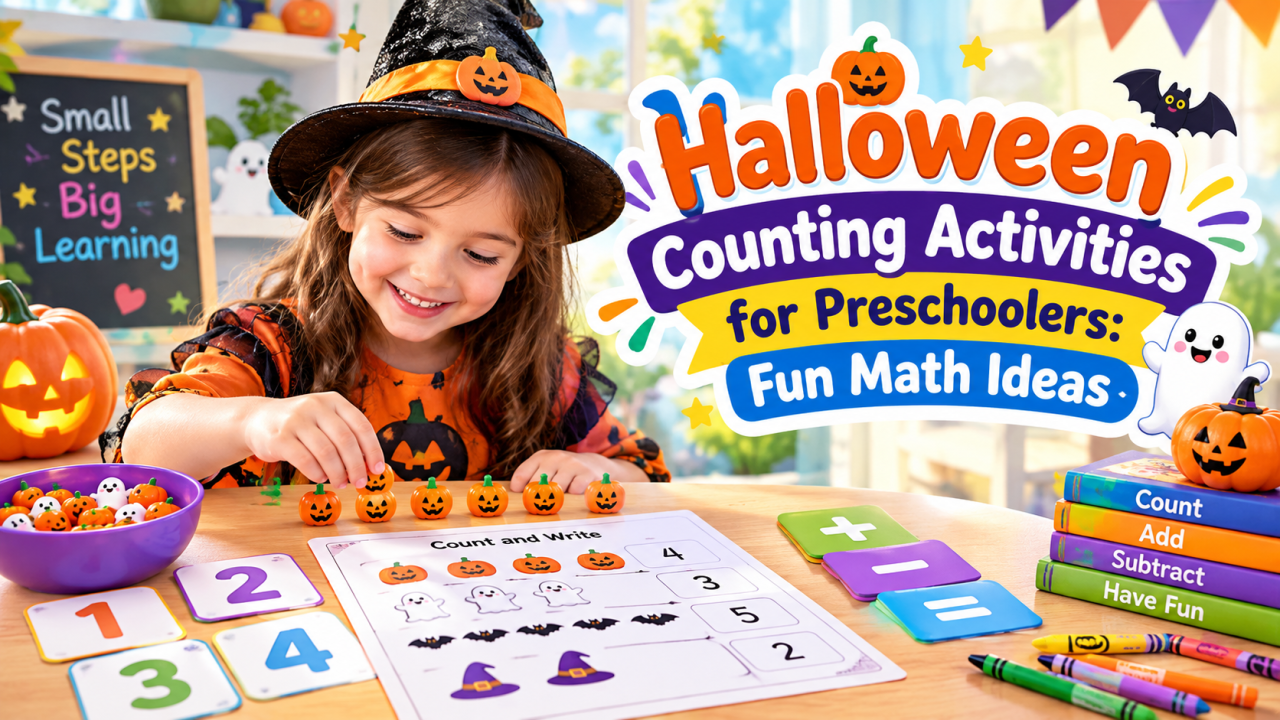
Explore fun Halloween counting activities for preschoolers using pumpkins, candy, ghosts, games, worksheets, and hands-on math practice.
Halloween Counting Activities for Preschoolers: Fun Math Ideas
Introduction
Halloween can turn everyday counting practice into a playful learning experience for young children. Instead of counting plain objects on a traditional worksheet, preschoolers can count pumpkins, friendly ghosts, bats, candy, spiders, stars, and other Halloween-themed objects.
Halloween counting activities for preschoolers can help children practice early number skills while giving them an enjoyable seasonal activity. Simple counting games, printable worksheets, number matching, sorting activities, scavenger hunts, and hands-on games can all be adapted for young learners.
The goal is not to make preschool math complicated. Young children often benefit from simple activities that allow them to see, touch, move, count, and talk about quantities.
With a few Halloween-themed objects and age-appropriate questions, parents and teachers can create short math activities that feel more like play than formal schoolwork.
for parentstext
Why Counting Is Important for Preschoolers
Counting is one of the foundations of early mathematics. Before children become comfortable with addition and subtraction, they need opportunities to understand quantities and connect numbers with groups of objects.
For example, a child may be able to say “one, two, three, four, five,” but that does not always mean they understand that the final number represents the total number of objects.
Hands-on counting activities give children opportunities to practice this connection.
A Halloween activity could ask a child to:
- [Story Library.](https://thesuperkidsai.com/stories)
- Count five pumpkins.
- Point to each pumpkin while counting.
- Choose the number card that represents the total.
- Add one more pumpkin and count again.
- Compare two groups of Halloween objects.
These small steps can help make early math concepts more concrete.
What Are Halloween Counting Activities for Preschoolers?
Halloween counting activities are simple early-math exercises that use seasonal themes to help young children practice numbers and quantities.
They can be completely screen-free or used as part of a digital learning activity.
Common examples include:
- Pumpkin counting
- Number matching
- Counting candy
- Ghost counting
- Halloween object sorting
- Counting scavenger hunts
- Number tracing
- Ten-frame activities
- Counting puzzles
- Simple counting worksheets
The best activity depends on the child's current ability and attention span.
15 Fun Halloween Counting Activities for Preschoolers
1. Pumpkin Counting Game
Pumpkins are an easy theme for preschool counting activities because children can recognize and count individual objects.
Place a small group of toy pumpkins, paper pumpkins, or pumpkin pictures in front of the child.
Ask:
“How many pumpkins can you count?”
Encourage the child to touch each pumpkin once while saying the numbers aloud.
Start with a small group and gradually increase the number of objects as the child becomes more comfortable.
2. Match Numbers to Pumpkins
Create pumpkin cards with numbers from 1 to 10.
Then create separate cards showing different quantities of pumpkins.
The child matches each number to the correct group.
For example:
Number card: 4
Picture card: 🎃 🎃 🎃 🎃
This activity helps children connect written numerals with quantities.
3. Count the Halloween Candy
Use pretend candy, small toys, counters, or printed pictures instead of real candy if you want to keep the activity completely focused on learning.
Give the child a small group of objects and ask them to count.
You can then ask:
- How many candies are there?
- Can you give me three?
- Can you find five?
- Which group has more?
- Which group has fewer?
Using objects that children can move around makes the activity more interactive.
4. Halloween Ten-Frame Counting
A ten-frame is a simple grid that can help children visualize quantities from 1 to 10.
Use pumpkins, bats, ghosts, or other Halloween pictures as counters.
For example, place three pumpkin pictures in a ten-frame and ask the child to identify the number represented.
Then add another pumpkin and ask:
“How many are there now?”
This can introduce the idea that quantities change when objects are added or removed.
5. Ghost Counting
Draw or print friendly ghosts in different groups.
Ask children to count each group.
For younger preschoolers, use numbers from 1 to 5.
For children who are ready for more practice, gradually increase the quantities.
You can also ask children to circle the group with more ghosts or fewer ghosts.
6. Halloween Counting Scavenger Hunt
Turn counting into a movement activity by creating a simple Halloween scavenger hunt.
Place safe objects around a room and give the child a counting challenge.
For example:
- Find 3 pumpkins.
- Find 4 stars.
- Find 5 bats.
- Find 2 orange objects.
The child walks around the room while counting objects.
This can be particularly useful when a child enjoys moving around rather than sitting at a table for a long period.
7. Count and Clip
Create cards showing different numbers of Halloween objects.
Write three possible answers on each card.
The child counts the objects and uses a clothespin or other safe marker to choose the correct number.
For example:
🎃 🎃 🎃 🎃 🎃
3 5 7
The correct answer is 5.
This combines counting with number recognition.
8. Halloween Counting Mats
Create simple counting mats with a large number at the top and empty spaces below.
Give the child small Halloween-themed counters.
If the mat says 6, the child places six objects on the mat.
This reverses the usual process. Instead of counting objects and identifying the number, children see the number first and build the corresponding quantity.
9. Count the Bats
Create several groups of bat pictures.
Ask children to count each group and identify the corresponding number.
You can also create a simple comparison game:
Which group has more bats?
Which group has fewer bats?
This introduces early comparison skills alongside counting.
10. Halloween Number Hunt
Write numbers on small Halloween-themed cards and hide them around the room.
Ask the child to find the numbers in order.
For example:
1 → 2 → 3 → 4 → 5
Once the child finds all five numbers, ask them to place the cards in numerical order.
For children who are still learning number recognition, begin with only a few numbers.
11. Count and Color
Give children a Halloween picture containing groups of objects.
Provide a simple instruction such as:
“Color 3 pumpkins.”
Then:
- Color 2 bats.
- Color 4 stars.
- Color 5 candies.
This combines counting, following directions, and creative activity.
12. Halloween Counting Puzzle
Create simple puzzles in which children match a number to a picture showing the same quantity.
For example:
- Number 2 → two ghosts
- Number 5 → five pumpkins
- Number 7 → seven stars
Cut the cards into simple pieces or provide them as a matching worksheet.
Puzzles can make repetition feel more playful.
13. Sort and Count Halloween Objects
Counting can be combined with sorting.
Give the child several types of objects and ask them to separate them into groups.
For example:
- Pumpkins
- Bats
- Ghosts
- Stars
After sorting, ask the child to count each group.
You can then ask which group contains the most objects and which contains the fewest.
14. Halloween Sticker Counting
Use Halloween stickers or printed pictures for a simple counting activity.
Give the child a number and ask them to place that many stickers on a page.
For example:
“Can you put 6 pumpkin stickers on the page?”
Afterward, ask the child to count the stickers again.
This gives children another opportunity to connect a spoken number, a written number, and a quantity.
15. Roll and Count Halloween Game
Use a standard die or a child-friendly number spinner.
After rolling, the child counts out the same number of Halloween-themed counters.
For example, if the die shows 4, the child places four pumpkins on the counting mat.
For an additional challenge, roll again and ask the child to combine the two groups.
This can become an early introduction to addition without requiring formal equations.
Halloween Counting Activities by Skill Level
Preschoolers do not all learn at the same pace. Some children may confidently count beyond 10, while others may still be learning to recognize small quantities.
Instead of choosing an activity only by age, consider what the child can already do.
| Skill Level | Suggested Activity | Example |
|---|---|---|
| Beginning | Count small groups | Count 1–5 pumpkins |
| Developing | Number matching | Match 6 to six bats |
| Growing | Count and compare | Which group has more? |
| Confident | Count to 10 or beyond | Count 10 Halloween objects |
| Ready for a challenge | Combine groups | Count two groups together |
This flexible approach allows parents and teachers to make the same Halloween theme useful for children at different stages.
Simple Halloween Counting Worksheets for Preschoolers
Worksheets can be useful when children need quiet, focused practice. For preschoolers, however, worksheets should generally be simple and visually clear.
A good Halloween counting worksheet might ask children to:
- Count objects and circle the correct number.
- Match numbers with quantities.
- Trace numbers.
- Count and color objects.
- Complete simple counting sequences.
- Identify which group has more.
- Identify which group has fewer.
Keep instructions short and avoid putting too many questions on one page.
For young children, the purpose of a worksheet should be practice and reinforcement rather than making the activity feel like a test.
Example: Count and Circle
Show a group of five pumpkins.
Ask:
How many pumpkins?
Then provide:
3 5 7
The child counts the pumpkins and circles 5.
Example: Count and Match
Show three groups containing different numbers of Halloween objects.
Place numbers next to them and ask the child to draw a line between each group and the correct number.
This provides practice with both counting and number recognition.
How Parents Can Make Halloween Counting More Interactive
Preschool children often learn well through movement and conversation. A worksheet does not need to be the entire learning experience.
Ask Children to Touch Each Object
When counting, encourage children to point to or move each object as they say the number.
This can help reduce the chance of counting the same object twice or skipping an object.
Ask “How Many?” in Everyday Situations
You can practice counting without preparing a formal activity.
Ask questions such as:
- How many pumpkins can you see?
- How many Halloween books do we have?
- How many stars are on the picture?
- Can you give me four blocks?
These small questions can turn everyday moments into opportunities for mathematical thinking.
Let Children Create Their Own Groups
Give children a collection of safe objects and ask them to make a group of a specific size.
For example:
“Can you make a group of five?”
After the child creates the group, ask them to count it again.
Halloween Counting Games Without Worksheets
Not every preschool learning activity needs paper.
Screen-free games can be especially useful when parents want to provide a change from table-based activities.
Pumpkin Basket Game
Place a basket or container in the play area.
Give the child several small pumpkin objects or paper cutouts.
Call out a number and ask the child to place that many pumpkins into the basket.
For example:
“Put four pumpkins in the basket.”
Afterward, count them together.
Feed the Friendly Monster
Create a friendly monster from paper or a cardboard box with a large opening for a mouth.
Give the child several counters and say:
“The monster is hungry. Can you give it three treats?”
The child counts three objects and places them into the monster's mouth.
For another round, change the number.
Halloween Number Jump
Write numbers on pieces of paper and place them on the floor.
Call out a number and ask the child to jump to it.
This combines number recognition with physical movement.
Using Halloween Counting to Introduce Early Addition
Once a child is comfortable counting small groups, you can begin introducing the idea of combining groups.
For example:
“Here are two pumpkins. Here is one more pumpkin. How many pumpkins are there altogether?”
Let the child physically move the objects together before counting the total.
At this stage, there is no need to rush into formal equations.
The important idea is:
Two objects + one object = three objects.
Using physical objects can make this concept easier for a young child to visualize.
Common Counting Mistakes Preschoolers May Make
Counting can look simple to adults, but young children are still developing several related skills.
Skipping Objects
A child may say numbers quickly while pointing randomly at objects.
Slow the activity down and encourage them to touch each object once.
Counting the Same Object Twice
Moving counted objects into a separate group can help children keep track of what they have already counted.
Knowing the Number Sequence but Not the Quantity
A child may recite numbers correctly but not understand that the final number tells how many objects are in the group.
After counting, ask:
“So, how many are there altogether?”
Then encourage the child to answer with the final number.
Confusing Written Numbers
Number recognition develops separately from counting ability.
A child might successfully count six objects but not recognize the written numeral 6 yet.
Use matching games and simple number cards to practice the connection gradually.
How to Keep Preschool Halloween Math Fun
The Halloween theme should make learning more inviting, not create additional pressure.
Try to:
- Keep activities short.
- Use familiar objects.
- Allow children to move objects while counting.
- Ask simple questions.
- Celebrate effort and careful counting.
- Change activities when children lose interest.
- Use both games and worksheets.
- Let children create their own counting problems.
If a child becomes frustrated, it is okay to stop and return to the activity later.
Continue With More Super Kids AI Activities
Halloween counting can be the beginning of a larger early-learning activity rather than the end of the learning session.
After practicing counting, children may be ready for a related Math activity, a simple Puzzle, a printable Worksheet, or another seasonal Kids Activity.
Children who enjoy drawing can continue with Art & Creativity, while a Halloween-themed story can provide an opportunity to connect early math with Reading & Phonics.
The most useful next activity is the one that naturally builds on what the child has just practiced.
Part 1 Summary
Halloween counting activities can give preschoolers a playful way to practice early number skills. Pumpkins, ghosts, bats, candy, stickers, and other seasonal objects can turn simple counting into an activity children can see, touch, move, and talk about.
Whether you choose a counting worksheet, a number hunt, a ten-frame, a sorting game, or a hands-on activity, keep the mathematical goal simple and appropriate for the child's current level.
In the next part, we will explore more hands-on Halloween counting games, printable activity ideas, classroom activities, age-based variations, and ways to connect counting with other early-learning skills.
16. Halloween Counting With Real Objects
Preschoolers do not always need special learning materials to practice counting. Everyday objects can become simple Halloween math tools.
For example, parents can use blocks, toy animals, bottle caps, craft pieces, or other safe objects and give them a Halloween theme through the activity.
Ask the child to pretend that the objects are Halloween treats or magical items.
Then give simple instructions such as:
- Count five treats.
- Put three treats in the basket.
- Make a group of four.
- Can you find six?
- Which group has more?
The object itself does not need to be Halloween-themed. The story and activity can provide the seasonal context.
17. Halloween Counting With Play Dough
Play dough can turn counting practice into a hands-on activity.
Ask children to make small pumpkins, balls, ghosts, or other simple shapes from play dough.
Then give them a number challenge.
For example:
“Can you make five little pumpkins?”
After making them, ask the child to count the pumpkins.
You can also ask:
- Can you make one more?
- How many do you have now?
- Can you make three ghosts?
- Which group is bigger?
This combines creativity with early mathematical thinking.
18. Halloween Counting With Blocks
Building blocks can also become counting tools.
Give the child a small collection of blocks and ask them to build Halloween towers.
For example:
- Build a tower with 3 blocks.
- Build another tower with 5 blocks.
- Which tower is taller?
- How many blocks are in both towers?
For younger children, focus on counting and comparing.
Children who are ready for a challenge can begin combining groups and exploring simple addition.
19. Halloween Counting With Snacks
Snack time can provide a natural opportunity for counting practice.
Parents can place a small number of child-appropriate snack pieces on a plate and ask the child to count them.
For example:
“How many pieces are on your plate?”
You can then ask:
- Can you count them again?
- What happens if we add one?
- Can you give me two?
- Which plate has more?
Keep the activity simple and age appropriate. The learning goal is counting, not the food itself.
20. Halloween Counting With Finger Puppets
Finger puppets or simple paper characters can make counting more interactive.
Use friendly Halloween characters such as pumpkins, ghosts, bats, or monsters.
Place one character on your finger, then add another.
Ask the child to count them as the group grows.
You can create a small story:
“One friendly ghost came to the party. Then another ghost arrived. How many ghosts are here now?”
This introduces early addition through storytelling and counting.
21. Halloween Counting Relay
If several children are participating, turn counting into a simple movement game.
Place Halloween-themed objects at one end of a safe play area.
Give each child a number.
The child then collects that many objects and brings them back.
For example:
- Child 1 collects 3 pumpkins.
- Child 2 collects 5 bats.
- Child 3 collects 4 stars.
After everyone finishes, count the objects together.
This activity can combine number recognition, counting, movement, and turn-taking.
22. Halloween Counting for Different Preschool Ages
Preschool covers several stages of early development, so a single counting activity may need to be adjusted for different children.
For Younger Preschoolers
Start with very small quantities.
Good activities include:
- Counting 1–3 objects
- Matching small groups
- Pointing to objects while counting
- Sorting two types of objects
- Finding a specific number of items
Keep the instructions short and use plenty of physical objects.
For Middle Preschool
Children who are becoming comfortable with small groups can practice counting up to 10.
Try:
- Number matching
- Counting mats
- Ten-frames
- Number hunts
- Count-and-color pages
- More-or-fewer activities
For Older Preschoolers
Children who are confident with basic counting can begin working with larger quantities and simple combinations.
Try:
- Counting beyond 10
- Counting backward
- Simple addition stories
- Combining two groups
- Comparing quantities
- Simple number puzzles
These activities can prepare children for more formal early math learning while keeping the experience playful.
23. Halloween Counting Activities for the Classroom
Teachers can use Halloween counting activities as short learning stations or small-group exercises.
Counting Station
Provide a basket of safe counters and several number cards.
Students choose a card and build a group containing the same number of objects.
Number Matching Station
Provide number cards and picture cards showing Halloween objects.
Children match each numeral to the correct quantity.
Counting and Sorting Station
Give children different types of Halloween pictures or counters.
Ask them to sort the objects and then count each group.
Math Puzzle Station
Use simple picture puzzles where children count objects before choosing the correct answer.
These stations can provide variety while reinforcing the same early math concepts.
24. Halloween Counting Circle Time Ideas
Counting does not always have to happen at a table.
During circle time, teachers can count Halloween objects together as a group.
For example, place five pumpkin pictures on a board.
Ask the children to count them together.
Then remove one pumpkin.
Ask:
“How many pumpkins are left?”
Next, add two more and count again.
This gives children an opportunity to observe how quantities change.
25. Halloween Counting Songs and Rhymes
Simple songs and rhymes can make number sequences easier to remember.
Teachers and parents can create short original counting chants using Halloween characters.
For example, children can count imaginary bats flying across the room:
- One bat flies.
- Two bats fly.
- Three bats fly.
- Four bats fly.
- Five bats fly.
Add simple movements such as flapping arms or pointing to picture cards.
The purpose is to make counting active and memorable.
26. Halloween Counting and Number Recognition
Counting and number recognition are related skills, but children may develop them at different rates.
A child may know how to count five objects but still need practice recognizing the written number 5.
To support both skills, combine quantities with numerals.
For example:
🎃 🎃 🎃 🎃 🎃 → 5
Ask the child to count the pumpkins and then find the number card that matches.
You can also reverse the activity.
Show the number 5 and ask the child to create a group of five objects.
Using both directions provides additional practice with the relationship between numbers and quantities.
27. Halloween Counting and Comparing
Once children can count small groups, introduce simple comparison questions.
Place two groups of Halloween objects in front of the child.
For example:
Group A: 🎃 🎃 🎃
Group B: 🎃 🎃 🎃 🎃 🎃
Ask:
- Which group has more?
- Which group has fewer?
- Can you count both groups?
- How many pumpkins are in the larger group?
Use everyday language first. Formal mathematical symbols can come later when the child is ready.
28. Halloween Counting and Patterns
Counting activities can naturally lead into simple pattern practice.
Create a sequence such as:
🎃 👻 🎃 👻 🎃 ___
Ask the child what should come next.
For younger children, use two repeating objects.
For children ready for more challenge, try:
🎃 👻 ⭐ 🎃 👻 ⭐ ___
After completing the pattern, ask the child to count how many pumpkins, ghosts, and stars appear.
This combines pattern recognition with counting.
29. Halloween Counting and Shapes
Halloween pictures can also introduce basic shapes.
Ask children to look for:
- Circles
- Triangles
- Squares
- Rectangles
- Ovals
After finding the shapes, ask children to count them.
For example:
“How many circles can you find?”
This creates a simple connection between counting and geometry.
30. Make Your Own Halloween Counting Worksheet
Parents and teachers can create simple worksheets without making the page complicated.
Start by choosing one skill.
For example:
Counting from 1 to 10.
Then create several short activities.
Activity A: Count and Circle
Show a group of Halloween objects and provide three possible numbers.
The child counts the objects and circles the correct answer.
Activity B: Count and Match
Show numbers on one side and groups of objects on the other.
The child draws a line between matching pairs.
Activity C: Count and Color
Give instructions such as:
“Color four pumpkins.”
The child counts the objects and colors the requested quantity.
Activity D: Complete the Number Sequence
Write:
1, 2, 3, __, 5
The child identifies the missing number.
For preschoolers, keep the sequence short and use numbers the child is already learning.
31. How to Use Printable Halloween Counting Worksheets
Printable worksheets can work well as a short follow-up after a hands-on activity.
For example, begin with a pumpkin counting game using physical objects.
Then give the child a worksheet containing pumpkin pictures.
This allows the child to move from:
Hands-on practice → Visual practice → Written number recognition
Using this sequence can make the worksheet feel more familiar.
It also gives parents and teachers an opportunity to observe whether the child can transfer what they practiced with physical objects to a printed page.
32. How to Encourage Independent Counting
As children become more confident, encourage them to complete simple counting tasks with less assistance.
Instead of immediately giving the answer, ask guiding questions.
- What number are you looking for?
- Can you count them again?
- Can you touch each one as you count?
- How many did you get?
- Can you show me the number?
This allows children to practice solving problems while still receiving support.
33. What to Avoid in Preschool Halloween Counting Activities
Simple activities are often the most appropriate for preschoolers, but a few common problems can make counting practice less effective.
Avoid Too Many Instructions
Young children may lose track when an activity includes several instructions at once.
Give one step at a time whenever possible.
Avoid Overly Complicated Designs
A worksheet filled with decorations can make it difficult for children to see which objects they need to count.
Use clear pictures and enough space.
Avoid Unnecessary Pressure
Counting is a skill children develop through repeated practice.
If a child does not understand an activity immediately, simplify it rather than turning it into a test.
Avoid Activities That Are Too Long
Preschool children can benefit from short activities that end while they are still engaged.
You can always return to the activity later.
34. A 15-Minute Halloween Counting Routine
Parents who want a quick activity can use this simple routine.
- Minutes 1–3: Count five to ten Halloween objects together.
- Minutes 3–6: Match quantities with number cards.
- Minutes 6–9: Play a short counting game.
- Minutes 9–12: Complete a simple counting worksheet.
- Minutes 12–15: Let the child create their own group and count it.
This short routine provides several types of practice without requiring a long lesson.
35. Connect Halloween Counting With Other Learning
Counting can easily be connected with other preschool learning areas.
Math
Continue from counting into comparing, simple addition, patterns, shapes, and early problem solving.
Art and Creativity
Ask children to draw five pumpkins, three bats, or another specific number of Halloween objects.
Reading and Phonics
Use a short Halloween story that includes characters or objects children can count.
Kids Activities
Turn counting into a scavenger hunt, movement game, sorting activity, or simple seasonal challenge.
For Super Kids AI, these connections create natural opportunities to guide families from one useful activity to another.
36. Continue Halloween Learning With Super Kids AI
After completing a Halloween counting activity, children can continue practicing related skills through other age-appropriate resources.
For more structured practice, explore Math and Worksheets.
For children who enjoy challenges, try Puzzles and simple problem-solving activities.
For broader seasonal ideas, explore Kids Activities.
Children who enjoy drawing and creating can continue with Art & Creativity, while a themed story can provide a natural connection to Stories and Reading & Phonics.
The goal is to create a natural learning journey where one activity leads to another useful activity.
Counting → Math Practice → Puzzle → Creative Activity → More Learning
Part 2 Summary
Halloween counting activities can be adapted in many ways for preschoolers. Children can count pumpkins, sort objects, match numbers, build groups with blocks, use play dough, play movement games, complete simple worksheets, and practice comparing quantities.
The most important thing is to keep the activity appropriate for the child's current ability.
Young children benefit from opportunities to physically interact with objects, say numbers aloud, connect quantities with written numerals, and explain what they are doing.
Halloween provides a playful theme, but the underlying goal should remain clear: helping children develop confidence with early counting and number concepts.
37. Frequently Asked Questions About Halloween Counting Activities for Preschoolers
What are Halloween counting activities for preschoolers?
Halloween counting activities for preschoolers are playful early-math exercises that use Halloween themes such as pumpkins, ghosts, bats, candy, stars, and friendly monsters to help children practice counting and number skills.
What numbers should preschoolers practice counting?
The appropriate numbers depend on the child's current development. Younger preschoolers can begin with very small groups, such as 1 to 5 objects. Children who are more confident can practice counting to 10 and gradually work with larger quantities.
How can I teach counting to a preschooler using Halloween activities?
Use simple objects or pictures and encourage the child to touch each object while saying the numbers aloud. You can also use number cards, counting mats, scavenger hunts, sorting games, stickers, puzzles, and Halloween-themed worksheets.
Are Halloween counting worksheets good for preschoolers?
Yes. Simple Halloween counting worksheets can provide useful practice with counting, number recognition, matching, comparing quantities, and number tracing. For preschoolers, worksheets should have clear instructions, simple visuals, and an appropriate number of questions.
What are some easy Halloween counting games for preschoolers?
Easy options include pumpkin counting, counting candy, ghost counting, number hunts, count-and-color activities, counting mats, sorting games, dice-and-count games, and Halloween scavenger hunts.
How can I make Halloween counting activities hands-on?
Use objects that children can touch and move, such as toy pumpkins, blocks, counters, play dough shapes, stickers, or paper cutouts. Ask children to create groups of a specific size, count the objects, and compare different groups.
Can Halloween counting activities help with addition?
Yes. Once children are comfortable counting small groups, parents and teachers can introduce simple addition concepts by combining two groups of objects. For example, a child can count two pumpkins and then add one more to see that there are three altogether.
How long should a preschool Halloween counting activity last?
There is no fixed length that works for every child. Short activities can be a practical choice for preschoolers, especially when the child is beginning to lose interest. Several short activities can be combined into a simple learning routine.
Can teachers use Halloween counting activities in preschool classrooms?
Yes. Teachers can use Halloween counting activities during small-group lessons, math stations, circle time, independent practice, partner activities, or seasonal classroom games.
What should I do if my child struggles with counting?
Make the activity simpler and use fewer objects. Encourage the child to touch or move each object while counting. You can also repeat the activity using different objects and provide plenty of opportunities for practice without turning the activity into a test.
Simple Halloween Counting Checklist for Parents and Teachers
Before starting an activity, use this quick checklist:
- Choose a number range that matches the child's ability.
- Use clear and easy-to-recognize objects.
- Start with a small number of objects.
- Encourage the child to touch each object while counting.
- Connect quantities with written numbers when appropriate.
- Use questions such as “How many?” and “Which has more?”
- Give children opportunities to move and manipulate objects.
- Keep worksheets short and uncluttered.
- Stop or change activities when the child becomes frustrated.
- Celebrate careful thinking and effort.
Final Thoughts on Halloween Counting Activities
Halloween counting activities for preschoolers can make early math practice more playful and approachable. Children can count pumpkins, match numbers, sort Halloween objects, complete simple worksheets, build groups with blocks, play movement games, and explore quantities through everyday activities.
The Halloween theme is simply a fun way to introduce familiar mathematical ideas. The most important part is choosing activities that match the child's current skill level and giving them enough opportunities to practice without unnecessary pressure.
For younger preschoolers, begin with small groups and simple questions. As counting becomes more comfortable, introduce number matching, comparisons, patterns, counting beyond 10, and simple combinations.
Parents and teachers can also combine hands-on games with printable worksheets. A child might first count physical pumpkins and then complete a worksheet showing pumpkin pictures. This creates a natural transition from hands-on learning to visual and written practice.
Most importantly, keep the experience enjoyable. When children are encouraged to explore numbers through play, stories, movement, creativity, and seasonal themes, counting can become a natural part of their everyday learning.
Keep the Learning Going With Super Kids AI
Halloween counting does not have to be a one-time seasonal activity. Once a child has practiced counting, the next step can be another activity that builds on the same skill.
Explore more Math activities for early number practice, use Worksheets for additional printable learning, or try Puzzles to introduce simple problem-solving challenges.
For children who enjoy creative activities, explore Art & Creativity. For children who enjoy stories, connect counting practice with Stories and Reading & Phonics.
You can also explore more Kids Activities to find playful ways to combine learning and fun.
Ready for another activity? Explore Super Kids AI and discover more age-appropriate ways for children to learn, play, create, and practice.
Key Takeaways
- Halloween counting activities can make preschool math more playful.
- Pumpkins, ghosts, bats, candy, stickers, blocks, and other objects can be used for counting practice.
- Start with small quantities and increase the challenge as the child becomes more confident.
- Hands-on activities allow children to touch, move, and count objects.
- Number matching helps connect written numerals with quantities.
- Counting activities can gradually introduce comparing groups and simple addition.
- Printable worksheets work best when they are simple, clear, and age appropriate.
- Short activities can be combined into a flexible preschool learning routine.
- Parents and teachers can connect counting with math, puzzles, art, stories, and other kids' activities.