Halloween Math Games for Preschoolers: Fun Learning Ideas
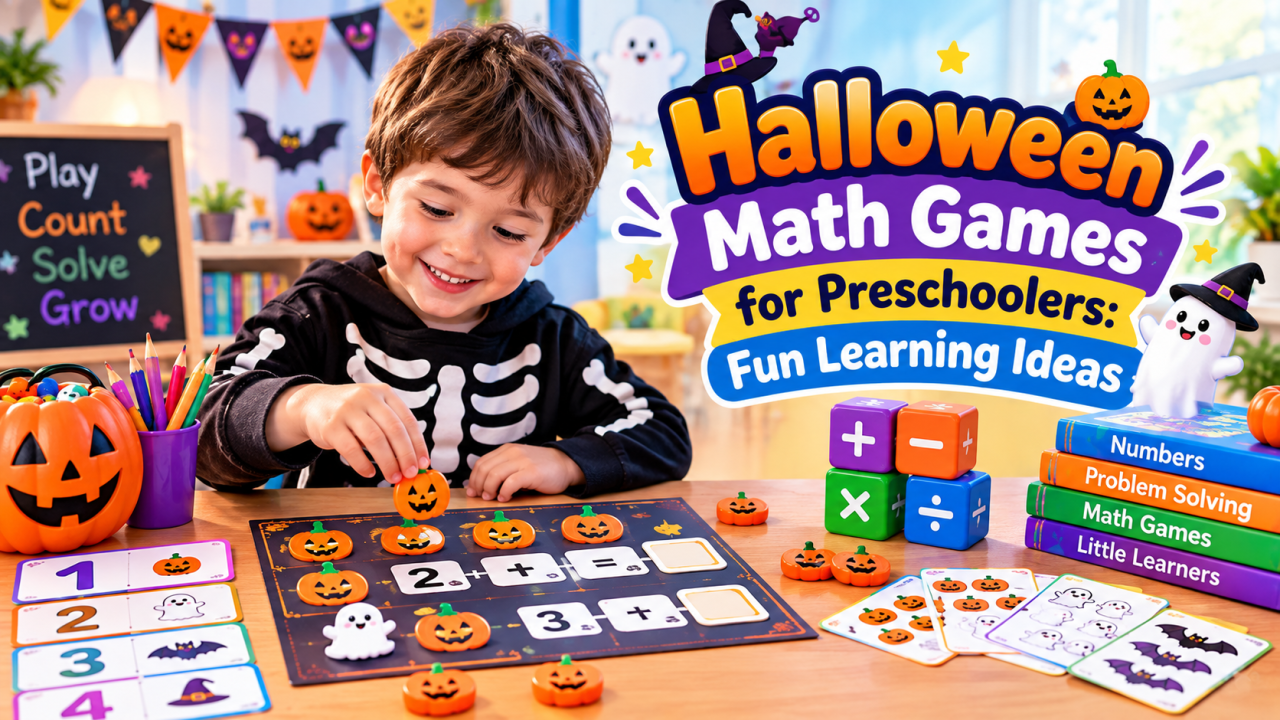
Discover fun Halloween math games for preschoolers that build counting, number recognition, patterns, sorting, and early problem-solving skills.
Halloween Math Games for Preschoolers: Fun Learning Ideas
Introduction
Halloween can be a fun opportunity to turn early math practice into play. Instead of asking preschoolers to complete the same type of exercise repeatedly, parents and teachers can use pumpkins, friendly ghosts, bats, candy, monsters, and other seasonal themes to create simple math games.
Halloween math games for preschoolers can help children practice important early skills such as counting, number recognition, sorting, patterns, comparing quantities, shapes, and simple problem solving.
The best preschool math games do not need to be complicated. A few number cards, counters, paper pumpkins, blocks, or household objects can be enough to create an engaging activity.
Halloween also gives children a familiar theme that can make learning feel more playful. A child might count pumpkins, match numbers to ghosts, sort Halloween objects, or move around the room looking for hidden numbers.
In this guide, you will find simple Halloween math games that parents and teachers can use at home, in preschool classrooms, or during seasonal learning sessions.
Why Use Games to Practice Preschool Math?
Young children often learn through active exploration. A math game gives them an opportunity to interact with numbers and quantities rather than only looking at them on a page.
Games can also introduce repetition without making every round feel exactly the same.
For example, a child may practice counting several times while:
- [Got to Worksheets & Activities](https://thesuperkidsai.com/worksheets)
- [Story Library](https://thesuperkidsai.com/stories)
- Rolling a die.
- Moving Halloween counters.
- Matching number cards.
- Building a pumpkin tower.
- Searching for hidden numbers.
The mathematical skill stays the same while the activity changes.
What Are Halloween Math Games for Preschoolers?
Halloween math games are playful activities that use a Halloween theme to support early mathematical learning.
They can be played individually, with a parent, in a small group, or with an entire preschool class.
Common examples include:
- Counting games
- Number matching games
- Sorting games
- Pattern games
- Shape games
- More-or-fewer games
- Dice games
- Number hunts
- Math scavenger hunts
- Simple board games
The activity should be adjusted according to the child's current skills.
20 Fun Halloween Math Games for Preschoolers
1. Pumpkin Counting Game
Place several paper pumpkins, toy pumpkins, or pumpkin pictures on a table.
Ask the child to count them one at a time.
Encourage the child to touch or move each pumpkin as they count.
Start with a small number of pumpkins and gradually increase the quantity as the child becomes more confident.
You can make the game more interactive by giving the child a number and asking them to create a group containing that many pumpkins.
2. Roll and Count
Use a standard die or a simple number spinner.
Give the child a collection of Halloween-themed counters.
The child rolls the die and counts out the same number of objects.
For example, if the die shows 4, the child places four pumpkins, bats, or other counters on the table.
Ask the child to count the group again before starting the next round.
3. Halloween Number Match
Create two sets of cards.
One set contains numerals and the other contains groups of Halloween objects.
The child matches each number to the correct quantity.
For example:
6 → 🎃 🎃 🎃 🎃 🎃 🎃
This game helps children connect written numbers with quantities.
4. Feed the Friendly Monster
Create a friendly monster using paper, cardboard, or a simple drawing.
Give the monster a large mouth or opening where children can place counters.
Then give the child a number challenge.
“The monster wants five treats. Can you give it five?”
The child counts five objects and places them into the monster's mouth.
Change the number for each round.
5. Halloween Number Hunt
Write numbers on small cards and place them around a safe play area.
Ask children to find the numbers and bring them back.
Once they have collected the cards, ask them to put the numbers in order.
For younger preschoolers, start with a small sequence such as 1 through 5.
6. Pumpkin Number Parking Lot
Create a pretend parking lot using paper spaces numbered from 1 to 10.
Give children small pumpkin pictures or toy vehicles.
Call out a number and ask the child to place the object on the matching space.
This combines movement with number recognition.
7. Halloween Sorting Game
Give children several types of Halloween objects or picture cards.
Ask them to sort the objects into groups.
For example:
- Pumpkins
- Bats
- Ghosts
- Stars
After sorting, ask children to count each group.
You can then ask which group has the most objects and which has the fewest.
8. More or Fewer Pumpkins
Place two groups of pumpkins in front of the child.
Make one group smaller than the other.
Ask:
- Which group has more?
- Which group has fewer?
- How many pumpkins are in each group?
This introduces early comparison skills in a simple way.
9. Halloween Ten-Frame Game
Use a ten-frame and Halloween-themed counters.
Place a few counters inside the frame and ask the child to identify how many there are.
Then add or remove one counter.
Ask the child to count again.
This can help children visualize quantities and observe how groups change.
10. Ghost Number Game
Create friendly ghost cards with numbers written on them.
Call out a number and ask the child to find the matching ghost.
You can also reverse the activity by showing a ghost card and asking the child to create a group containing that many objects.
11. Halloween Shape Hunt
Turn shape recognition into a Halloween-themed search.
Look for circles, triangles, squares, rectangles, and ovals in Halloween pictures or decorations.
Ask children to find and count each shape.
For example:
“How many circles can you find?”
This combines geometry with counting.
12. Halloween Pattern Game
Create a simple repeating pattern using Halloween pictures.
For example:
🎃 👻 🎃 👻 🎃 ___
Ask the child what should come next.
Once the child understands a two-object pattern, introduce slightly more challenging patterns.
Patterns can be created with picture cards, blocks, stickers, or physical objects.
13. Count and Move
Combine math with physical movement.
Give the child a number and an action.
For example:
- Jump 3 times.
- Clap 5 times.
- Flap like a bat 4 times.
- Stomp like a friendly monster 6 times.
This gives children another way to practice number quantities.
14. Halloween Counting Relay
Place Halloween-themed counters at one end of a safe play area.
Give the child a number and ask them to collect that many objects.
For example:
“Bring me four pumpkins.”
The child collects four pumpkins and brings them back.
Count the objects together to check the result.
15. Halloween Dice Addition
For preschoolers who are ready for an early addition challenge, use two dice.
Roll one die and count the corresponding number of Halloween counters.
Then roll the second die and create another group.
Place the two groups together and count all the objects.
This provides a hands-on introduction to combining quantities.
16. Halloween Number Fishing
Create paper number cards and attach a simple clip to each one.
Use a child-safe magnetic fishing toy or another simple method to pick up the cards.
When a child catches a number, ask them to identify it and create a matching group of Halloween counters.
17. Pumpkin Tower Challenge
Use blocks or cups decorated with pumpkin faces.
Give the child a number and ask them to build a tower containing that many pieces.
For example:
“Can you build a tower with six pumpkins?”
After building, count the pieces together.
18. Halloween Mystery Bag
Place several safe objects inside a bag.
Ask the child to take out a specific number of objects.
For example:
“Can you take three objects from the bag?”
Once the objects are outside, count them together.
19. Halloween Number Bingo
Create simple bingo cards containing numbers appropriate for the child's level.
Call out a number or show a group of Halloween objects.
The child finds the matching number on the card.
This can be played individually or with a small group.
20. Halloween Math Treasure Hunt
Create several simple math clues around the room.
Each clue can ask children to count objects or identify a number.
For example:
“Find the card showing 5.”
After finding it, the child receives the next clue.
Keep the questions simple and focus on one skill at a time.
How to Choose the Right Halloween Math Game
The best game depends on what the child is currently learning.
If the child is beginning to understand numbers, choose counting and matching games.
If the child already counts confidently, introduce comparison, patterns, shapes, and simple combinations.
A simple progression could look like this:
- Beginning: Count small groups of objects.
- Developing: Match numbers to quantities.
- Growing: Compare groups and identify patterns.
- Confident: Combine groups and solve simple problems.
There is no need to rush to the next level. Repeating a familiar game can be valuable when a child is still developing confidence.
Halloween Math Games Using Household Items
You do not need expensive educational toys to create preschool math games.
Many activities can use objects that are already available at home.
Try using:
- Building blocks
- Plastic cups
- Paper cutouts
- Buttons
- Pom-poms
- Craft sticks
- Stickers
- Small toys
- Number cards
Always choose objects that are appropriate for the child's age and supervise young children when small objects are involved.
Halloween Math Games Without Screens
Screen-free games can provide a useful change from digital activities.
Children can practice math while moving, sorting, building, drawing, or playing pretend.
Some easy screen-free options include:
- Pumpkin counting
- Number hunts
- Sorting games
- Dice games
- Shape hunts
- Pattern games
- Counting scavenger hunts
- Number bingo
The advantage of these activities is that children can physically interact with the objects they are counting.
Part 1 Summary
Halloween math games for preschoolers can turn early math practice into an enjoyable seasonal experience. Children can count pumpkins, match numbers, sort objects, recognize shapes, complete patterns, compare groups, and begin exploring simple addition through play.
Games do not need to be complicated. Simple objects, number cards, dice, paper cutouts, and household materials can provide plenty of opportunities for mathematical exploration.
The most important step is to choose an activity that matches the child's current ability and keep the learning experience playful.
21. Halloween Math Games for Different Skill Levels
Preschoolers can have very different levels of math experience. One child may be learning to recognize numbers, while another may already be comfortable counting and comparing groups.
Instead of choosing a game only because of age, choose one that matches the child's current skills.
For Children Beginning to Learn Numbers
Start with simple games involving small quantities.
- Count 1 to 5 pumpkins.
- Match a number to a small group of objects.
- Find a specific number card.
- Sort two types of Halloween objects.
- Count objects while touching each one.
For Children Practicing Numbers to 10
Once children are comfortable with smaller quantities, introduce games that use numbers from 1 to 10.
- Ten-frame counting.
- Number bingo.
- Count-and-match games.
- Number hunts.
- More-or-fewer games.
For Children Ready for More Challenge
Children who are confident with basic counting can explore simple combinations, patterns, comparisons, and early problem solving.
- Combine two groups of Halloween counters.
- Complete number patterns.
- Compare larger groups.
- Play simple two-dice games.
- Solve picture-based math problems.
22. Halloween Math Games for Small Groups
Halloween math games can work especially well in small groups because children can take turns, explain their thinking, and watch how other children solve the same problem.
Pumpkin Pass and Count
Give each child a small collection of pumpkin counters.
Ask everyone to count their pumpkins.
Then have the children pass one pumpkin to the next person and count again.
Ask questions such as:
- How many pumpkins do you have now?
- Did your number change?
- Who has more?
- Who has fewer?
This combines counting with simple comparison.
Number Card Challenge
Place number cards face down.
Each child takes a card and creates a group of Halloween counters that matches the number.
Children can then check one another's groups by counting them together.
Halloween Sorting Race
Give the group a mixed collection of Halloween picture cards.
Ask children to sort them into categories.
After sorting, count each category.
The goal is not simply to finish quickly. Encourage children to sort carefully and explain why objects belong together.
23. Halloween Math Games for One Child
Many Halloween math games can also be played independently with simple materials.
Set up a small activity tray containing:
- Number cards.
- Halloween counters.
- A die.
- A counting mat.
- Simple picture cards.
The child can choose a card, complete the activity, and check the answer by counting.
Parents can stay nearby and provide support when necessary.
24. Halloween Math Games for Parents and Children
Playing together gives parents an opportunity to observe how a child thinks about numbers.
Instead of correcting every mistake immediately, ask questions that encourage the child to check their own work.
Try asking:
- How did you get that answer?
- Can we count them together?
- What happens if we add one?
- Which group has more?
- Can you show me another way?
These questions can turn a simple game into a conversation about mathematics.
25. Halloween Math Games With Dice
A die is a simple tool for introducing numbers into a game.
For younger preschoolers, use one die.
The child rolls it, identifies the number, and counts the same number of Halloween objects.
For example:
Roll 3 → Count 3 pumpkins.
Once children are comfortable with this process, introduce a second die.
Ask them to create two groups and then count the combined group.
This provides a hands-on introduction to addition.
26. Halloween Math Board Game
Create a simple path with numbered spaces.
Decorate the path with pumpkins, bats, stars, and friendly ghosts.
The child rolls a die and moves forward the correct number of spaces.
At certain spaces, add a simple math challenge.
For example:
- Count three pumpkins.
- Find the number 5.
- Show four fingers.
- Tell which group has more.
Keep the rules simple so the game remains appropriate for preschoolers.
27. Halloween Math Games With Movement
Movement can make math practice more engaging for children who find it difficult to sit for long periods.
Number Jump
Place number cards on the floor.
Call out a number and ask the child to jump to it.
Monster Steps
Give the child a number and ask them to take that many pretend monster steps.
For example:
“Take five monster steps.”
Bat Flaps
Call out a number and ask the child to flap their arms that many times.
Afterward, count the movements together.
These games combine number understanding with physical activity.
28. Halloween Math Games With Art
Art can become part of a math activity.
Ask children to draw a specific number of Halloween objects.
For example:
- Draw 3 pumpkins.
- Draw 4 stars.
- Draw 2 friendly ghosts.
- Draw 5 bats.
After drawing, ask the child to count each group.
This creates a natural connection between creativity and mathematics.
29. Halloween Math Games With Stickers
Stickers can be useful for simple number and quantity games.
Give the child a number and ask them to place that many Halloween stickers on a page.
For example:
“Put seven pumpkin stickers on the page.”
When finished, ask the child to count the stickers again.
You can also create simple groups and ask children to identify which group contains more stickers.
30. Halloween Math Games for Number Recognition
Number recognition can be practiced through quick games throughout the day.
Place several number cards on a table.
Call out a number and ask the child to find it.
Then ask the child to create a matching group of Halloween objects.
For example:
“Find number 6. Now make a group of six pumpkins.”
This connects the written numeral with the quantity it represents.
31. Halloween Math Games for Counting Backward
Once a child is comfortable counting forward, simple backward counting can be introduced as a playful challenge.
Start with a small number.
For example:
5, 4, 3, 2, 1
You can pretend that five friendly ghosts are getting ready to fly away.
Remove one picture at a time while counting backward.
This gives the number sequence a visual context.
32. Halloween Math Games for More and Fewer
Comparing quantities is an important early math skill.
Place two groups of Halloween objects in front of the child.
For example:
Group A: 🎃 🎃 🎃
Group B: 🎃 🎃 🎃 🎃 🎃
Ask which group has more and which has fewer.
Then ask the child to count both groups.
Physical objects make the comparison easier to see.
33. Halloween Math Games for Patterns
Patterns are another useful preschool math concept.
Create a simple repeating sequence.
For example:
🎃 👻 🎃 👻 🎃 ___
Ask the child to identify the missing object.
Once the child understands the pattern, make it slightly more challenging.
For example:
🎃 👻 ⭐ 🎃 👻 ⭐ ___
Children can also create their own Halloween patterns using blocks, stickers, or picture cards.
34. Halloween Math Games for Shapes
Halloween pictures can provide opportunities to practice basic shapes.
Ask children to identify shapes in drawings and decorations.
Try questions such as:
- Can you find a circle?
- How many triangles can you see?
- Which object looks like a rectangle?
- Can you draw a square pumpkin sign?
After identifying the shapes, ask children to count them.
35. Halloween Math Games for Simple Word Problems
Preschoolers who are ready for a challenge can explore very simple story-based math problems.
For example:
“There are two pumpkins on the table. We add one more pumpkin. How many pumpkins are there now?”
Let the child use physical objects to act out the problem.
Another example:
“There are five bats. Two fly away. How many are left?”
Keep the numbers small and allow the child to solve the problem with objects rather than requiring formal written equations.
36. Halloween Math Games and Printable Worksheets
Games and worksheets can work together rather than being treated as separate activities.
For example, begin with a hands-on pumpkin counting game.
After the child has practiced counting the pumpkins, provide a simple worksheet showing groups of pumpkins.
The child can then:
- Count each group.
- Circle the correct number.
- Match numbers to quantities.
- Color a specific number of objects.
This progression moves from physical practice to visual and written practice.
37. How to Keep Halloween Math Games Simple
Young children do not need complicated rules to learn mathematical concepts.
When creating a game, focus on one main learning goal.
For example:
- Counting.
- Number recognition.
- Sorting.
- Comparing.
- Patterns.
- Shapes.
If the game contains too many rules, the child may focus more on remembering what to do than on the mathematical idea.
Simple rules can make it easier for children to understand the activity and participate independently.
38. How Long Should a Halloween Math Game Last?
There is no single amount of time that works for every preschooler.
A short game may be enough for one child, while another child may enjoy several rounds.
Watch the child's attention and adjust accordingly.
If the child is still engaged, you can add another round or a small challenge.
If the child becomes distracted or frustrated, switch activities or take a break.
39. Making Halloween Math Games Inclusive and Friendly
Halloween activities do not need to be scary to be fun.
Friendly pumpkins, smiling ghosts, colorful stars, cute bats, and playful monsters can create a seasonal theme without making the activity frightening.
This can be especially helpful when activities are used with groups of children who may have different comfort levels with Halloween imagery.
The focus should remain on learning and enjoyment.
40. Continue Learning After the Game
A Halloween math game can naturally lead into another learning activity.
After a counting game, children might complete a related worksheet.
After a pattern game, they might create their own patterns through art.
After a number game, they might try a simple puzzle.
This creates a natural learning path:
Math Game → Practice → Puzzle → Creative Activity → More Learning
For families using Super Kids AI, this approach can make it easier to discover related activities instead of stopping after one game.
Part 2 Summary
Halloween math games can support many preschool skills, including counting, number recognition, sorting, comparison, patterns, shapes, and early problem solving.
Parents and teachers can adapt the same game for different skill levels by changing the number range, quantity of objects, or complexity of the instructions.
Hands-on materials such as pumpkins, blocks, stickers, number cards, dice, and paper cutouts can make the activities more interactive.
The best games keep the rules simple and focus on one clear mathematical idea at a time.
41. Frequently Asked Questions About Halloween Math Games for Preschoolers
What are Halloween math games for preschoolers?
Halloween math games for preschoolers are playful activities that use seasonal themes such as pumpkins, ghosts, bats, stars, and friendly monsters to help children practice early math skills.
What math skills can preschoolers practice with Halloween games?
Preschoolers can practice counting, number recognition, sorting, comparing quantities, patterns, shapes, sequencing, and simple addition through age-appropriate Halloween math games.
What is an easy Halloween math game for preschoolers?
Pumpkin counting is a simple option. Give the child several pumpkin pictures or counters and ask them to count the objects. You can then give the child a number and ask them to create a matching group.
Can I make Halloween math games at home?
Yes. Many Halloween math games can be created with household materials such as blocks, paper, stickers, cups, craft materials, number cards, and other safe objects.
Do Halloween math games need special Halloween toys?
No. The Halloween theme can come from pictures, stories, colors, paper cutouts, or pretend play. Ordinary objects such as blocks and counters can be used for the mathematical part of the activity.
How can I teach counting through Halloween games?
Give children small groups of Halloween-themed objects and encourage them to touch or move each object while saying the numbers aloud. Then ask them to connect the quantity with the matching written number.
Can preschoolers learn addition through Halloween games?
Yes. Children who are ready can combine two small groups of objects and count the total. Using physical objects can make the idea of combining quantities easier to understand.
Are Halloween math games useful in preschool classrooms?
Yes. Teachers can use Halloween math games during small-group activities, math centers, circle time, partner games, classroom stations, or independent practice.
How do I make a Halloween math game easier?
Use fewer objects, smaller numbers, and one-step instructions. For example, instead of asking a child to count, sort, and compare several groups at once, focus on counting one small group first.
How do I make a Halloween math game more challenging?
Increase the number range, introduce comparisons, add simple patterns, combine two groups, or ask the child to explain how they reached an answer.
Quick Halloween Math Game Checklist
Before starting a Halloween math game, check that the activity is appropriate for the child.
- Choose a number range the child can reasonably work with.
- Use clear and easy-to-recognize objects.
- Focus on one main math skill.
- Give short and simple instructions.
- Let children touch and move objects whenever possible.
- Ask questions instead of immediately giving answers.
- Adjust the challenge based on the child's progress.
- Keep small objects away from children who may put them in their mouths.
- Supervise young children during activities involving small materials.
- Keep the experience playful rather than turning it into a test.
Final Thoughts on Halloween Math Games for Preschoolers
Halloween math games for preschoolers can turn early math practice into a fun seasonal experience. Children can count pumpkins, match numbers, sort objects, identify shapes, complete patterns, compare quantities, and explore simple addition through play.
The activities do not need expensive materials or complicated instructions. A few paper cards, blocks, counters, stickers, dice, or household objects can provide plenty of opportunities for children to practice important early math concepts.
The key is to choose a game that matches the child's current ability. Children who are beginning to learn numbers can start with small counting groups and number matching. Children who are more confident can move toward comparisons, patterns, shapes, and simple math problems.
Hands-on games can also be combined with printable worksheets. After children practice counting real objects, a worksheet can give them an opportunity to recognize quantities and numbers in a different format.
Most importantly, keep the experience enjoyable. Halloween provides a playful theme, but the real goal is to help children become comfortable exploring numbers and mathematical ideas.
Keep Learning With Super Kids AI
One Halloween math game can be the beginning of a larger learning activity.
After playing a counting game, children can continue with a related Math activity or practice the same concept with Worksheets.
Children who enjoy challenges can explore Puzzles, while creative learners can continue with Art & Creativity.
You can also discover more Kids Activities that combine learning, creativity, movement, and play.
Ready for more playful learning? Explore Super Kids AI to discover activities that help children learn, practice, create, and have fun.
Key Takeaways
- Halloween themes can make preschool math practice more engaging.
- Counting, number recognition, sorting, patterns, shapes, and comparisons can all be practiced through games.
- Simple materials such as paper cards, blocks, stickers, counters, and dice are often enough.
- Games can be adjusted for different preschool skill levels.
- Hands-on activities allow children to physically explore quantities.
- Simple addition can be introduced by combining small groups of objects.
- Movement and pretend play can make math practice more active.
- Printable worksheets can be used as follow-up practice after a hands-on game.
- The best activities keep instructions simple and focus on one main skill.