Halloween Pattern Activities for Preschoolers
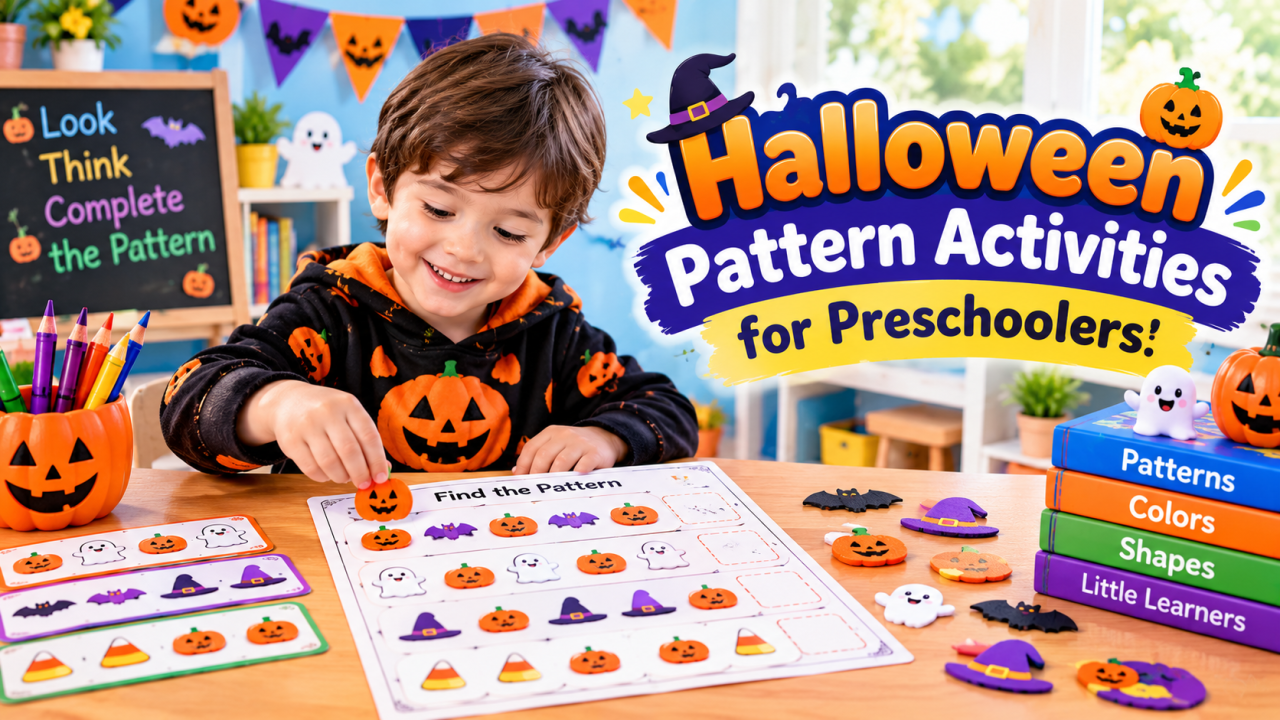
Try fun Halloween pattern activities for preschoolers using pumpkins, ghosts, bats, colors, and simple hands-on learning games.
Halloween Pattern Activities for Preschoolers: Fun Learning Ideas
Introduction
Halloween is a fun time to introduce preschoolers to early math concepts through playful activities. Pumpkins, ghosts, bats, stars, candy, and colorful Halloween decorations can all become part of simple learning games.
Halloween pattern activities for preschoolers help children notice what comes next, identify repeating sequences, sort objects, and create their own patterns. These skills can support early mathematical thinking while giving children an opportunity to learn through play.
Pattern activities do not have to be complicated. Parents and teachers can use paper cutouts, blocks, stickers, toys, crayons, or printable cards to create simple sequences.
For example, a child might see:
🎃 👻 🎃 👻 🎃 ___
The child can look carefully at the repeating sequence and decide what should come next.
As children become more comfortable with simple patterns, the activities can gradually become more challenging.
In this guide, you will find easy Halloween pattern activities that can be used at home, in preschool classrooms, or during seasonal learning sessions.
What Are Pattern Activities for Preschoolers?
A pattern is a sequence that follows a recognizable rule or repeats in a predictable way.
For preschoolers, patterns can be introduced using objects, pictures, colors, sounds, movements, or actions.
For example:
🍎 🍌 🍎 🍌 🍎 🍌
The child can identify that the two objects repeat.
With a Halloween theme, the same idea can be presented using seasonal pictures:
🎃 👻 🎃 👻 🎃 👻
Children can learn to notice what stays the same and what changes.
Why Are Patterns Important for Preschoolers?
Pattern activities encourage children to observe relationships and sequences.
When children complete a repeating pattern, they are not simply memorizing pictures. They are looking for a rule and using that rule to predict what comes next.
Pattern practice can also be connected with:
- Early math skills
- Observation
- Classification
- Sequencing
- Prediction
- Problem solving
- Attention to detail
These concepts can be introduced through short, playful activities rather than formal lessons.
Easy Halloween Pattern Activities for Preschoolers
1. Pumpkin and Ghost Pattern
Start with one of the simplest Halloween patterns.
Place paper pumpkin and ghost pictures in a repeating sequence.
For example:
🎃 👻 🎃 👻 🎃 ___
Ask the child:
“What should come next?”
Let the child choose between a pumpkin and a ghost.
Once the child selects the answer, ask them to explain the pattern.
2. Bat and Star Pattern
Use bat and star cards to create another two-item pattern.
For example:
🦇 ⭐ 🦇 ⭐ 🦇 ___
Ask the child to complete the sequence.
You can then let the child create a new bat-and-star pattern for someone else to solve.
3. Pumpkin Color Patterns
Use paper pumpkins in different colors.
Create a simple color sequence.
For example:
Orange → Purple → Orange → Purple → Orange → ___
Ask the child which color should come next.
After solving the pattern, encourage the child to make their own color sequence.
4. Halloween Sticker Patterns
Stickers can make pattern practice more interactive.
Give the child two or three types of Halloween stickers.
Start a simple sequence and ask the child to continue it.
For example:
Pumpkin → Ghost → Pumpkin → Ghost → ___
The child places the next sticker in the correct position.
5. Halloween Block Patterns
Use building blocks to create patterns.
You can combine Halloween-themed blocks with regular blocks.
For example:
Black block → Orange block → Black block → Orange block
Ask the child to continue the pattern.
This activity works well when children enjoy building and manipulating objects.
6. Halloween Object Sorting and Patterns
Give children a collection of Halloween objects or picture cards.
First, ask them to sort the objects into groups.
Then use the groups to create a pattern.
For example:
- Pumpkin
- Ghost
- Pumpkin
- Ghost
Ask what should come next.
7. Halloween Candy Pattern
Use pretend candy, paper candy pictures, or colorful counters.
Create a repeating sequence based on color.
For example:
Red → Yellow → Red → Yellow → Red → ___
Ask the child to identify the next color.
For safety, use age-appropriate materials and supervise young children around real food.
8. Ghost Color Pattern
Create ghost shapes in different colors.
Arrange them in a simple repeating sequence.
For example:
White → Purple → White → Purple → ___
Ask the child to complete the sequence.
You can make the activity more challenging by adding a third color.
9. Halloween Shape Pattern
Patterns do not have to use Halloween characters.
Use simple shapes such as circles, triangles, squares, and rectangles.
For example:
Circle → Triangle → Circle → Triangle → ___
Then ask the child to connect the shapes with Halloween pictures.
For example, they might create a pumpkin using a circle and a triangle for decoration.
10. Halloween Number Pattern
Numbers can also be used to introduce simple patterns.
Start with an easy repeating sequence.
For example:
1, 2, 1, 2, 1, ___
Ask the child what number comes next.
For children who are ready for more challenge, try:
1, 2, 3, 1, 2, 3, ___
Use Halloween pictures alongside the numbers to make the activity more engaging.
11. Halloween Movement Patterns
Patterns can involve movement instead of objects.
Ask the child to perform two repeating actions.
For example:
- Clap → Jump → Clap → Jump
- Stomp → Clap → Stomp → Clap
- Spin → Tap → Spin → Tap
After a few repetitions, stop and ask the child what movement should come next.
This gives children another way to experience patterns.
12. Halloween Sound Patterns
Use simple sounds to create an auditory pattern.
For example:
Clap → Tap → Clap → Tap → ___
Ask the child to continue the sequence.
You can use gentle Halloween-inspired sounds such as a pretend ghost “boo” and a clap.
Keep the sounds playful and comfortable for the child.
13. Halloween Scavenger Hunt Patterns
Create a simple pattern using objects around the room.
For example, hide a pumpkin card, then a ghost card, then another pumpkin card.
Ask the child to find the missing item needed to continue the pattern.
This turns pattern recognition into an active game.
14. Complete the Missing Halloween Pattern
Place a sequence on a table but leave one space empty.
For example:
🎃 👻 ___ 👻 🎃 👻
Give the child a small selection of cards and ask them to choose the missing picture.
Encourage the child to look at both sides of the empty space before deciding.
15. Create Your Own Halloween Pattern
After children have practiced completing patterns, encourage them to create their own.
Give them several Halloween cards, blocks, stickers, or paper shapes.
Ask them to make a pattern and then explain the rule.
For example:
“I used a pumpkin, ghost, pumpkin, ghost.”
Let another child, parent, or teacher try to continue the sequence.
Start With Simple Patterns
When children are learning about patterns for the first time, start with a simple repeating sequence.
A two-item pattern is often easier to understand than a sequence containing several different elements.
Examples include:
- Pumpkin → Ghost → Pumpkin → Ghost
- Bat → Star → Bat → Star
- Orange → Purple → Orange → Purple
- Clap → Jump → Clap → Jump
Once the child can identify these patterns confidently, introduce more variety.
Move From AB Patterns to ABC Patterns
A simple way to increase the challenge is to introduce a third repeating element.
An AB pattern might look like:
🎃 👻 🎃 👻 🎃 👻
An ABC pattern might look like:
🎃 👻 ⭐ 🎃 👻 ⭐
Ask the child what should come next.
The goal is to help children notice the repeating rule rather than simply memorize a particular sequence.
Use Real Objects for Hands-On Learning
Children can physically move objects to create and change patterns.
Try using:
- Building blocks
- Paper pumpkins
- Craft sticks
- Stickers
- Plastic cups
- Buttons
- Pom-poms
- Paper shapes
For young children, choose materials that are appropriate for their age and supervise them when using small objects.
Part 1 Summary
Halloween pattern activities for preschoolers can introduce children to repeating sequences through pumpkins, ghosts, bats, stars, colors, shapes, numbers, sounds, and movement.
Start with simple two-item patterns and gradually introduce more challenging sequences when the child is ready.
Hands-on materials can make pattern practice more engaging because children can physically move, arrange, and change the objects.
The next step is to turn these simple patterns into games, classroom activities, printable practice, and creative challenges.
Superkidstext our activities for parentstext the blogtext
16. Halloween Pattern Matching Cards
Pattern matching cards are an easy way to help preschoolers practice recognizing sequences.
Create cards showing simple Halloween patterns and provide separate cards containing the possible missing object.
For example:
🎃 👻 🎃 👻 🎃 ___
The child chooses the ghost card to complete the pattern.
Start with very simple patterns and gradually introduce more challenging combinations.
17. Halloween Pattern Train
Turn pattern practice into a pretend train activity.
Use paper rectangles or building blocks as train cars.
Decorate the cars with Halloween pictures and create a repeating sequence.
For example:
Pumpkin → Ghost → Pumpkin → Ghost → Pumpkin
Ask the child to add the next train car.
You can also ask the child to build an entire Halloween train using their own pattern.
18. Pumpkin Pattern Necklace
Use large, child-safe beads or paper shapes to create a pretend Halloween necklace.
Start with a simple pattern such as:
Orange → Purple → Orange → Purple
Ask the child to continue the sequence.
For children who are ready for more challenge, try:
Orange → Purple → Green → Orange → Purple → Green
Always choose materials appropriate for the child's age and supervise children when small objects are involved.
19. Halloween Pattern Blocks
Building blocks can become Halloween math materials.
Choose two or three colors and arrange them into a repeating pattern.
For example:
Orange → Black → Orange → Black
Ask the child to continue the sequence.
Then allow the child to create a pattern for you to solve.
This simple change gives the child an opportunity to move from identifying patterns to creating them.
20. Halloween Pattern Play Dough
Use play dough to make small pumpkins, ghosts, stars, or other simple shapes.
Arrange the shapes into a pattern.
For example:
🎃 ⭐ 🎃 ⭐ 🎃 ___
Ask the child to make the next shape.
Children can also make their own play dough patterns once they understand the idea.
21. Halloween Pattern Hunt
Take pattern learning around the classroom or home.
Look for repeating colors, shapes, objects, or decorations.
Ask questions such as:
- What do you notice?
- Can you find something that repeats?
- What comes next?
- Can you make a similar pattern?
The goal is to help children notice that patterns can exist beyond worksheets and prepared games.
22. Halloween Pattern Cutting Activity
For children who are ready to use child-safe scissors, create a simple cutting-and-pattern activity.
Prepare strips of paper containing Halloween pictures.
Children can cut out the pictures and arrange them into repeating sequences.
For example:
Ghost → Pumpkin → Ghost → Pumpkin
After arranging the cards, ask the child to identify the repeating rule.
Adult supervision is important whenever children use scissors.
23. Halloween Pattern Coloring Activity
Give children a row of simple Halloween pictures.
Ask them to color the pictures according to a repeating rule.
For example:
Pumpkin = orange, Ghost = purple
The sequence might be:
Pumpkin → Ghost → Pumpkin → Ghost
This combines color recognition, creativity, and pattern practice.
24. Halloween Pattern Dot Activity
Use dot markers, crayons, or stickers to create a color pattern.
Draw a row of large circles and start a simple sequence.
For example:
Orange → Black → Orange → Black → ___
Ask the child to complete the next circle.
Afterward, encourage them to create their own pattern.
25. Halloween Pattern Story
Patterns can also be included in pretend stories.
Tell a short story about a friendly Halloween character following a repeating routine.
For example:
“The little ghost visits the pumpkin, then visits the star. Then the ghost visits the pumpkin again and the star again.”
Ask the child what the ghost should visit next.
This helps connect pattern recognition with language and storytelling.
26. Halloween Pattern Snack Idea
Food can sometimes be used to demonstrate patterns when appropriate and safe for the child.
For example, a parent might arrange suitable foods in a simple repeating sequence.
Fruit → Cracker → Fruit → Cracker
Ask the child what should come next.
Keep food choices appropriate for the child's age and follow any dietary or allergy considerations.
27. Halloween Pattern Dance Game
Turn pattern recognition into a movement game.
Create a two-action sequence.
For example:
Clap → Stomp → Clap → Stomp
Perform the sequence together several times.
Then stop and ask the child what action should come next.
You can introduce Halloween-inspired movements such as:
- Fly like a bat.
- Stomp like a monster.
- Wave like a ghost.
- Jump like a pumpkin.
28. Halloween Pattern Sound Game
Use sounds to create an auditory pattern.
For example:
Clap → Tap → Clap → Tap
Ask the child to repeat the sequence.
Then pause before the final sound and ask what should come next.
Sound patterns can be useful for children who enjoy music and movement.
29. Halloween Pattern Memory Game
Show the child a short Halloween pattern for a few seconds.
Cover the pattern and ask the child to recreate it using the same cards or objects.
Start with two repeating elements.
For example:
🎃 👻 🎃 👻
Once the child is comfortable, increase the length or introduce a third element.
30. Halloween Pattern Puzzle
Create a simple pattern puzzle by cutting a sequence into separate pieces.
Mix the pieces and ask the child to put them back in the correct order.
For example, the completed sequence might be:
🎃 👻 ⭐ 🎃 👻 ⭐
The child arranges the pieces to recreate the repeating pattern.
31. Halloween Pattern Relay
For a small group, place Halloween picture cards at one end of a safe play area.
Give children a pattern to complete.
They take turns bringing back the card needed to continue the sequence.
Keep the activity focused on identifying the correct pattern rather than simply being the fastest.
32. Halloween Pattern Parking Lot
Create a pretend parking lot using spaces decorated with Halloween pictures.
Place toy cars or paper vehicles into a repeating sequence.
For example:
Orange car → Black car → Orange car → Black car
Ask the child which car belongs in the next space.
33. Halloween Pattern Garden
Create a pretend garden using paper flowers, pumpkins, leaves, and stars.
Ask children to arrange the objects into repeating patterns.
For example:
Pumpkin → Flower → Pumpkin → Flower
Children can then create their own garden patterns.
34. Halloween Pattern Classroom Center
Teachers can create a dedicated pattern station with simple reusable materials.
The station might include:
- Halloween picture cards.
- Colored blocks.
- Pattern strips.
- Stickers.
- Shape cards.
- Number cards.
Children can complete prepared patterns and then create their own.
This provides both guided practice and independent exploration.
35. Halloween Pattern Worksheets
Printable worksheets can provide additional pattern practice after children have explored patterns with physical objects.
A simple worksheet might show:
🎃 👻 🎃 👻 🎃 ___
The child circles the picture that completes the sequence.
Other worksheet activities can ask children to:
- Draw the missing object.
- Color a repeating pattern.
- Match two identical patterns.
- Continue a sequence.
- Create their own pattern.
36. How to Make Pattern Activities Easier
If a child finds patterns difficult, simplify the activity.
Use only two objects and make the repetition obvious.
For example:
🎃 👻 🎃 👻 ___
Use large objects and place them in a straight line.
You can also say the pattern aloud while pointing to each object.
“Pumpkin, ghost, pumpkin, ghost...”
Then ask the child what comes next.
37. How to Make Pattern Activities More Challenging
When a child is comfortable with simple AB patterns, introduce additional challenges.
You can:
- Add a third element.
- Use longer sequences.
- Remove an item from the middle.
- Ask children to create their own patterns.
- Ask children to explain the pattern rule.
- Combine colors, shapes, and objects.
For example:
🎃 👻 ⭐ 🎃 👻 ⭐ ___
The child needs to notice that three elements repeat.
38. Questions to Ask During Pattern Activities
Parents and teachers can use simple questions to encourage children to think about the pattern.
- What do you notice?
- What is repeating?
- What comes next?
- How do you know?
- Can you show me the repeating part?
- Can you make the pattern longer?
- Can you create a different pattern?
These questions encourage children to explain their thinking instead of simply guessing the next object.
39. Common Mistakes to Avoid
Pattern activities should remain simple enough for children to understand the learning goal.
Avoid starting with patterns that contain too many different objects or colors.
It can also be helpful to avoid changing several features at once.
For example, if a child is learning a color pattern, keep the objects the same and change only the colors.
Once the child understands the basic idea, you can introduce more variation.
40. Connect Patterns With Everyday Activities
Pattern learning does not have to stop when the Halloween game ends.
Look for patterns in everyday routines.
Children might notice patterns in:
- Clothing.
- Toys.
- Building blocks.
- Books.
- Music.
- Movement.
- Decorations.
When children begin noticing patterns around them, they can start understanding that patterns are part of everyday life rather than only something found in worksheets.
Part 2 Summary
Halloween pattern activities can be turned into games involving cards, blocks, stickers, movement, sounds, art, puzzles, and pretend play.
Parents and teachers can make activities easier by using simple AB patterns and small quantities. Children who are ready for more challenge can work with ABC patterns, missing elements, longer sequences, and pattern creation.
The goal is to help children recognize the repeating rule, predict what comes next, and eventually create patterns of their own.
41. Frequently Asked Questions About Halloween Pattern Activities
What are Halloween pattern activities for preschoolers?
Halloween pattern activities for preschoolers are playful learning activities that use pumpkins, ghosts, bats, stars, colors, shapes, and other seasonal themes to help children recognize, continue, and create repeating patterns.
Why are pattern activities important for preschoolers?
Pattern activities help preschoolers practice recognizing sequences, predicting what comes next, observing relationships, sorting, and organizing information. These are useful early math and thinking skills.
What is an easy Halloween pattern activity for preschoolers?
A simple pumpkin-and-ghost pattern is a good starting point. Arrange pumpkins and ghosts in a repeating sequence such as pumpkin, ghost, pumpkin, ghost, and ask the child what should come next.
How do I teach patterns to a preschooler?
Begin with a simple repeating pattern using two objects, colors, or actions. Point to each item while saying the sequence aloud. Then stop before the next item and ask the child what should come next.
What are some Halloween objects I can use for pattern activities?
You can use paper pumpkins, ghost pictures, bat cards, stars, stickers, blocks, craft shapes, colored counters, or other safe household materials to create Halloween patterns.
What is an AB pattern?
An AB pattern is a simple repeating sequence containing two elements. For example, pumpkin, ghost, pumpkin, ghost is an AB pattern.
What is an ABC pattern?
An ABC pattern contains three repeating elements. For example, pumpkin, ghost, star, pumpkin, ghost, star is an ABC pattern.
How can I make Halloween pattern activities easier?
Use only two elements, make the objects visually different, and begin with a short sequence. You can also say the pattern aloud while pointing to each item.
How can I make Halloween pattern activities harder?
Introduce three-element patterns, longer sequences, missing items in the middle of a pattern, or ask the child to create and explain their own pattern.
Can Halloween pattern activities be used in preschool classrooms?
Yes. Teachers can use Halloween pattern activities during math centers, small-group lessons, classroom stations, partner activities, art projects, or independent practice.
Can children make their own Halloween patterns?
Yes. Once children understand simple repeating patterns, give them several objects or picture cards and ask them to create a pattern. They can then explain the rule or ask another person to continue it.
Can I use worksheets for Halloween pattern practice?
Yes. Worksheets can provide additional practice after children have worked with physical objects. Children can complete missing patterns, match sequences, color patterns, or draw what comes next.
Halloween Pattern Activity Ideas at a Glance
Here is a quick collection of activities you can try with preschoolers:
- Pumpkin and ghost patterns
- Bat and star patterns
- Color patterns
- Sticker patterns
- Block patterns
- Shape patterns
- Number patterns
- Movement patterns
- Sound patterns
- Pattern hunts
- Pattern puzzles
- Pattern memory games
- Pattern coloring
- Pattern cutting activities
- Pattern creation challenges
Tips for Parents and Teachers
Keep pattern activities playful and flexible. Preschoolers learn at different speeds, so one child may be ready for a three-element pattern while another may still be practicing a simple two-element sequence.
Instead of focusing on whether the child gets every answer right, encourage them to look carefully, talk about what they notice, and try again.
Hands-on materials can be particularly helpful because children can move the objects themselves and immediately see how changing one item affects the sequence.
You can also repeat the same mathematical idea using different activities. A child might first complete a pumpkin-and-ghost card pattern, then create a color pattern with blocks, and finally make a movement pattern with clapping and jumping.
Turn Pattern Practice Into More Learning
Once a child finishes a Halloween pattern activity, continue the learning with another related activity.
For example, after creating a pumpkin pattern, ask the child to count all the pumpkins. After making a color pattern, ask which color appears more often. After completing a shape pattern, ask the child to identify each shape.
This creates opportunities to connect patterns with other early math concepts such as:
- Counting
- Number recognition
- Sorting
- Comparing quantities
- Shape recognition
- Early problem solving
For more activities, families and teachers can explore related Math, Worksheets, and Puzzles on Super Kids AI.
Final Thoughts
Halloween pattern activities for preschoolers are a simple way to combine seasonal fun with early mathematical thinking.
Children can learn about repeating sequences using pumpkins, ghosts, bats, stars, colors, shapes, numbers, sounds, and movement. The activities can be as simple as arranging two picture cards or as creative as designing an entire Halloween pattern story.
Start with an easy AB pattern and give the child plenty of opportunities to observe, predict, and explain what comes next. When they are ready, introduce ABC patterns, missing elements, longer sequences, and pattern creation.
You do not need expensive materials. Paper cutouts, blocks, stickers, crayons, household objects, and printable cards can all become useful learning tools.
Most importantly, let children explore. When math is presented as a playful challenge rather than a test, preschoolers can build confidence while developing important early learning skills.
Keep the Learning Going With Super Kids AI
Looking for more ways to make learning playful?
Explore Super Kids AI for more children's activities, math practice, worksheets, puzzles, creative activities, and other learning ideas.
Turn everyday play into a learning opportunity and discover the next activity your child will enjoy.
Key Takeaways
- Patterns are an important early math concept for preschoolers.
- Halloween themes can make pattern practice more playful and engaging.
- Start with simple AB patterns before introducing ABC patterns.
- Use pumpkins, ghosts, bats, stars, shapes, colors, stickers, or blocks.
- Movement and sound can also be used to teach patterns.
- Ask children to explain why a particular item comes next.
- Encourage children to create their own patterns after practicing existing ones.
- Worksheets can provide additional practice after hands-on activities.
- Patterns can be connected with counting, sorting, shapes, and other early math skills.
- Keep activities simple, playful, and appropriate for the child's current ability.