Math Worksheets for Grade 1: Number Bonds & Times Tables
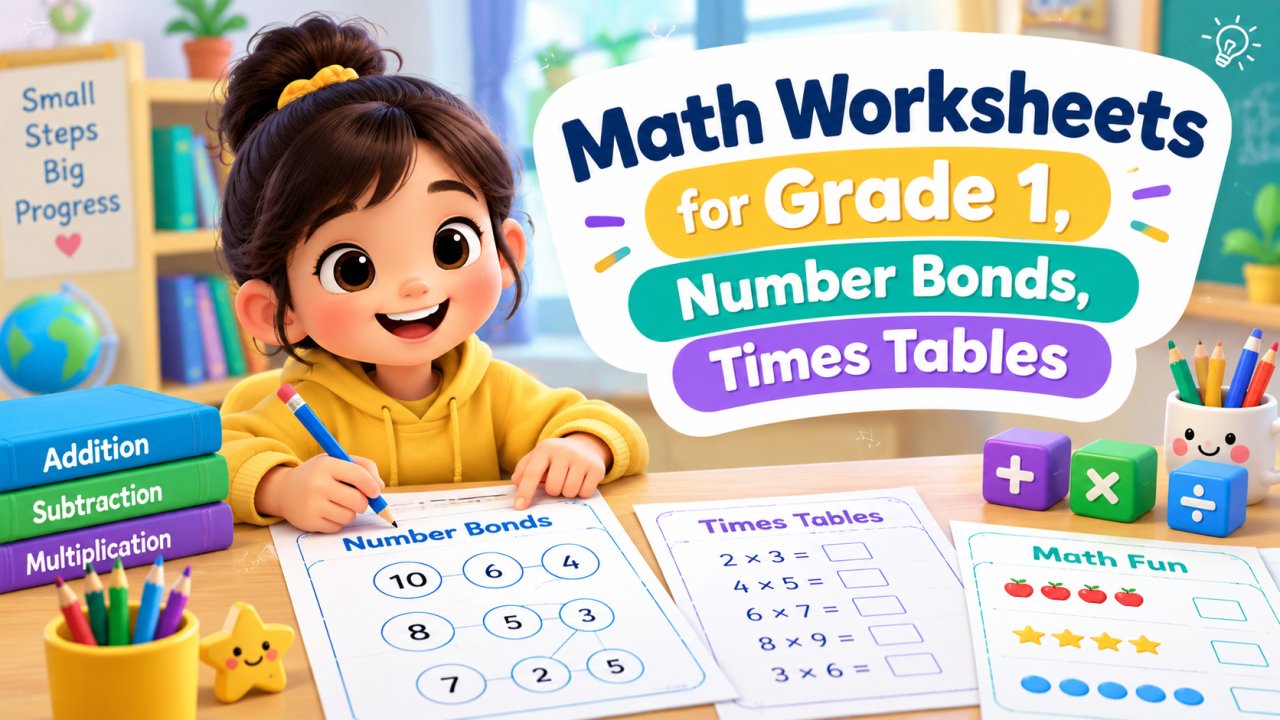
Help Grade 1 children build strong math skills with simple worksheets covering number bonds, addition, counting, and early times tables practice.
Math Worksheets for Grade 1: Number Bonds, Times Tables and Easy Math Practice
Learning math becomes easier when children get regular opportunities to practice one skill at a time. Math worksheets for Grade 1 can help children strengthen basic number skills, understand simple addition, recognize number relationships, and begin learning early multiplication patterns.
At Grade 1 level, children are developing their confidence with numbers. A worksheet should not feel like a difficult test. Instead, it should provide short, manageable activities that allow children to practice what they have learned in class or at home.
This guide focuses on important early math skills, including number bonds, counting, addition, subtraction, number patterns, and beginner-friendly times tables practice.
Why Math Worksheets Matter in Grade 1
Grade 1 is an important stage for building a strong foundation in mathematics.
Children begin moving beyond simply recognizing numbers. They start to understand how numbers relate to each other and how they can be combined, separated, compared, and grouped.
For example, a child may know that:
5 + 3 = 8
With practice, the child can also begin to understand that:
- Worksheets & Activities
- for parents
- 5 and 3 make 8.
- 8 can be split into 5 and 3.
- 3 + 5 also makes 8.
- 8 is 2 more than 6.
- Two groups of 4 make 8.
-> What does a Nursery child actually get?
These connections become useful when children move on to more advanced addition, subtraction, multiplication, and problem-solving.
What Makes a Good Grade 1 Math Worksheet?
A useful worksheet should:
- Focus on one clear skill.
- Use simple instructions.
- Provide enough practice without overwhelming the child.
- Use age-appropriate numbers.
- Give children enough space to write.
- Move gradually from easy questions to more challenging ones.
- Encourage understanding instead of guessing.
Worksheets are most useful when they support teaching and hands-on learning rather than replacing them.
What Are Number Bonds?
Number bonds are a simple way to show how numbers can be combined to make another number.
For example:
4 + 6 = 10
Here, 4 and 6 are the parts, while 10 is the whole.
A number bond can be represented like this:
| Part | Part | Whole |
|---|---|---|
| 4 | 6 | 10 |
Children can also understand the same relationship through subtraction:
10 - 4 = 6
This helps children see that addition and subtraction are connected.
Simple Number Bond Examples
Here are some beginner-friendly examples:
- 1 + 4 = 5
- 2 + 3 = 5
- 5 + 5 = 10
- 6 + 4 = 10
- 7 + 3 = 10
- 8 + 2 = 10
The goal is not simply to memorize answers. Children should gradually understand that a number can be made using different combinations.
For example, 10 can be made using:
- 1 + 9
- 2 + 8
- 3 + 7
- 4 + 6
- 5 + 5
Understanding these combinations can make mental addition easier later.
Why Number Bonds Are Useful
Number bonds help children develop number sense.
Instead of seeing numbers as separate objects, children begin to recognize relationships between them.
For example, if a child knows:
7 + 3 = 10
they can use that knowledge to solve:
7 + 4
They may think:
7 + 3 = 10, and 1 more makes 11.
This type of thinking helps children move away from counting every object individually.
Number Bonds and Addition Practice
A simple worksheet can ask children to complete missing numbers.
| Question | Answer |
|---|---|
| 3 + __ = 10 | 7 |
| 6 + __ = 10 | 4 |
| __ + 2 = 10 | 8 |
| 5 + __ = 10 | 5 |
These questions are simple, but they encourage children to think about the relationship between numbers.
Beginner-Friendly Math Skills for Grade 1
Number bonds are only one part of early mathematics. Grade 1 children can also practice several other foundational skills.
1. Counting
Counting helps children build an understanding of numbers and their order.
Practice can include:
- Counting from 1 to 20.
- Counting from 1 to 50.
- Counting forward.
- Counting backward.
- Counting objects.
- Filling in missing numbers.
For example:
1, 2, 3, __, 5
Answer: 4
Another example:
10, 11, __, 13, 14
Answer: 12
2. Number Recognition
Children should become comfortable recognizing numbers in different forms.
For example, the number 7 can be represented as:
- The numeral 7.
- Seven dots.
- Seven objects.
- 5 + 2.
- 6 + 1.
This helps children connect written numbers with quantities and mathematical relationships.
3. Addition
Simple addition worksheets can give children regular practice with small numbers.
Examples include:
- 2 + 3 = __
- 4 + 1 = __
- 5 + 2 = __
- 6 + 3 = __
- 7 + 2 = __
At first, children can use counters, fingers, drawings, or other objects to understand the problems.
With practice, they can begin solving more questions mentally.
4. Subtraction
Subtraction can be introduced as taking away or finding the difference.
For example:
8 - 3 = 5
A child can imagine having eight objects and removing three.
A worksheet might include:
| Problem | Answer |
|---|---|
| 5 - 2 | 3 |
| 7 - 1 | 6 |
| 8 - 3 | 5 |
| 9 - 4 | 5 |
| 10 - 6 | 4 |
Visual support can be helpful when children are first learning subtraction.
Introducing Times Tables in Grade 1
Times tables are usually taught more formally as children progress through elementary mathematics. However, Grade 1 children can begin learning the ideas behind multiplication through counting patterns, repeated addition, and equal groups.
For young learners, the focus should be on understanding groups rather than expecting them to memorize many multiplication facts immediately.
For example:
2 + 2 + 2 = 6
can be understood as:
3 groups of 2 = 6
This creates a natural connection between addition and multiplication.
Early Times Tables Practice
Children can begin with simple counting patterns.
Counting by 2s
2, 4, 6, 8, 10
Counting by 5s
5, 10, 15, 20, 25
Counting by 10s
10, 20, 30, 40, 50
These patterns provide an early foundation for multiplication.
Number Bonds vs. Times Tables
Number bonds and times tables are different skills, but both help children understand relationships between numbers.
| Skill | Main Idea | Example |
|---|---|---|
| Number bonds | Parts make a whole | 4 + 6 = 10 |
| Addition | Combining quantities | 3 + 5 = 8 |
| Subtraction | Taking away or finding a difference | 9 - 4 = 5 |
| Counting patterns | Counting in equal steps | 2, 4, 6, 8 |
| Early multiplication | Equal groups | 3 groups of 2 = 6 |
The important thing is to introduce each concept at a pace the child can understand.
How to Use Math Worksheets at Home
Parents do not need to turn worksheet practice into a long study session.
For many young children, short and regular practice can be easier to manage than completing a large number of questions at once.
Step 1: Choose One Skill
Start with one topic, such as number bonds to 10.
Avoid mixing too many new concepts together when the child is still learning the basics.
Step 2: Explain One Example
Before the child starts the worksheet, solve one question together.
For example:
6 + __ = 10
Explain that the missing number is 4 because 6 and 4 make 10.
Step 3: Let the Child Try
Give the child a few questions to solve independently.
If they make a mistake, ask them how they reached the answer rather than immediately giving them the correct answer.
Step 4: Review Together
Look at the completed questions together.
Celebrate correct thinking and gently explain any mistakes.
Step 5: Take a Break When Needed
Math practice should help build confidence.
If a child becomes tired or frustrated, a short break may be more useful than forcing them to finish every question.
Making Worksheets More Engaging
A worksheet does not have to be only a page of calculations.
Parents and teachers can combine worksheet practice with simple activities.
Use Everyday Objects
Use objects such as:
- Blocks
- Pencils
- Buttons
- Toy cars
- Coins
- Small pieces of fruit
For example, place 5 blocks on a table and add 3 more.
Ask:
How many blocks are there now?
This turns an abstract equation into something the child can see.
Use Drawings
Children can draw circles, stars, or other objects to represent numbers.
For example:
3 + 4 = ?
The child can draw three objects and then four more.
This visual approach can make addition easier to understand.
Use Number Lines
Number lines can be useful for both addition and subtraction.
For example, to solve:
5 + 3
Start at 5 and move forward three spaces:
5 → 6 → 7 → 8
Therefore:
5 + 3 = 8
Simple Grade 1 Worksheet Example
Here is a small practice set that can be used as a model for a Grade 1 math worksheet.
A. Complete the Number Bonds
- 2 + __ = 10
- 5 + __ = 10
- 7 + __ = 10
- __ + 3 = 10
- __ + 6 = 10
B. Solve the Addition
- 2 + 4 = __
- 3 + 5 = __
- 6 + 2 = __
- 4 + 4 = __
- 7 + 1 = __
C. Continue the Pattern
- 2, 4, 6, __, __
- 5, 10, 15, __, __
- 10, 20, 30, __, __
These activities introduce several important ideas without making the worksheet unnecessarily difficult.
Tips for Parents and Teachers
When using math worksheets for Grade 1, keep the learning experience positive and manageable.
Do
- Start with skills the child already understands.
- Introduce one new idea at a time.
- Use pictures and objects when helpful.
- Ask children to explain their thinking.
- Give children time to solve problems.
- Repeat difficult concepts on another day.
- Combine worksheets with hands-on activities.
Avoid
- Giving extremely long worksheets.
- Expecting instant answers.
- Treating every mistake as a failure.
- Introducing advanced multiplication before the child understands grouping.
- Comparing one child's progress with another child's progress.
Children can develop mathematical skills at different rates, so regular practice should focus on understanding and progress.
What Children Can Practice Through Grade 1 Math Worksheets
Age-appropriate worksheet activities can give children opportunities to practice:
- Number recognition
- Counting
- Addition
- Subtraction
- Number bonds
- Number patterns
- Equal groups
- Early multiplication concepts
- Mental math
- Basic problem-solving
The goal is not to complete as many questions as possible.
The goal is to help children understand numbers and become more comfortable using them.
A Simple Learning Progression
A practical progression can move from familiar concepts toward more challenging ones:
Counting → Number Recognition → Number Bonds → Addition → Subtraction → Counting Patterns → Equal Groups → Early Multiplication
Children can move back and forth between these skills as needed.
For example, if a child struggles with 3 × 2, going back to three groups of two objects may make the concept easier to understand.
That is why math worksheets should be used as part of a broader learning experience rather than as the only teaching method.
Internal Link Opportunities
When publishing this article, consider adding relevant internal links to pages such as:
- Grade 1 Learning Activities
- Printable Addition Worksheets
- Printable Subtraction Worksheets
- Number Recognition Activities
- Kids Learning Worksheets
- Early Multiplication Activities
Use descriptive anchor text instead of generic phrases such as "click here."
Article Details
Category: Math Worksheets / Educational Activities
Author: Superkids Team
Primary Keyword: Math Worksheets for Grade 1
Target Audience: Parents, teachers, and Grade 1 learners
Search Intent: Informational
Advanced Math Practice for Grade 1
Once children are comfortable with counting, simple addition, subtraction, and number bonds, they can begin connecting these skills in new ways.
The next step is not simply giving harder questions. It is helping children understand how familiar skills work together.
For example, a child who understands that:
5 + 5 = 10
can begin using the same idea to understand:
10 - 5 = 5
Later, the child can connect equal groups with repeated addition:
5 + 5 + 5 = 15
and eventually:
3 × 5 = 15
This gradual progression helps make multiplication less confusing when formal times tables are introduced.
How to Build Number Bond Skills
Number bonds can be practiced with different target numbers.
Start with smaller numbers before moving to larger ones.
Number Bonds to 5
| Part | Part | Whole |
|---|---|---|
| 1 | 4 | 5 |
| 2 | 3 | 5 |
| 3 | 2 | 5 |
| 4 | 1 | 5 |
Ask children to find the missing part.
Examples:
- 1 + __ = 5
- 2 + __ = 5
- __ + 3 = 5
- __ + 4 = 5
Number Bonds to 10
Once children are comfortable with smaller numbers, practice combinations that make 10.
| Part | Part | Whole |
|---|---|---|
| 1 | 9 | 10 |
| 2 | 8 | 10 |
| 3 | 7 | 10 |
| 4 | 6 | 10 |
| 5 | 5 | 10 |
A child can practice these combinations in different forms:
- 3 + __ = 10
- __ + 7 = 10
- 10 - 4 = __
- 10 - __ = 6
Changing the question format encourages children to understand the relationship instead of memorizing only one pattern.
Using Number Bonds to Improve Mental Math
Number bonds can support simple mental math strategies.
Suppose a child needs to solve:
8 + 5
Instead of counting from 1, the child can use a number bond.
They know:
8 + 2 = 10
There are 3 left from the 5.
So:
10 + 3 = 13
Therefore:
8 + 5 = 13
This type of thinking becomes increasingly useful as children work with larger numbers.
Introducing Equal Groups
Before asking a Grade 1 child to memorize multiplication facts, introduce the idea of equal groups.
For example:
● ● ● ● ● ●
There are three groups.
Each group has two objects.
So there are:
3 groups of 2 = 6
This can also be written as repeated addition:
2 + 2 + 2 = 6
This gives children a visual connection between grouping, addition, and multiplication.
Equal Groups Worksheet Example
Ask children to count the objects and complete the sentence.
Group 1: ● ●
Group 2: ● ●
Group 3: ● ●
There are:
3 groups of 2
Total:
6
Another example:
▲ ▲ ▲ ▲ ▲ ▲
There are:
2 groups of 3 = 6
These activities can be easier for beginners than starting with multiplication symbols.
Early Times Tables Practice
When introducing times tables, start with patterns that are easy to see.
2 Times Table
The 2s pattern increases by 2 each time.
| Multiplication | Answer |
|---|---|
| 1 × 2 | 2 |
| 2 × 2 | 4 |
| 3 × 2 | 6 |
| 4 × 2 | 8 |
| 5 × 2 | 10 |
Children can also practice the same pattern through counting:
2, 4, 6, 8, 10
5 Times Table
The 5s pattern increases by 5.
| Multiplication | Answer |
|---|---|
| 1 × 5 | 5 |
| 2 × 5 | 10 |
| 3 × 5 | 15 |
| 4 × 5 | 20 |
| 5 × 5 | 25 |
Counting by 5s can help children recognize the pattern:
5, 10, 15, 20, 25
10 Times Table
Counting by 10s is another useful early pattern.
| Multiplication | Answer |
|---|---|
| 1 × 10 | 10 |
| 2 × 10 | 20 |
| 3 × 10 | 30 |
| 4 × 10 | 40 |
| 5 × 10 | 50 |
The purpose at this stage is to develop understanding and familiarity, not to pressure children into memorizing every multiplication fact.
Practical Tip: Connect Multiplication to Real Life
Children often understand multiplication more easily when they can see it around them.
For example:
There are 3 plates.
Each plate has 2 cookies.
How many cookies are there altogether?
The child can draw:
2 + 2 + 2 = 6
Then introduce:
3 × 2 = 6
Another example:
There are 4 boxes.
Each box has 5 pencils.
That creates:
5 + 5 + 5 + 5 = 20
and:
4 × 5 = 20
Real-world examples make mathematical symbols easier to understand.
Choosing the Right Difficulty Level
Not every Grade 1 child should work on the same worksheet.
A child who is still learning numbers up to 10 may need simple activities such as:
- Counting objects
- Number matching
- Number bonds to 5
- Addition within 10
A child who is comfortable with those skills may be ready for:
- Number bonds to 10
- Addition within 20
- Subtraction within 20
- Counting by 2s, 5s, and 10s
- Simple equal-group activities
A Simple Difficulty Guide
| Level | Suggested Practice |
|---|---|
| Beginner | Counting and number recognition |
| Developing | Number bonds and addition |
| Intermediate | Addition and subtraction combinations |
| Moving Forward | Number patterns and equal groups |
| Early Multiplication | Repeated addition and simple times tables |
The exact progression can vary depending on the child's learning needs and the curriculum being followed.
Worksheet Design: Keep Questions Clear
A well-designed worksheet should make it obvious what the child needs to do.
Instead of giving a page filled with unrelated questions, group similar activities together.
For example:
Section A: Number Bonds
- 2 + __ = 10
- 6 + __ = 10
- __ + 4 = 10
- 8 + __ = 10
Section B: Addition
- 3 + 2 = __
- 4 + 5 = __
- 6 + 3 = __
- 7 + 2 = __
Section C: Counting Patterns
- 2, 4, 6, __, __
- 5, 10, 15, __, __
- 10, 20, 30, __, __
This structure makes the activity easier to follow.
Comparison: Different Types of Grade 1 Math Practice
| Activity | Main Purpose | Best Used For |
|---|---|---|
| Number bonds | Understanding number relationships | Addition and subtraction |
| Counting worksheets | Number order and recognition | Early number skills |
| Addition worksheets | Combining quantities | Basic arithmetic |
| Subtraction worksheets | Taking away and comparing | Basic arithmetic |
| Number pattern worksheets | Recognizing sequences | Number sense |
| Equal-group activities | Understanding groups | Early multiplication |
| Times table practice | Building multiplication familiarity | Later foundational practice |
Using a mixture of activities can give children opportunities to approach math from different directions.
Pros and Cons of Math Worksheets
Pros
- Easy to organize.
- Simple to repeat.
- Useful for independent practice.
- Can focus on one specific skill.
- Helpful for reviewing classroom lessons.
- Can show which questions a child finds difficult.
- Easy for parents and teachers to check.
Cons
- Too many questions can make children tired.
- Worksheets alone may not provide enough hands-on learning.
- Some children may focus on finishing rather than understanding.
- Repetitive activities can become boring.
- A worksheet may not explain a concept as clearly as a teacher or parent can.
The best approach is to combine worksheets with conversation, examples, games, objects, drawings, and other learning activities.
Common Mistakes When Teaching Grade 1 Math
Mistake 1: Moving Too Quickly
A child may be ready to count but not yet ready to memorize multiplication facts.
Give the child time to understand the underlying idea.
Mistake 2: Focusing Only on Correct Answers
An answer can be correct even when the child does not understand why it is correct.
Ask questions such as:
- How did you get that answer?
- Can you show it with objects?
- Can you draw it?
- Can you solve it another way?
Mistake 3: Giving Too Much Practice at Once
A long worksheet does not automatically provide better learning.
A shorter worksheet with thoughtful questions can be more useful.
Mistake 4: Introducing Multiplication Without Groups
Writing:
3 × 2 = 6
may not mean much to a beginner.
Showing three groups of two objects gives the equation meaning.
Mistake 5: Ignoring Mistakes
Mistakes can show which concept needs more practice.
Instead of simply marking an answer wrong, help the child understand the step where the confusion happened.
Best Practices for Grade 1 Math Worksheets
Keep Instructions Short
Use simple instructions such as:
- Count and write.
- Fill in the missing number.
- Add the numbers.
- Take away.
- Complete the pattern.
- Match the numbers.
- Count the groups.
Use Enough White Space
Children need room to write their answers.
Crowded worksheets can make even simple problems harder to follow.
Mix Familiar and New Questions
A worksheet can begin with questions the child already understands and then introduce a few questions that require more thought.
For example:
- 2 + 2 = __
- 3 + 3 = __
- 5 + 2 = __
- 7 + __ = 10
This gradual increase can help children feel confident while still challenging their thinking.
Review Incorrect Answers
After the worksheet is finished, spend a few minutes reviewing mistakes.
The review can be more valuable than simply checking the final score.
A Practical Weekly Math Practice Plan
A simple weekly routine can help children practice different skills without making every session feel the same.
| Day | Suggested Activity |
|---|---|
| Monday | Number recognition and counting |
| Tuesday | Number bonds |
| Wednesday | Addition and subtraction |
| Thursday | Counting by 2s, 5s, and 10s |
| Friday | Equal groups and early multiplication |
| Weekend | Math games or real-life math activities |
The schedule can be adjusted according to the child's school lessons and individual needs.
How Parents Can Support Worksheet Learning
Parents do not need to be math experts to support early practice.
Simple questions can encourage children to explain their thinking.
Instead of asking only:
"What is the answer?"
try:
- "How did you find it?"
- "Can you show me?"
- "What number comes next?"
- "Can you make 10 another way?"
- "How many groups do you see?"
- "What happens if we add one more?"
These questions encourage children to think about the process behind the answer.
When a Child Finds a Worksheet Difficult
If a child struggles with several questions, do not immediately move to a much harder worksheet.
Go back to the basic concept.
For number bonds, use objects.
For addition, use a number line.
For subtraction, physically remove objects.
For multiplication, make equal groups.
For counting patterns, say the sequence aloud together.
After the concept becomes clearer, return to a few worksheet questions.
Printable Math Worksheets: What to Look For
If you are choosing printable math worksheets for Grade 1, check whether they:
- Match the child's current level.
- Have clear instructions.
- Use readable text.
- Provide enough writing space.
- Focus on a specific skill.
- Include age-appropriate numbers.
- Avoid unnecessary visual clutter.
- Allow children to practice independently.
- Can be reviewed easily by an adult.
A worksheet should support learning rather than make the page itself difficult to understand.
Example: From Number Bonds to Multiplication
One useful way to connect skills is to show how a child can move from one concept to another.
Start with:
5 + 5 = 10
Then show:
5 + 5 + 5 = 15
Now explain that there are three groups of 5.
So:
3 × 5 = 15
The child can see that multiplication is connected to repeated addition.
This connection can make future times table practice more meaningful.
Actionable Practice Ideas
Try these simple activities during worksheet sessions:
Activity 1: Make 10
Give the child a number from 1 to 9.
Ask:
"What number do we need to make 10?"
If the number is 7:
7 + 3 = 10
Activity 2: Count in Groups
Place objects into equal groups.
For example:
● ● | ● ● | ● ●
Ask:
- How many groups?
- How many objects in each group?
- How many objects altogether?
Activity 3: Complete the Pattern
Write:
2, 4, 6, __, __
Then:
5, 10, 15, __, __
Then:
10, 20, 30, __, __
Activity 4: Create Your Own Number Bond
Give the child the whole number:
10
Ask them to find as many pairs as possible:
- 1 + 9
- 2 + 8
- 3 + 7
- 4 + 6
- 5 + 5
This can turn worksheet practice into a small problem-solving activity.
The Role of Repetition
Repetition can be useful in math, but it should be purposeful.
If a child is learning number bonds to 10, seeing several different questions involving the same relationships can help reinforce the concept.
However, repeating exactly the same type of question too many times may become frustrating or boring.
Try changing the format:
6 + __ = 10
Then:
__ + 4 = 10
Then:
10 - 6 = __
The underlying relationship is the same, but the child has to think about it in a different way.
Building Confidence Alongside Math Skills
Confidence matters because children who feel comfortable making mistakes are often more willing to try unfamiliar problems.
Keep feedback specific.
Instead of saying only:
"Good job."
you can say:
"You used the number bond to find the missing number."
Or:
"You counted the groups correctly before solving the problem."
Specific feedback tells children what they did successfully.
Final Tips for Using Grade 1 Math Worksheets
Keep the process simple:
- Choose one appropriate skill.
- Explain one example.
- Let the child try.
- Encourage them to explain their thinking.
- Review mistakes calmly.
- Use objects or drawings when needed.
- Stop when the child becomes tired.
- Return to the skill again later.
With this approach, math worksheets can become a useful part of regular learning without turning practice into unnecessary pressure.
Conclusion
Math worksheets for Grade 1 can give children regular practice with the number skills they need for later mathematics. Number bonds, counting, addition, subtraction, number patterns, equal groups, and early times tables can all be introduced gradually and practiced in simple ways.
The most useful worksheet is not necessarily the longest one. A good worksheet focuses on a clear learning goal, uses age-appropriate questions, and gives children enough space and time to think.
Number bonds can help children understand how numbers fit together. Counting patterns can prepare them for multiplication. Equal-group activities can show what multiplication means before children begin memorizing times tables.
Parents and teachers can make worksheet practice more effective by combining it with objects, drawings, number lines, games, and conversations about how children found their answers.
With regular, manageable practice, Grade 1 children can build a stronger understanding of numbers while becoming more comfortable solving math problems independently.
Call To Action
Ready to make Grade 1 math practice easier?
Explore our collection of kid-friendly math worksheets for number bonds, addition, subtraction, counting, number patterns, and early times tables. Choose activities that match your child's current level and practice one skill at a time.
Start with a simple worksheet today and help your child build stronger math skills through regular, enjoyable practice.
1. What are math worksheets for Grade 1?
Math worksheets for Grade 1 are practice activities designed to help young children develop foundational math skills. They may include counting, number recognition, addition, subtraction, number bonds, number patterns, and introductory multiplication activities.
2. What are number bonds in Grade 1 math?
Number bonds show how two or more numbers combine to make a whole number. For example, 6 and 4 are number partners that make 10 because 6 + 4 = 10. They help children understand relationships between numbers.
3. How can Grade 1 children practice number bonds?
Children can practice number bonds by completing missing-number questions, using objects, drawing pictures, or finding different pairs that make the same whole number. For example, children can find different pairs that make 10.
4. Should Grade 1 children learn times tables?
Grade 1 children can begin developing early multiplication skills through counting patterns, repeated addition, and equal groups. Formal times-table expectations vary by curriculum and school, so practice should match the child's learning stage.
5. Which times tables can children practice first?
Simple counting patterns such as 2s, 5s, and 10s can provide an early introduction to multiplication. Children can practice sequences such as 2, 4, 6, 8 and 5, 10, 15, 20 before moving toward more formal multiplication practice.
6. How often should Grade 1 children use math worksheets?
The amount of worksheet practice can vary depending on the child's age, schoolwork, attention span, and learning needs. Short, regular practice is often easier to manage than completing a large number of questions in one session.
7. Are printable math worksheets useful for Grade 1?
Printable math worksheets can be useful for reviewing skills, practicing specific concepts, and giving children independent work. They work best when combined with explanations, hands-on activities, and other forms of math practice.
8. How can parents make math worksheets more fun?
Parents can combine worksheets with blocks, toys, drawings, number lines, counting games, and everyday examples. Asking children to explain how they found an answer can also turn worksheet practice into a conversation about math.
9. What should a Grade 1 math worksheet include?
A Grade 1 math worksheet should have clear instructions, age-appropriate numbers, enough writing space, and questions focused on a specific skill. Depending on the child's level, it may include counting, number bonds, addition, subtraction, patterns, equal groups, or early multiplication.
10. How can number bonds help with addition?
Number bonds help children recognize combinations that make a whole number. Knowing facts such as 7 + 3 = 10 can help children use 10 as a helpful reference when solving other addition problems, such as 7 + 4.