Math Word Problems for Grade 1 With Answers: 30 Easy Practice Questions
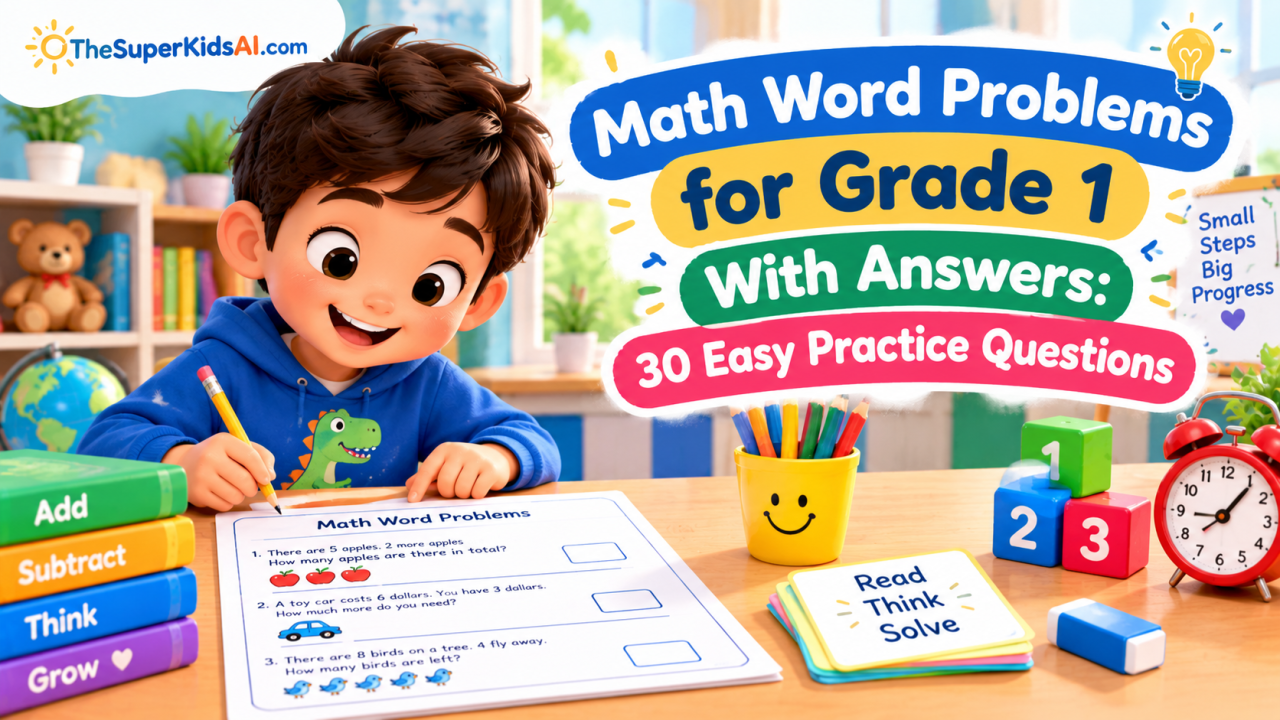
Practice 30 easy math word problems for Grade 1 with answers. Help children solve addition, subtraction, comparison, and everyday math problems step by step.
Math Word Problems for Grade 1 With Answers: 30 Easy Practice Questions
Math word problems help children use numbers in real-life situations. Instead of only solving number sentences, children learn to read a short story, find the important information, choose an operation, and solve the problem.
This collection of math word problems for Grade 1 with answers gives children simple practice with addition, subtraction, comparing numbers, and everyday situations. The problems use familiar examples such as toys, fruits, books, pencils, snacks, and classroom objects.
The goal is not just to find the answer. Children should also learn how to think about a problem.
What Are Math Word Problems?
A math word problem is a short story that includes numbers and asks a mathematical question.
For example:
Mia has 4 apples. Her mother gives her 3 more apples. How many apples does Mia have now?
A child needs to understand the story before solving it.
The child can think:
- Mia starts with 4 apples.
- She gets 3 more.
- The number is getting bigger.
- So, addition is needed.
- 4 + 3 = 7.
Answer: Mia has 7 apples.
This simple process builds both reading and math skills.
Worksheets & Activities
- Learning worlds to explore
- Number Ninjas
- Brain Boosters
- Puzzle Path
- Word Wizards
- Art Studio
- Story Land
Why Are Word Problems Important for Grade 1?
First graders are beginning to connect mathematics with everyday experiences. Word problems give them a chance to use math in meaningful situations.
They help children practice:
- Addition
- Subtraction
- Number sense
- Comparing quantities
- Reading carefully
- Identifying important information
- Choosing the correct operation
- Explaining an answer
- Logical thinking
- Everyday problem-solving
A child may know that 6 + 4 = 10, but a word problem asks the child to recognize when 6 + 4 is the right calculation.
That extra step is an important part of mathematical thinking.
How to Solve a Grade 1 Math Word Problem
Teach children to use a simple routine.
Step 1: Read the problem
Read the whole problem slowly.
Step 2: Find the numbers
Look for the numbers that provide useful information.
Step 3: Ask what is happening
Is something being added?
Is something being taken away?
Are two groups being compared?
Step 4: Choose the operation
For many Grade 1 problems, the operation will be:
- Addition (+)
- Subtraction (−)
Step 5: Solve
Write a number sentence and calculate.
Step 6: Check the answer
Ask:
Does my answer make sense?
This routine can help children become more independent problem solvers.
Addition Word Problems for Grade 1
Addition word problems usually describe situations where quantities are put together or something is added to an existing group.
1. Apples in a Basket
Emma has 5 apples. Her father gives her 3 more apples.
How many apples does Emma have now?
Solution
5 + 3 = 8
Answer: Emma has 8 apples.
2. Toy Cars
Sam has 4 toy cars. He gets 2 more toy cars for his birthday.
How many toy cars does Sam have altogether?
Solution
4 + 2 = 6
Answer: Sam has 6 toy cars.
3. Classroom Books
There are 7 books on a table. The teacher puts 3 more books on the table.
How many books are there now?
Solution
7 + 3 = 10
Answer: There are 10 books.
4. Red and Blue Balloons
A party has 6 red balloons and 4 blue balloons.
How many balloons are there altogether?
Solution
6 + 4 = 10
Answer: There are 10 balloons altogether.
5. Pencils
Riya has 3 pencils. Her teacher gives her 5 more pencils.
How many pencils does Riya have now?
Solution
3 + 5 = 8
Answer: Riya has 8 pencils.
6. Birds in a Tree
There are 4 birds sitting in a tree. Then 3 more birds join them.
How many birds are in the tree now?
Solution
4 + 3 = 7
Answer: There are 7 birds in the tree.
7. Stickers
Arjun has 8 stickers. His friend gives him 2 more.
How many stickers does Arjun have now?
Solution
8 + 2 = 10
Answer: Arjun has 10 stickers.
8. Cookies
Mom puts 5 cookies on a plate. Then she adds 4 more cookies.
How many cookies are on the plate?
Solution
5 + 4 = 9
Answer: There are 9 cookies on the plate.
9. Flowers
A garden has 3 yellow flowers and 6 pink flowers.
How many flowers are there altogether?
Solution
3 + 6 = 9
Answer: There are 9 flowers altogether.
10. Blocks
Leo builds a tower with 7 blocks. He adds 2 more blocks.
How many blocks are in the tower now?
Solution
7 + 2 = 9
Answer: There are 9 blocks in the tower.
Subtraction Word Problems for Grade 1
Subtraction word problems often describe something being taken away, used, eaten, given away, or removed.
Children can look for clues such as:
- left
- remain
- take away
- gave away
- used
- eaten
- fewer
However, children should understand the story rather than simply search for a keyword.
11. Balloons
Tom has 9 balloons. Three balloons pop.
How many balloons are left?
Solution
9 − 3 = 6
Answer: 6 balloons are left.
12. Bananas
There are 8 bananas in a basket. The family eats 2 bananas.
How many bananas are left?
Solution
8 − 2 = 6
Answer: 6 bananas are left.
13. Toy Blocks
Ava has 10 blocks. She gives 4 blocks to her brother.
How many blocks does Ava have left?
Solution
10 − 4 = 6
Answer: Ava has 6 blocks left.
14. Library Books
There are 9 books on a shelf. A teacher takes 3 books away.
How many books remain on the shelf?
Solution
9 − 3 = 6
Answer: 6 books remain.
15. Pencils
Kabir has 7 pencils. He gives 2 pencils to a friend.
How many pencils does Kabir have left?
Solution
7 − 2 = 5
Answer: Kabir has 5 pencils left.
16. Cupcakes
There are 10 cupcakes on a tray. The children eat 4 cupcakes.
How many cupcakes are left?
Solution
10 − 4 = 6
Answer: 6 cupcakes are left.
17. Fish
There are 8 fish in a pond. Two fish swim behind some plants and cannot be seen.
How many fish can you see now?
Solution
8 − 2 = 6
Answer: You can see 6 fish now.
18. Crayons
Nina has 9 crayons. She loses 3 crayons.
How many crayons does she have now?
Solution
9 − 3 = 6
Answer: Nina has 6 crayons now.
19. Balloons at a Party
There are 10 balloons. Five balloons are given to the children.
How many balloons are left?
Solution
10 − 5 = 5
Answer: 5 balloons are left.
20. Storybooks
Rahul has 8 storybooks. He gives 3 books to his cousin.
How many storybooks does Rahul have left?
Solution
8 − 3 = 5
Answer: Rahul has 5 storybooks left.
Mixed Addition and Subtraction Word Problems
Once children understand basic addition and subtraction stories, give them mixed problems.
The important skill here is deciding which operation to use.
21. Toy Animals
Maya has 5 toy animals. She gets 3 more.
How many toy animals does she have now?
Solution
5 + 3 = 8
Answer: Maya has 8 toy animals.
22. Oranges
There are 10 oranges in a basket. Dad takes 3 oranges.
How many oranges are left?
Solution
10 − 3 = 7
Answer: 7 oranges are left.
23. Children on the Playground
There are 6 children playing on the playground. Four more children join them.
How many children are playing now?
Solution
6 + 4 = 10
Answer: 10 children are playing now.
24. Marbles
Dev has 9 marbles. He gives 5 marbles to his friend.
How many marbles does Dev have left?
Solution
9 − 5 = 4
Answer: Dev has 4 marbles left.
25. Books in a Bag
Sara puts 4 books into her school bag. Then she puts 3 more books inside.
How many books are in her bag?
Solution
4 + 3 = 7
Answer: There are 7 books in her bag.
Comparison Word Problems for Grade 1
Comparison problems help children understand ideas such as:
- More
- Fewer
- Greater
- Less
- Difference
These problems are useful for developing number sense.
26. Comparing Pencils
Aarav has 8 pencils. Ben has 5 pencils.
Who has more pencils?
Solution
8 is greater than 5.
Answer: Aarav has more pencils.
27. Comparing Stickers
Mia has 7 stickers. Zoe has 4 stickers.
How many more stickers does Mia have than Zoe?
Solution
7 − 4 = 3
Answer: Mia has 3 more stickers than Zoe.
28. Comparing Apples
There are 9 red apples and 6 green apples.
How many fewer green apples are there than red apples?
Solution
9 − 6 = 3
Answer: There are 3 fewer green apples.
29. Comparing Toys
Rohan has 6 toy cars. His sister has 9 toy cars.
Who has more toy cars, and how many more?
Solution
9 − 6 = 3
Answer: His sister has 3 more toy cars.
30. Comparing Books
A classroom has 10 picture books and 7 storybooks.
How many more picture books are there than storybooks?
Solution
10 − 7 = 3
Answer: There are 3 more picture books.
A Simple Word Problem Strategy for Young Children
Children may sometimes know how to add or subtract but still struggle with word problems.
A simple visual strategy can help.
Write the problem and ask the child to identify three things:
What do I know?
What do I need to find?
What should I do?
For example:
Liam has 6 pencils. His teacher gives him 2 more pencils. How many pencils does he have now?
What do I know?
Liam has 6 pencils.
He gets 2 more.
What do I need to find?
The total number of pencils.
What should I do?
Add.
6 + 2 = 8
Answer: Liam has 8 pencils.
This approach encourages children to understand the situation before calculating.
Use Pictures to Teach Word Problems
Pictures can make Grade 1 word problems easier to understand.
Suppose the problem says:
There are 5 birds. Two more birds fly into the tree. How many birds are there now?
A child can draw:
🐦 🐦 🐦 🐦 🐦
Then add:
🐦 🐦
Now count all the birds.
5 + 2 = 7
Pictures help children connect the story to the numbers.
They are especially useful for children who are still developing reading skills.
Use Objects for Hands-On Practice
You do not always need a worksheet.
Use objects that are already available at home or in the classroom.
Try:
- Blocks
- Buttons
- Pencils
- Crayons
- Toy cars
- Small balls
- Bottle caps
- Coins used for learning
- LEGO-style building pieces
For example:
Give a child 6 blocks.
Then say:
"I am giving you 3 more blocks. How many do you have now?"
Let the child physically add the blocks and count the total.
Hands-on practice can make the meaning of addition and subtraction clearer.
How Parents Can Practice Word Problems at Home
Parents can turn everyday activities into short math problems.
During snack time
"If you have 4 grapes and I give you 2 more, how many grapes do you have?"
During cleanup
"There are 8 toys on the floor. We put away 3. How many are still on the floor?"
While shopping
"There are 5 apples in the basket. We add 2 more. How many apples are there?"
During play
"You have 7 toy cars. If you give me 2, how many do you have left?"
These quick questions take only a few minutes but provide useful practice.
Tips for Teaching Grade 1 Word Problems
1. Start With Small Numbers
Begin with numbers that children can easily count.
Numbers from 0 to 10 are often a good starting point for early practice.
Move toward numbers up to 20 as the child becomes comfortable.
2. Use Familiar Situations
Children understand problems more easily when the context is familiar.
Use examples involving:
- Family
- School
- Toys
- Food
- Animals
- Friends
- Games
3. Let Children Draw
A drawing can help a child understand what is happening.
Do not worry if the picture is not perfect.
The goal is to represent the math.
4. Ask Children to Explain
Instead of asking only:
"What is the answer?"
also ask:
"How did you get your answer?"
A child might say:
"I had 5, then I added 3, so I counted 6, 7, 8."
That explanation shows understanding.
5. Do Not Focus Only on Keywords
Words such as "more" and "left" can provide clues, but children should understand the entire story.
For example, a problem can contain the word "more" without requiring simple addition.
Teach children to ask:
What is happening in the problem?
This is more useful than memorizing keyword rules.
6. Keep Practice Short
Grade 1 children do not need long sessions.
Try 5 to 10 word problems at a time, depending on the child's ability and attention.
Stop before practice becomes frustrating.
Common Mistakes Children Make
Mistake 1: Choosing an operation without reading
A child may automatically add every problem.
Solution: Ask, "Did something get added or taken away?"
Mistake 2: Using every number
Sometimes children use numbers simply because they appear in the story.
Solution: Ask which numbers actually help answer the question.
Mistake 3: Forgetting the question
Children may solve a calculation but not answer what was asked.
Solution: Have them read the final question again.
Mistake 4: Giving only a number
A child may write "7" without showing what it represents.
Solution: Encourage a complete answer such as:
"There are 7 books."
Mistake 5: Rushing
Some children see numbers and immediately calculate.
Solution: Teach them to pause and explain what is happening first.
How to Make Grade 1 Word Problems More Fun
Word problems do not always have to look like worksheets.
Try turning them into games.
Mystery Problem
Read a problem aloud and let children decide whether they need addition or subtraction.
Draw It
Give a problem and ask the child to draw the situation before solving it.
Act It Out
Use toys or classroom objects to physically show the problem.
Make Your Own Problem
Give a child a number sentence such as:
6 + 3 = 9
Then ask the child to create a short story that matches it.
This is an excellent way to check whether the child understands what addition means.
What Grade 1 Students Should Practice
A strong Grade 1 word-problem routine can include:
| Skill | Example |
|---|---|
| Addition | 5 + 3 |
| Subtraction | 9 − 4 |
| Combining groups | 4 apples + 2 apples |
| Taking away | 8 toys − 3 toys |
| Comparing | 7 is 2 more than 5 |
| Finding the difference | 9 − 6 |
| Explaining an answer | "There are 7 books." |
| Drawing a model | Pictures showing the quantities |
Children do not need to master every type at once.
Start with simple situations and gradually increase the challenge.
A Quick Practice Routine
Try this 10-minute routine several times a week:
2 minutes: Read a simple word problem.
2 minutes: Identify the numbers and what is happening.
2 minutes: Choose addition or subtraction.
2 minutes: Solve using numbers, objects, or a drawing.
2 minutes: Explain and check the answer.
This short routine can build confidence without making math practice feel overwhelming.
Printable Word Problem Practice
These problems can also be turned into a simple worksheet.
For each question, leave space for:
- Draw or show your thinking
- Write the number sentence
- Write the answer
For example:
Problem:
There are 6 birds in a tree. Two more birds arrive. How many birds are there now?
My picture:
Number sentence:
6 + 2 = _____
Answer:
There are _____ birds.
This format helps children practice the complete problem-solving process rather than simply writing an answer.
Worksheets & Activities
More Math Word Problems for Grade 1 With Answers
The first set of problems introduced simple addition, subtraction, and comparison. Now children can practice more problem types while continuing to use the same basic strategy: read, understand, choose, solve, and check.
The problems below gradually add variety without making the language too difficult.
More Addition Word Problems
31. Crayons in a Box
A box has 6 crayons. The teacher puts 4 more crayons in the box.
How many crayons are in the box now?
Solution
6 + 4 = 10
Answer: There are 10 crayons in the box.
32. Children at the Park
There are 5 children playing at the park. Three more children arrive.
How many children are playing at the park now?
Solution
5 + 3 = 8
Answer: There are 8 children at the park.
33. Toy Trains
Jack has 7 toy trains. He gets 2 more toy trains.
How many toy trains does Jack have altogether?
Solution
7 + 2 = 9
Answer: Jack has 9 toy trains.
34. Mangoes
There are 4 mangoes in a basket. Mom puts 5 more mangoes in it.
How many mangoes are in the basket now?
Solution
4 + 5 = 9
Answer: There are 9 mangoes in the basket.
35. Stars
A worksheet has 3 stars at the top. A child draws 6 more stars.
How many stars are there altogether?
Solution
3 + 6 = 9
Answer: There are 9 stars altogether.
More Subtraction Word Problems
36. Candies
Priya has 10 candies. She gives 3 candies to her brother.
How many candies does Priya have left?
Solution
10 − 3 = 7
Answer: Priya has 7 candies left.
37. Ducks
There are 9 ducks near a pond. Four ducks walk away.
How many ducks are left?
Solution
9 − 4 = 5
Answer: 5 ducks are left.
38. Balloons
A child has 8 balloons. Two balloons fly away.
How many balloons are left?
Solution
8 − 2 = 6
Answer: 6 balloons are left.
39. Books
There are 10 books on a desk. A student takes 5 books.
How many books remain on the desk?
Solution
10 − 5 = 5
Answer: 5 books remain on the desk.
40. Biscuits
There are 7 biscuits on a plate. The children eat 3.
How many biscuits are left?
Solution
7 − 3 = 4
Answer: 4 biscuits are left.
More Comparison Word Problems
Comparison problems are useful because children learn that subtraction can show the difference between two quantities.
41. Pencils
Anaya has 9 pencils. Tara has 6 pencils.
How many more pencils does Anaya have?
Solution
9 − 6 = 3
Answer: Anaya has 3 more pencils.
42. Toy Cars
A box has 8 red toy cars and 5 blue toy cars.
How many more red toy cars are there?
Solution
8 − 5 = 3
Answer: There are 3 more red toy cars.
43. Books
A shelf has 7 picture books and 4 science books.
How many fewer science books are there than picture books?
Solution
7 − 4 = 3
Answer: There are 3 fewer science books.
44. Flowers
There are 10 roses and 6 lilies in a garden.
How many more roses are there than lilies?
Solution
10 − 6 = 4
Answer: There are 4 more roses.
45. Marbles
Aarav has 5 marbles. Rohan has 8 marbles.
Who has more marbles? How many more?
Solution
8 − 5 = 3
Answer: Rohan has 3 more marbles.
Missing Number Word Problems
Missing-number problems encourage children to think about the relationship between numbers.
They are a useful bridge between simple word problems and more advanced mathematical thinking.
46. Missing Number: Apples
There are 4 apples in a basket. Mom adds some more apples. Now there are 7 apples.
How many apples did Mom add?
Solution
4 + ___ = 7
7 − 4 = 3
Answer: Mom added 3 apples.
47. Missing Number: Toys
Ravi has some toy cars. His friend gives him 2 more. Now he has 8 toy cars.
How many toy cars did Ravi have at first?
Solution
___ + 2 = 8
8 − 2 = 6
Answer: Ravi had 6 toy cars at first.
48. Missing Number: Balloons
There are 9 balloons. Some balloons pop. Now 6 balloons remain.
How many balloons popped?
Solution
9 − ___ = 6
9 − 6 = 3
Answer: 3 balloons popped.
49. Missing Number: Pencils
A teacher has some pencils. She gives 3 pencils to a student. She has 5 pencils left.
How many pencils did she have at first?
Solution
___ − 3 = 5
5 + 3 = 8
Answer: The teacher had 8 pencils at first.
50. Missing Number: Cookies
There are 5 cookies on a plate. Some more cookies are added. Now there are 9 cookies.
How many cookies were added?
Solution
5 + ___ = 9
9 − 5 = 4
Answer: 4 cookies were added.
Beginner Two-Step Word Problems
Two-step problems can be introduced carefully when a Grade 1 child is comfortable with one-step problems.
A two-step problem asks children to solve one part before using that information for the next part.
Keep the numbers small and the language simple.
51. Apples and Oranges
Mia has 3 apples. Her mother gives her 2 more apples. Then Mia gives 1 apple to her brother.
How many apples does Mia have now?
Step 1
3 + 2 = 5
Mia has 5 apples.
Step 2
5 − 1 = 4
Answer: Mia has 4 apples now.
52. Toy Blocks
Sam has 4 blocks. He gets 3 more blocks. Then he gives 2 blocks to his sister.
How many blocks does Sam have now?
Solution
First:
4 + 3 = 7
Then:
7 − 2 = 5
Answer: Sam has 5 blocks now.
53. Books
There are 5 books on a table. The teacher adds 4 more books. Then she takes 2 books away.
How many books are on the table now?
Solution
5 + 4 = 9
9 − 2 = 7
Answer: There are 7 books on the table.
54. Stickers
Ava has 6 stickers. Her friend gives her 3 more. Ava gives 2 stickers to her brother.
How many stickers does Ava have now?
Solution
6 + 3 = 9
9 − 2 = 7
Answer: Ava has 7 stickers.
55. Balloons
There are 4 balloons in a room. Dad brings 5 more balloons. Then 3 balloons pop.
How many balloons are left?
Solution
4 + 5 = 9
9 − 3 = 6
Answer: 6 balloons are left.
Equal Groups and Simple Sharing Problems
Grade 1 children can also begin thinking about equal groups and sharing. At this stage, keep the numbers small and focus on the idea rather than formal division rules.
56. Sharing Cookies
There are 6 cookies. Two children share them equally.
How many cookies does each child get?
Solution
Give one cookie to each child at a time.
6 cookies can be shared equally into 2 groups:
3 + 3 = 6
Answer: Each child gets 3 cookies.
57. Sharing Pencils
There are 8 pencils. They are shared equally between 2 children.
How many pencils does each child get?
Solution
8 can be split into two equal groups:
4 + 4 = 8
Answer: Each child gets 4 pencils.
58. Groups of Toys
There are 6 toy cars. They are placed into 3 equal groups.
How many toy cars are in each group?
Solution
2 + 2 + 2 = 6
Answer: Each group has 2 toy cars.
Choosing the Correct Operation
One of the most important skills in solving a word problem is deciding what mathematical operation the story describes.
Use addition when:
- Two groups are put together.
- Something is added.
- A quantity increases.
- You need to find a total.
Example:
There are 4 birds. Two more arrive.
4 + 2 = 6
Use subtraction when:
- Something is taken away.
- Something is used or eaten.
- A quantity decreases.
- You need to find how many are left.
- You need to find the difference.
Example:
There are 8 birds. Three fly away.
8 − 3 = 5
Use comparison when:
- You need to decide which group has more.
- You need to decide which group has fewer.
- You need to find how many more or fewer.
Example:
Tom has 8 cars. Ben has 5 cars.
8 − 5 = 3
Tom has 3 more cars.
Teach Children to Draw a Math Model
A math model is a simple drawing or representation that shows what is happening.
For example:
Lily has 4 flowers. She gets 3 more flowers. How many flowers does she have?
A child can draw:
🌸 🌸 🌸 🌸 + 🌸 🌸 🌸
Then count:
1, 2, 3, 4, 5, 6, 7
4 + 3 = 7
The drawing gives the numbers a meaning.
Children can also use:
- Dots
- Circles
- Tallies
- Ten frames
- Number lines
- Blocks
- Counters
Use a Number Line
A number line is another useful way to solve simple Grade 1 word problems.
For addition, start at the first number and move forward.
Example:
5 + 3
Start at 5.
Move forward 3 spaces:
6 → 7 → 8
Answer: 8
For subtraction, move backward.
Example:
9 − 4
Start at 9.
Move backward 4 spaces:
8 → 7 → 6 → 5
Answer: 5
Number lines can help children see addition and subtraction as movement between numbers.
Ten Frames for Word Problems
Ten frames are especially helpful when children are working with numbers up to 10.
Suppose the problem says:
There are 6 counters. Two more are added. How many counters are there?
The child can show 6 counters on a ten frame and add 2 more.
The visual model makes the change easy to see.
Ten frames can also help children develop an understanding of:
- Numbers to 10
- Numbers to 20
- Making 10
- Addition
- Subtraction
- Number relationships
How to Turn Word Problems Into Worksheets
A good Grade 1 word-problem worksheet should not be crowded.
Give children enough space to think.
A simple worksheet can include:
Problem
There are 7 birds in a tree. Two more birds arrive.
How many birds are in the tree now?
Draw
Number sentence
7 + 2 = ______
Answer
There are ______ birds.
This structure encourages children to show their reasoning.
Word Problem Worksheet Ideas
You can create different worksheet formats to keep practice interesting.
Worksheet 1: Choose the Operation
Read each problem and circle:
+ or −
Then solve.
Worksheet 2: Draw and Solve
Read the problem.
Draw the objects.
Write the number sentence.
Write the answer.
Worksheet 3: Fill in the Missing Number
Example:
5 + ___ = 8
___ − 2 = 6
Worksheet 4: Compare
Read two quantities.
Circle:
more / fewer / equal
Then find the difference when needed.
Worksheet 5: Write Your Own Problem
Give the child:
4 + 3 = 7
Ask:
"Can you write a short story that matches this equation?"
This activity checks deeper understanding.
How Teachers Can Differentiate Word Problems
Not every Grade 1 student will be ready for the same level of difficulty.
For children who need extra support
Use:
- Smaller numbers
- Pictures
- Objects
- Number lines
- Ten frames
- Oral problems
- One-step problems
Give them plenty of time to explain their thinking.
For children working at grade level
Use:
- Numbers up to 20
- Mixed addition and subtraction
- Comparison problems
- Missing-number problems
- Simple two-step problems
For children who need more challenge
Try:
- Larger numbers
- Less familiar situations
- Missing information
- Two-step problems
- Create-your-own problems
- Explain more than one way to solve
The goal is to make the problem challenging enough to encourage thinking without making it unnecessarily difficult.
How Parents Can Help Without Giving the Answer
When a child gets stuck, avoid immediately telling them which operation to use.
Instead, ask guiding questions.
Try:
"What do you know?"
"What is the problem asking?"
"Did the number get bigger or smaller?"
"Can you draw the story?"
"Can you show it with blocks?"
"What number did you start with?"
These questions encourage the child to think independently.
A Simple Weekly Word Problem Practice Plan
A short weekly routine can make practice manageable.
| Day | Practice |
|---|---|
| Monday | 3 addition word problems |
| Tuesday | 3 subtraction word problems |
| Wednesday | 3 comparison problems |
| Thursday | 3 missing-number problems |
| Friday | 3 mixed problems |
| Saturday | Create 2 word problems |
| Sunday | Review difficult problems |
The exact number of questions can be adjusted to the child's age, attention, and confidence.
The important part is regular practice, not completing a large worksheet in one sitting.
Signs That a Child Understands Word Problems
A child is making good progress when they can:
- Read a simple problem and explain what is happening.
- Identify the important numbers.
- Decide whether to add or subtract.
- Use a drawing or object model when needed.
- Write a matching number sentence.
- Solve the calculation.
- Explain how they found the answer.
- Check whether the answer makes sense.
- Solve similar problems with less adult help.
Remember that solving a word problem correctly is more than getting the final number right.
A child who can explain the reasoning is developing stronger mathematical understanding.
How to Build Confidence With Math Word Problems
Some children become nervous when they see a page full of word problems.
Make the experience less stressful by starting with easy examples.
Start small
Use one or two problems and celebrate careful thinking.
Use familiar language
Choose situations children recognize.
Let them talk
Talking through a problem can make the thinking process easier.
Allow drawings
A drawing is a mathematical tool, not a sign that a child cannot solve the problem.
Review mistakes calmly
Instead of saying, "That's wrong," ask:
"Let's look at the story again. What happened first?"
This encourages children to treat mistakes as part of learning.
Final Practice Tip
The best math word problems for Grade 1 are not necessarily the longest or hardest ones.
A good problem gives children a chance to:
Understand → Represent → Calculate → Explain
For example:
Noah has 5 toy cars. His friend gives him 3 more. How many toy cars does Noah have now?
The child can:
- Understand that 3 cars are added.
- Draw or use 5 and 3 objects.
- Write 5 + 3 = 8.
- Explain, "Noah has 8 toy cars."
This simple process builds a strong foundation for more complex mathematics later.
Regular practice with math word problems for Grade 1 with answers can help children become more comfortable reading mathematical situations, choosing operations, and explaining their thinking.
Conclusion
Grade 1 math word problems help children connect classroom math with real-life situations. By practicing addition, subtraction, comparison, missing numbers, and simple sharing problems, children learn to think about what the numbers mean instead of simply calculating.
Start with small numbers and familiar situations. Encourage children to draw pictures, use objects, write number sentences, and explain their answers.
With regular, short practice, children can become more confident at reading, understanding, and solving math word problems independently.
Help Your Child Practice Math Word Problems
Looking for simple ways to build your child's math skills?
Use these math word problems for Grade 1 with answers for quick practice at home or in the classroom. You can turn them into printable worksheets, use toys and counters for hands-on learning, or create your own everyday math stories.
For more easy learning activities, math worksheets, puzzles, and educational resources for children, explore the other learning resources on our website.
Ready to practice? Choose a few problems today, let your child show their thinking, and build confidence one problem at a time.
Frequently Asked Questions
1. What are math word problems for Grade 1?
Math word problems for Grade 1 are short stories that use simple numbers and ask children to solve a mathematical question. They commonly involve addition, subtraction, comparison, and basic sharing.
2. How do I teach word problems to a Grade 1 child?
Start with familiar situations and small numbers. Ask the child to read the problem, identify what is happening, choose an operation, solve it, and explain the answer. Pictures and physical objects can also make the problem easier to understand.
3. What types of word problems should Grade 1 students practice?
Grade 1 students can practice addition, subtraction, comparison, missing-number, simple sharing, and beginner two-step word problems. Start with one-step problems before introducing more challenging questions.
4. Should Grade 1 children use addition or subtraction in word problems?
They may use either operation depending on what happens in the story. Addition is often used when quantities are combined or increased. Subtraction is often used when something is taken away or when comparing quantities.
5. How can I help my child understand a difficult word problem?
Ask questions such as, "What do you know?", "What is the problem asking?", and "Did the amount get bigger or smaller?" Encourage the child to draw the problem or use blocks, counters, or other objects.
6. Should children draw pictures to solve word problems?
Yes. Drawings can help Grade 1 children visualize what is happening. They can draw objects, use dots or circles, make tally marks, or use a number line.
7. How many word problems should a Grade 1 child solve at a time?
There is no fixed number for every child. A short practice session of about 5 to 10 problems can be enough. The goal should be understanding and careful thinking rather than completing as many questions as possible.
8. What are comparison word problems?
Comparison word problems ask children to compare two quantities. They may ask which group has more or fewer, or how many more or fewer one group has than another.
9. When should Grade 1 students start solving two-step word problems?
Children should first become comfortable with simple one-step problems. Once they can identify operations and solve basic problems confidently, they can begin practicing short two-step problems with small numbers.
10. How can I make Grade 1 math word problems more fun?
Use toys, blocks, snacks, pencils, books, and everyday situations to create problems. Children can also act out the story, draw pictures, play math games, or create their own word problems from a given number sentence.