Phonics Activities for Kids: CVC Words & Letter Sounds
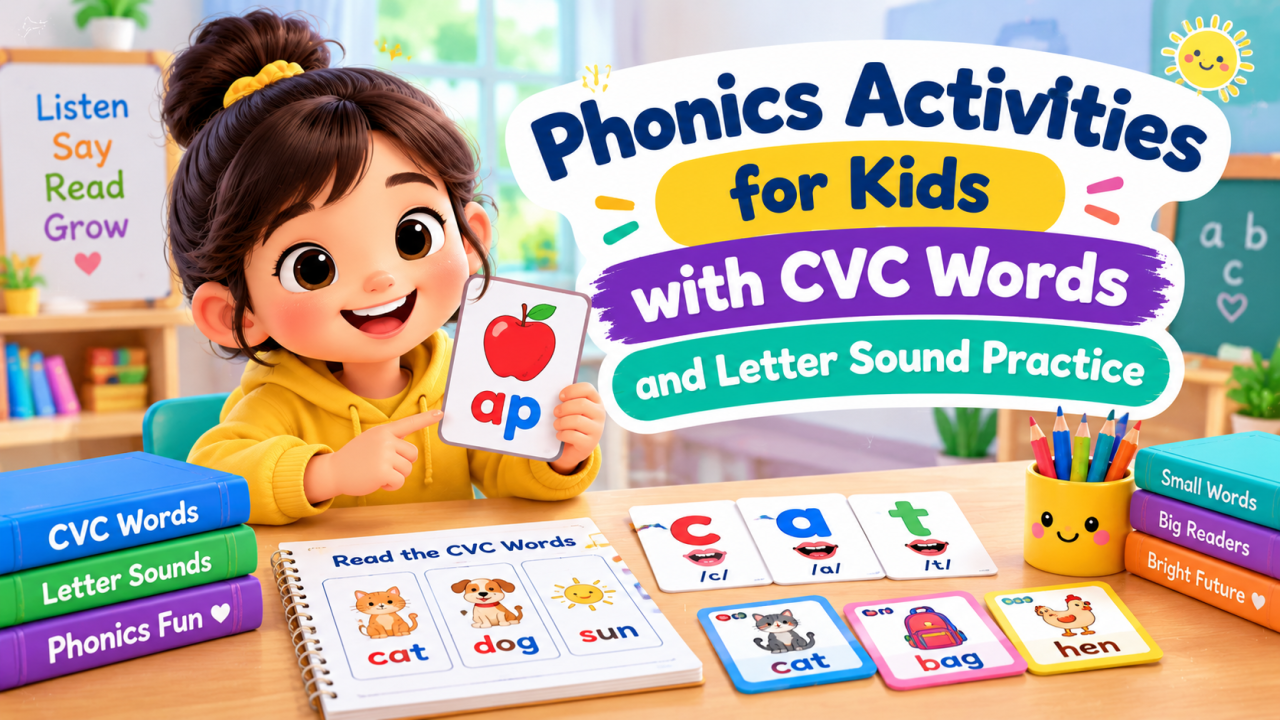
Help children build early reading skills with fun phonics activities, CVC words, and simple letter sound practice for beginners.
Phonics Activities, CVC Words and Letter Sounds for Early Readers
Learning to read begins with understanding the relationship between letters and sounds. Simple phonics activities can help children recognize letter sounds, blend sounds together, read short words, and develop confidence with early reading.
For beginning readers, it is helpful to start with small and manageable steps. Children can first learn individual letter sounds, then practice putting sounds together to form simple words.
One useful group of words for early phonics practice is CVC words. CVC stands for consonant-vowel-consonant, such as cat, dog, sun, map, and pig.
This guide explains how parents and teachers can use phonics activities, CVC words, and letter sound games to support early literacy.
What Is Phonics?
Phonics is a method of teaching reading by helping children understand the connection between letters and the sounds they represent.
For example:
- our activities
- Worksheets & Activities
- Learning worlds to explore
- m can represent the /m/ sound.
- s can represent the /s/ sound.
- t can represent the /t/ sound.
- a can represent the short /a/ sound in words such as cat.
Once children know individual sounds, they can begin combining them.
For example:
c + a + t = cat
This process is called blending.
Phonics practice can also help children connect sounds to spelling. When children hear a word such as sun, they can learn to identify the sounds:
/s/ /u/ /n/
and connect those sounds to the letters s-u-n.
Why Phonics Activities Matter
Early phonics practice gives children opportunities to work with the building blocks of written words.
Instead of trying to memorize every word they see, children can learn strategies for working out unfamiliar simple words.
Phonics activities can help children practice:
- Letter recognition
- Letter sounds
- Beginning sounds
- Ending sounds
- Short vowel sounds
- Sound blending
- Word reading
- Early spelling
- CVC words
- Listening skills
The activities should be appropriate for the child's current reading level.
What Are Letter Sounds?
A letter sound is the sound associated with a written letter or letter combination.
For example:
| Letter | Example Word | Beginning Sound |
|---|---|---|
| b | ball | /b/ |
| c | cat | /k/ |
| d | dog | /d/ |
| f | fish | /f/ |
| m | moon | /m/ |
| s | sun | /s/ |
| t | top | /t/ |
Children can practice identifying these sounds by looking at pictures and saying the first sound they hear.
For example:
Picture of a sun → /s/
Picture of a dog → /d/
Picture of a ball → /b/
These activities help children pay attention to the sounds within spoken words.
What Are CVC Words?
CVC means consonant-vowel-consonant.
A CVC word contains three letters arranged in this basic pattern:
Consonant + Vowel + Consonant
Examples include:
- cat
- dog
- sun
- map
- pen
- pig
- sit
- hop
- red
- cup
CVC words are useful for beginning phonics practice because they are short and can often be sounded out using basic letter-sound knowledge.
CVC Word Examples
| CVC Word | Sounds |
|---|---|
| cat | /c/ /a/ /t/ |
| dog | /d/ /o/ /g/ |
| sun | /s/ /u/ /n/ |
| map | /m/ /a/ /p/ |
| pen | /p/ /e/ /n/ |
| pig | /p/ /i/ /g/ |
| hop | /h/ /o/ /p/ |
| cup | /c/ /u/ /p/ |
The exact pronunciation of sounds can vary by accent, so teachers and parents should use the pronunciation appropriate for the child's language and reading program.
Why CVC Words Are Helpful for Beginners
CVC words give children a simple structure for practicing blending.
Take the word:
map
A child can identify:
m → /m/
a → /a/
p → /p/
Then blend the sounds:
/m/ /a/ /p/ → map
This provides a practical bridge between knowing individual letters and reading complete words.
CVC words can also be changed one letter at a time.
For example:
cat → cap → map → mop → hop
This allows children to notice how changing one sound can change the entire word.
Starting With Letter Sound Activities
Before asking children to read many words, give them opportunities to become familiar with individual sounds.
Activity 1: Find the Beginning Sound
Show a picture and ask:
What sound does the word start with?
Examples:
- Apple → /a/
- Ball → /b/
- Cat → /c/
- Dog → /d/
- Fish → /f/
Children can point to or write the matching letter.
Activity 2: Letter Sound Matching
Create two sets of cards.
One set contains letters:
m, s, t, p
The other contains pictures:
- moon
- sun
- top
- pig
Ask children to match each picture with its beginning letter.
Activity 3: Sound Hunt
Choose one sound.
For example:
/m/
Ask children to find objects around the room that begin with that sound.
Possible examples might include:
- mat
- marker
- mug
- map
The activity turns sound recognition into an everyday game.
Beginning Sounds vs. Letter Names
Children need to understand that the name of a letter and the sound it represents are not always the same thing.
For example:
The letter is called B.
Its common sound in simple words such as bat is /b/.
During phonics practice, it is useful to ask both types of questions:
What letter is this?
and:
What sound does it represent here?
This helps children connect the visual symbol with its role in a word.
Introducing Short Vowel Sounds
Short vowel sounds are important when children begin reading many CVC words.
The five common vowel letters are:
a, e, i, o, u
Simple CVC examples include:
| Vowel | Example CVC Words |
|---|---|
| a | cat, map, bat |
| e | bed, pen, hen |
| i | pig, sit, lip |
| o | dog, hot, log |
| u | sun, cup, bus |
Children do not need to master every vowel at once.
It can be helpful to introduce one vowel pattern at a time and provide plenty of opportunities for practice.
Simple CVC Word Families
Word families can help children notice patterns in words.
For example, the -at family includes:
- cat
- bat
- hat
- mat
- sat
The ending stays similar while the beginning sound changes.
Another example is the -ig family:
- pig
- dig
- fig
- big
Children can use their knowledge of the shared ending to help read new words.
Word Family Practice
Write:
_at
Then ask children to add different beginning letters.
c + at = cat
b + at = bat
h + at = hat
This activity helps children notice repeated spelling and sound patterns.
Blending Sounds to Read CVC Words
Blending means putting individual sounds together to read a word.
For example:
/s/ /a/ /t/
When the sounds are blended, the child reads:
sat
Start slowly if necessary.
You can point to each letter:
s → a → t
Then encourage the child to say the sounds together more smoothly.
With practice, children can begin recognizing familiar patterns without stopping after every letter.
Segmenting Sounds for Early Spelling
Phonics activities can also work in the opposite direction.
Instead of giving children a word and asking them to read it, say a word and ask them to identify its sounds.
For example:
cat
Ask:
What sounds can you hear?
The child can identify:
/c/ /a/ /t/
Then write:
c-a-t
This is called segmenting.
Blending supports reading, while segmenting can support early spelling.
Easy Phonics Worksheet Ideas
A phonics worksheet can include several simple activities.
Match the Letter to the Sound
| Letter | Sound |
|---|---|
| m | /m/ |
| s | /s/ |
| t | /t/ |
| p | /p/ |
Circle the Beginning Letter
__at
Choices:
m s c
Answer:
c
Complete the CVC Word
c _ t
Choices:
a e i
Answer:
a
Read and Match
Match each word to the correct picture:
- cat
- dog
- sun
- pig
These activities can be adapted to the child's reading level.
Fun Phonics Activities at Home
Phonics practice does not always need a worksheet.
Parents can use everyday objects, cards, books, toys, and simple games.
Sound Sorting
Choose two sounds.
For example:
/m/ and /s/
Show pictures or objects and ask the child to sort them into two groups.
/m/
- mat
- mug
- moon
/s/
- sun
- sock
- spoon
This helps children listen carefully to beginning sounds.
CVC Word Building
Use letter cards to build words.
Start with:
c - a - t
Ask the child to say each sound and then blend them.
Next, change one letter:
c - a - p
Then:
m - a - p
This shows how small spelling changes create new words.
Phonics Memory Game
Create pairs of cards.
One card can show a letter.
The matching card can show a picture beginning with that sound.
For example:
B → ball
M → moon
S → sun
Place the cards face down and let children find matching pairs.
Keeping Phonics Practice Age-Appropriate
Young children can become tired if an activity lasts too long.
Keep practice sessions manageable and vary the activities.
A short session might include:
- Review three or four letter sounds.
- Practice a few CVC words.
- Play a quick sound game.
- Read a few simple words.
- Finish with a positive review.
The exact amount of practice can vary depending on the child's age, attention span, learning needs, and classroom program.
Tips for Parents and Teachers
When teaching phonics, focus on clear and consistent practice.
Do
- Introduce sounds gradually.
- Use simple words.
- Encourage children to say sounds aloud.
- Practice blending.
- Practice segmenting.
- Use pictures and objects.
- Repeat difficult sounds over time.
- Celebrate effort and improvement.
- Read simple books alongside phonics practice.
Avoid
- Introducing too many sounds at once.
- Making every activity feel like a test.
- Expecting children to memorize long word lists immediately.
- Correcting mistakes harshly.
- Using words that contain sound patterns the child has not learned without support.
The goal is to help children develop useful strategies for reading and spelling.
A Simple Beginner Phonics Practice Set
Here is a small practice activity for beginning readers.
A. Identify the Beginning Sound
- sun → __
- map → __
- dog → __
- pig → __
B. Complete the Word
- c _ t
- m _ p
- p _ g
- s _ n
C. Blend the Sounds
- /m/ /a/ /p/ = __
- /s/ /i/ /t/ = __
- /c/ /a/ /t/ = __
- /d/ /o/ /g/ = __
D. Find the Rhyming Word
- cat → bat
- sun → fun
- pig → big
- hop → top
These simple exercises can be used as a starting point for early phonics practice.
Building a Strong Early Reading Routine
A consistent routine can make phonics practice easier.
A simple sequence is:
Hear the sound → See the letter → Say the sound → Blend sounds → Read the word → Use the word
For example:
Hear: /m/
See: m
Say: /m/
Blend: /m/ /a/ /p/
Read: map
Use: "I see a map."
This connects individual sounds to meaningful reading.
Internal Link Opportunities
When publishing this article, consider adding relevant internal links to pages such as:
- Printable Phonics Worksheets
- CVC Word Worksheets
- Letter Recognition Activities
- Alphabet Worksheets for Kids
- Beginning Reading Activities
- Kindergarten Reading Worksheets
- Early Literacy Activities
Use descriptive anchor text that tells readers what they will find on the linked page.
Article Details
Category: Phonics / Early Learning
Author: Superkids Team
Primary Keyword: Phonics Activities
Target Audience: Parents, teachers, and beginning readers
Search Intent: Informational
Moving From Letter Sounds to Word Reading
Once children can recognize several common letter sounds, the next step is helping them use those sounds together.
Knowing that c represents /c/, a represents /a/, and t represents /t/ is useful. However, children also need to learn how those sounds work together in a complete word.
For example:
c → /c/
a → /a/
t → /t/
Blend the sounds:
/c/ /a/ /t/ → cat
This connection between individual sounds and complete words is an important part of early phonics practice.
Blending Strategies for Beginners
Some children can blend sounds quickly, while others need more support.
Try these approaches.
Strategy 1: Say Each Sound Slowly
Write:
m a p
Ask the child to say:
/m/ /a/ /p/
Then ask:
"What word do those sounds make?"
Answer:
map
Strategy 2: Use Sound Buttons
Place a dot or small mark underneath each letter.
m • a • p •
Ask the child to touch each mark while saying the corresponding sound.
Then encourage the child to say the sounds together.
Strategy 3: Stretch the Word
Some sounds can be held slightly longer than others.
For example:
ssss-uuunnn
Then say the word normally:
sun
This can help some beginning readers hear how the sounds connect.
Segmenting CVC Words
Segmenting is the reverse of blending.
Instead of seeing:
c-a-t → cat
the child hears:
cat
and identifies:
/c/ /a/ /t/
This skill is useful for early spelling.
Segmenting Activity
Say:
"map"
Ask:
"What is the first sound?"
Answer:
/m/
Then ask:
"What is the middle sound?"
Answer:
/a/
Then:
"What is the last sound?"
Answer:
/p/
This helps children listen carefully to each part of a word.
Beginning, Middle and Ending Sounds
CVC words provide a simple structure for teaching sound positions.
Take:
cat
| Position | Letter | Sound |
|---|---|---|
| Beginning | c | /c/ |
| Middle | a | /a/ |
| Ending | t | /t/ |
Another example:
sun
| Position | Letter | Sound |
|---|---|---|
| Beginning | s | /s/ |
| Middle | u | /u/ |
| Ending | n | /n/ |
Ask children to identify one position at a time.
This is often easier than asking them to analyze the entire word at once.
CVC Word Families
Word families are groups of words that share a common ending pattern.
-at Family
- cat
- bat
- hat
- mat
- rat
- sat
-an Family
- can
- fan
- man
- pan
- ran
-ig Family
- big
- dig
- fig
- pig
- wig
-op Family
- hop
- mop
- pop
- top
-un Family
- bun
- fun
- run
- sun
Word families allow children to notice recurring sound and spelling patterns.
Word Building: Change One Sound
A useful phonics activity is to change one letter at a time.
Start with:
cat
Change the first letter:
cat → bat
Change it again:
bat → hat
Then:
hat → hot
Then:
hot → hop
This activity helps children understand that changing one letter can change the word.
It also gives them repeated practice with blending and decoding.
CVC Word Sorting Activities
Sorting words can help children recognize patterns.
Sort by Vowel
Give children words such as:
- cat
- map
- bed
- pen
- pig
- sit
- dog
- hot
- sun
- cup
Ask them to sort the words according to their middle vowel.
| Short A | Short E | Short I | Short O | Short U |
|---|---|---|---|---|
| cat | bed | pig | dog | sun |
| map | pen | sit | hot | cup |
This activity helps children notice the vowel sound inside each word.
Short Vowel Practice
Short vowels can sometimes be challenging for beginning readers because the vowel is in the middle of a short word.
Short A
Examples:
- cat
- bat
- map
- cap
- fan
Short E
Examples:
- bed
- red
- hen
- pen
- leg
Short I
Examples:
- pig
- sit
- fin
- lip
- win
Short O
Examples:
- dog
- log
- hot
- pot
- fox
Short U
Examples:
- sun
- cup
- bus
- rug
- tub
Practice one vowel pattern at a time when a child is still developing confidence.
Practical Activity: Vowel Detective
Write several CVC words on cards.
For example:
cat, bed, pig, dog, sun
Ask the child:
"Which vowel can you see in each word?"
Then ask:
"What sound does that vowel make in this word?"
This turns vowel practice into a simple observation activity.
Phonics Games Without Worksheets
Phonics practice can happen away from a desk.
1. Sound Hunt
Choose a sound such as /s/.
Ask the child to find objects or words around the home that begin with that sound.
Examples may include:
- sock
- spoon
- soap
- shoe
2. Letter Sound Bingo
Create a simple grid containing letters.
Call out a sound.
For example:
/m/
The child finds m and marks it.
3. Word Building Race
Give the child three or four letter cards.
For example:
c, a, t
Ask them to build the word:
cat
Then change one card to make:
cap
The activity can be done at the child's own pace rather than as a competition.
4. Odd One Out
Give three words:
cat, cap, dog
Ask:
"Which word is different?"
The child can identify dog because it does not belong to the same -at/-ap sound pattern.
Using Pictures in Phonics Activities
Pictures can provide helpful context for beginning readers.
For example, show pictures of:
- cat
- sun
- dog
- pig
Ask the child to identify the word or beginning sound.
However, pictures should support phonics learning rather than encourage children to guess every word from the picture.
After identifying the picture, encourage the child to look at the letters and sounds in the written word.
Decodable Words and Simple Reading Practice
When children are learning phonics, it can be helpful to provide reading material that matches the sound patterns they have been taught.
For example, if a child has practiced simple CVC words, short sentences might include:
The cat sat.
A dog ran.
The pig is big.
The sun is hot.
The exact words used should match the child's current phonics knowledge.
Phonics and Spelling Practice
Reading and spelling can support each other.
If a child can read:
cat
they can also practice spelling it by identifying its sounds:
/c/ /a/ /t/
Then write:
c-a-t
A simple spelling activity can include:
- Say the word.
- Ask the child to repeat it.
- Stretch the word.
- Identify each sound.
- Write the letters.
- Read the completed word.
This creates a connection between hearing, speaking, reading, and writing.
Comparison of Common Phonics Activities
| Activity | Main Skill | Example |
|---|---|---|
| Letter matching | Letter recognition | Match m with /m/ |
| Beginning sound | Initial sound recognition | Sun → /s/ |
| Sound sorting | Listening and classification | /m/ vs /s/ |
| Blending | Word reading | /c/ /a/ /t/ → cat |
| Segmenting | Early spelling | cat → /c/ /a/ /t/ |
| Word families | Pattern recognition | cat, bat, hat |
| Word building | Sound manipulation | cat → cap |
| Vowel sorting | Short vowel recognition | cat → short a |
| CVC reading | Decoding | dog, sun, pig |
| Simple sentences | Reading in context | The dog ran. |
Using different activity types can give children multiple ways to practice the same underlying skills.
Pros and Cons of Phonics Worksheets
Pros
- Easy to organize.
- Useful for focused practice.
- Can target one sound or spelling pattern.
- Helpful for reviewing recently taught skills.
- Can provide independent practice.
- Easy for parents and teachers to check.
- Can be used at home or in a classroom.
Cons
- Too much worksheet work can become repetitive.
- Worksheets cannot always provide enough speaking and listening practice.
- Some children learn better through movement and hands-on activities.
- Children may focus on finishing instead of understanding.
- A worksheet may not show exactly why a child is struggling.
For this reason, worksheets are best used as one part of a wider phonics routine.
Common Phonics Teaching Mistakes
Mistake 1: Teaching Too Many Sounds at Once
Children may become confused when they are introduced to many new sounds in a short period.
Introduce a manageable group and provide repeated practice.
Mistake 2: Relying Only on Letter Names
Knowing the alphabet is useful, but phonics also requires children to connect letters with sounds.
For example:
m → /m/
The sound should be practiced in words as well.
Mistake 3: Asking Children to Guess Words
If a child does not know a simple word, encourage them to look at the letters and work through the sounds.
For example:
s-u-n
rather than simply guessing from a picture.
Mistake 4: Moving to Difficult Words Too Quickly
If CVC words are still difficult, spend more time practicing simple CVC patterns before introducing more complicated spelling patterns.
Mistake 5: Ignoring Listening Skills
Phonics is not only about looking at letters.
Children also need opportunities to hear, compare, and identify sounds in spoken words.
Best Practices for Teaching CVC Words
Start Simple
Begin with words containing sound patterns the child already knows.
Practice Short Sessions
A focused 10-minute activity may be more manageable than a long session for a young learner.
Repeat Important Patterns
Words such as:
cat, bat, hat, mat
provide repeated exposure to the -at pattern.
Change One Sound
Try:
cat → cap → map → mop
This encourages children to pay attention to individual sounds.
Mix Reading and Spelling
Ask children to read words and also build or spell some of the same words.
Use Meaningful Words
Whenever possible, connect a word to a picture, object, sentence, or simple story.
A Practical Phonics Lesson Structure
A simple beginner lesson might look like this:
Step 1: Review
Review two or three previously learned letter sounds.
Step 2: Introduce
Introduce one new sound or spelling pattern.
Step 3: Practice
Use letter cards, pictures, or a worksheet.
Step 4: Blend
Build a few simple words using the sounds.
Step 5: Segment
Say the words and ask the child to identify each sound.
Step 6: Read
Read a few simple words or sentences containing familiar patterns.
Step 7: Review
Ask the child to explain or demonstrate what they learned.
This routine can be adjusted according to the child's needs.
Example CVC Worksheet
A. Circle the Correct Beginning Letter
-
__at
b / c / m -
__og
d / p / s -
__un
m / s / t -
__ig
p / r / b
B. Fill in the Missing Vowel
- c _ t
- p _ g
- d _ g
- s _ n
- p _ n
C. Read the Word
- cat
- sun
- pig
- dog
- pen
D. Build the Word
Use the letters to make a word:
a, c, t → cat
p, i, g → pig
s, u, n → sun
These activities can be adapted to different reading levels.
How to Help a Child Who Struggles With Phonics
If a child finds a particular sound difficult, return to simpler activities.
For example, if the child struggles with the short a sound:
- Say the sound clearly.
- Show the letter a.
- Say simple words containing the sound.
- Ask the child to identify the vowel.
- Practice a few -at words.
- Build words using letter cards.
- Read the words again later.
Avoid turning the practice into a stressful experience.
If a child continues to have significant difficulty with reading or language skills, parents can discuss their concerns with the child's teacher or an appropriately qualified education professional.
Making Phonics Practice More Effective
A balanced approach can include:
Listening + Speaking + Reading + Writing
For example:
Hear: /m/
Say: /m/
See: m
Build: map
Read: map
Write: map
This gives children several opportunities to connect the sound, letter, and word.
Simple Weekly Phonics Practice Plan
| Day | Main Activity |
|---|---|
| Monday | Review letter sounds |
| Tuesday | Beginning sound activities |
| Wednesday | CVC word blending |
| Thursday | Word families |
| Friday | CVC spelling and segmenting |
| Weekend | Phonics games and simple reading |
The schedule does not need to be followed exactly. The main goal is regular exposure and practice.
Final Practical Tips
Keep phonics learning simple and consistent.
- Introduce a small number of new sounds at a time.
- Review previously learned sounds regularly.
- Practice CVC words through reading and spelling.
- Use word families to highlight patterns.
- Include both blending and segmenting.
- Use games to keep practice varied.
- Let children hear sounds clearly.
- Encourage children to look at letters when decoding.
- Keep activities short enough to maintain attention.
- Match reading materials to the child's current phonics knowledge.
Phonics develops gradually. Children benefit from repeated opportunities to hear sounds, connect them to letters, blend them into words, and use those words in meaningful reading and writing activities.
Conclusion
Phonics activities can give beginning readers a simple and structured way to learn letter sounds, blend sounds, read CVC words, and develop early spelling skills.
CVC words such as cat, dog, sun, pig, and map are useful for practicing the connection between individual sounds and complete words. Children can build these skills through blending, segmenting, word families, sound sorting, letter matching, and simple reading activities.
The best phonics practice is not about rushing through a large number of words. Children need repeated opportunities to hear sounds, say them, connect them with letters, and use those sounds when reading and writing.
Parents and teachers can combine phonics worksheets with games, picture activities, letter cards, everyday objects, and short reading sessions. Keeping activities simple and appropriate for the child's current level can help make early reading practice more manageable and meaningful.
Call To Action
Ready to make phonics practice easier and more engaging?
Explore our collection of phonics activities, CVC word worksheets, letter sound exercises, and early reading resources. Choose activities that match your child's current level and practice one sound or word pattern at a time.
Start with simple letter sounds and CVC words, then gradually build toward blending, reading, and spelling. Regular practice can help children become more comfortable working with sounds and words.
Frequently Asked Questions
1. What are phonics activities?
Phonics activities are learning activities that help children understand the relationship between letters and sounds. They can include letter sound games, beginning-sound activities, blending, segmenting, CVC word practice, word building, and simple reading exercises.
2. What are CVC words?
CVC words are words with a consonant-vowel-consonant structure. Examples include cat, dog, sun, map, pig, and cup. These short words are commonly used for early phonics and decoding practice.
3. How do CVC words help children learn to read?
CVC words give children opportunities to practice individual letter sounds and blend those sounds into complete words. For example, children can combine /c/, /a/, and /t/ to read the word cat.
4. What is blending in phonics?
Blending is the process of combining individual sounds to read a word. For example, a child can blend /m/, /a/, and /p/ to read map.
5. What is segmenting in phonics?
Segmenting means breaking a spoken word into its individual sounds. For example, the word cat can be separated into /c/, /a/, and /t/. Segmenting can support early spelling as well as phonics development.
6. How can I practice letter sounds at home?
You can practice letter sounds using picture cards, letter cards, objects around the home, sound-matching games, sorting activities, and simple phonics worksheets. Ask the child to identify the sound at the beginning of familiar words.
7. What are CVC word families?
CVC word families are groups of words that share a common ending pattern. For example, cat, bat, hat, and mat share the -at pattern. Practicing word families can help children notice repeated sound and spelling patterns.
8. Which vowels are used in CVC words?
The five vowel letters are a, e, i, o, and u. CVC words can contain short vowel sounds, such as the a in cat, e in bed, i in pig, o in dog, and u in sun.
9. Are phonics worksheets useful for beginners?
Phonics worksheets can provide focused practice with letter sounds, CVC words, blending, segmenting, and spelling patterns. They are most useful when combined with speaking, listening, reading, games, and hands-on activities.
10. How can I help a child who struggles with phonics?
Start with sounds and words the child already knows, then introduce one small step at a time. Use clear examples, repeat important patterns, and use letter cards, pictures, objects, and simple CVC words. If significant difficulties continue, parents can discuss their concerns with the child's teacher or an appropriately qualified education professional.