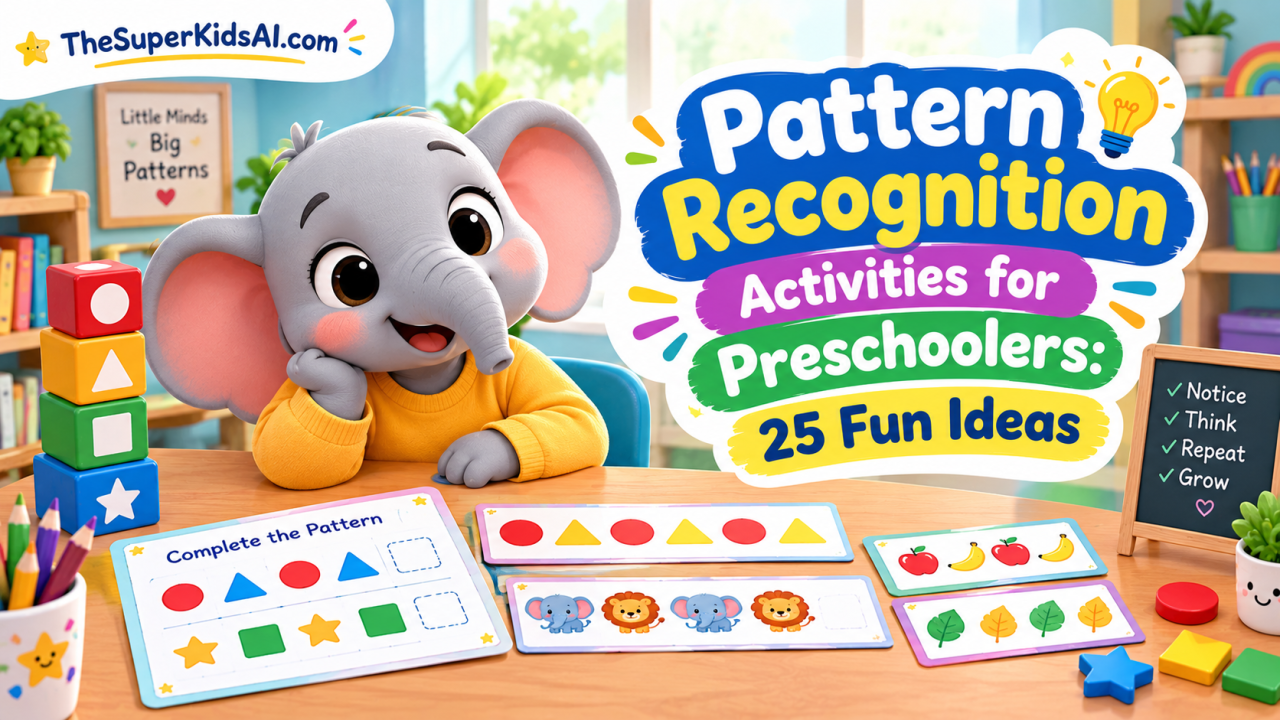
Pattern Recognition Activities for Preschoolers: 25 Fun Ideas
Discover fun and easy pattern recognition activities for preschoolers. Explore colorful patterns, hands-on games, and simple learning ideas that help children develop early math, observation, and problem-solving skills.
Pattern Recognition Activities for Preschoolers: 25 Fun and Easy Ideas
Pattern recognition activities for preschoolers are a fun way to help young children learn about colors, shapes, sizes, sounds, and sequences. These activities encourage children to notice what comes next, identify similarities, and understand how things repeat.
The best part is that children do not need expensive toys or special learning materials. Everyday items such as building blocks, buttons, crayons, leaves, and snacks can become simple learning tools.
Whether you are a parent, preschool teacher, or caregiver, you can use these activities to make learning enjoyable and meaningful.
In this guide, you will discover 25 fun pattern recognition activities for preschoolers, along with simple instructions, examples, and helpful tips for different learning levels.
What Is Pattern Recognition for Preschoolers?
Pattern recognition is the ability to notice and understand a sequence or arrangement that follows a particular rule.
For example, when a child sees a red block, a blue block, another red block, and another blue block, they may notice that the colors keep repeating.
The pattern looks like this:
Red → Blue → Red → Blue → ?
The child can predict that the next color should be red.
This is a simple example of an AB pattern, where two different items repeat in the same order.
Preschoolers can learn patterns through colors, shapes, movements, sounds, numbers, and everyday objects.
Common Types of Patterns for Preschoolers
Here are some simple patterns children can practice:
| Pattern Type | Example |
|---|---|
| Color pattern | Red, blue, red, blue |
| Shape pattern | Circle, square, circle, square |
| Size pattern | Big, small, big, small |
| Object pattern | Toy car, ball, toy car, ball |
| Sound pattern | Clap, tap, clap, tap |
| Movement pattern | Jump, clap, jump, clap |
| Nature pattern | Leaf, stone, leaf, stone |
These patterns help children understand repetition and predict what comes next.
Why Are Pattern Recognition Activities Important for Preschoolers?
Pattern recognition is an important part of early learning. It helps children notice relationships between objects and understand how things are organized.
Pattern activities can also support early mathematical thinking and prepare children for more advanced concepts.
Worksheets & Activities
- Story Land
- Number Ninjas
- Word Wizards
- Brain Boosters
- Puzzle Path
- Art Studio
- Learning worlds to explore
Here are some key benefits.
1. Builds Early Math Skills
Patterns are closely connected to early mathematics.
When children arrange objects in a repeating sequence, they begin to understand order, repetition, and relationships.
These ideas can support later learning in counting, sorting, and number patterns.
For example, a child who creates a pattern using two red blocks and two blue blocks is practicing how to organize objects according to a rule.
2. Develops Observation Skills
Pattern activities encourage children to look carefully at objects and notice what is similar or different.
They may observe that:
- Two objects have the same color.
- A small shape comes after a large shape.
- A particular sound repeats.
- A sequence follows the same order.
These observations help children become more aware of details in their surroundings.
3. Encourages Logical Thinking
When children complete a pattern, they need to understand the sequence and decide what belongs next.
For example:
Star → Heart → Star → Heart → ?
The child must recognize the repeating order before choosing the next shape.
This encourages simple logical thinking and helps children practice making predictions.
4. Supports Problem-Solving Skills
Pattern activities give children small problems to solve.
They may need to identify a missing object, correct a mistake, or create a new sequence.
These activities encourage children to try different ideas and learn from their attempts.
5. Improves Attention and Concentration
Following a pattern requires children to pay attention to the order of objects.
Simple activities such as arranging colored beads or copying a movement sequence can encourage children to focus on a task.
Keep activities short and enjoyable so children do not feel overwhelmed.
6. Encourages Creativity
Patterns do not always need to follow a single example.
Children can create their own sequences using colors, shapes, toys, or movements.
For example, one child may create a pattern using blocks, while another may use toy animals.
Encouraging children to invent patterns gives them opportunities to explore their ideas.
7. Builds Confidence Through Hands-On Learning
When children successfully complete a pattern, they can feel proud of their work.
Simple activities allow them to practice independently while receiving support when needed.
Remember that preschoolers learn at different speeds. The goal is to encourage exploration rather than expect every child to complete a pattern perfectly.
25 Fun Pattern Recognition Activities for Preschoolers
You can introduce patterns through play, movement, art, and everyday objects.
Start with simple patterns that repeat two items. As children become comfortable, introduce patterns with three items or more complex sequences.
Here are 25 easy activities to try at home or in the classroom.
Activity 1: Color Block Patterns
Age group: 3–5 years
Materials: Colorful building blocks
Color block patterns are one of the easiest ways to introduce repeating sequences.
How to Do It
- Collect blocks in two different colors.
- Place a red block on the table.
- Add a blue block beside it.
- Continue the sequence: red, blue, red, blue.
- Ask your child which color should come next.
Example:
🟥 🟦 🟥 🟦 🟥 __
Answer: Blue.
Learning Benefit
This activity helps children recognize repeating color patterns and practice predicting what comes next.
Try this next: Let your child create a new pattern using three colors.
Activity 2: Shape Pattern Cards
Age group: 3–5 years
Materials: Paper, crayons, and scissors
Shape patterns help children notice differences between simple geometric shapes.
How to Do It
- Draw circles and squares on separate pieces of paper.
- Arrange them in a repeating sequence.
- Ask your child to study the pattern.
- Leave one space empty.
- Encourage your child to choose the correct shape.
Example:
Circle → Square → Circle → Square → __
Answer: Circle.
Learning Benefit
Children practice recognizing shapes, following sequences, and predicting the next item.
Try this next: Add triangles to create a pattern with three different shapes.
Activity 3: Big and Small Object Patterns
Age group: 3–5 years
Materials: Toys, blocks, or household objects in different sizes
This activity teaches children to recognize patterns based on size.
How to Do It
- Collect a few big and small objects.
- Arrange them in a big-small sequence.
- Repeat the sequence several times.
- Ask your child to identify the next object.
Example:
Big → Small → Big → Small → __
Answer: Big.
Learning Benefit
Children learn to compare sizes while practicing pattern recognition.
Try this next: Use three sizes—big, medium, and small—to create a more challenging sequence.
Activity 4: Toy Animal Patterns
Age group: 3–5 years
Materials: Toy animals or animal pictures
Turn animal toys into a playful pattern activity.
How to Do It
- Choose two different animal toys, such as a cat and a dog.
- Arrange them in a repeating sequence.
- Ask your child to name each animal.
- Invite them to continue the pattern.
Example:
Cat → Dog → Cat → Dog → __
Answer: Cat.
Learning Benefit
This activity combines pattern recognition with animal identification and vocabulary practice.
Try this next: Use three animals to create a longer pattern.
Activity 5: Color Bead Patterns
Age group: 4–5 years
Materials: Large, age-appropriate beads and a string or pipe cleaner
Children can create patterns by arranging beads in a repeating order.
How to Do It
- Choose two colors of large beads.
- Show your child how to place them in an alternating sequence.
- Let your child continue the pattern.
- Ask them to explain which color comes next.
Example:
Red → Yellow → Red → Yellow → __
Answer: Red.
Learning Benefit
Bead patterns encourage children to notice sequences and practice hand-eye coordination.
Safety note: Use large, age-appropriate materials and supervise children closely. Small beads can be a choking hazard.
Activity 6: Clap and Tap Sound Patterns
Age group: 3–5 years
Materials: No materials needed
Patterns can be made with sounds as well as objects.
This activity is ideal for children who enjoy music and movement.
How to Do It
- Clap your hands once.
- Tap your knees once.
- Repeat the sequence: clap, tap, clap, tap.
- Ask your child to copy the pattern.
- Pause and invite them to continue.
Example:
Clap → Tap → Clap → Tap → __
Answer: Clap.
Learning Benefit
Sound patterns help children listen carefully, remember sequences, and coordinate their movements.
Try this next: Create a pattern using a clap, a stomp, and a tap.
Activity 7: Nature Object Patterns
Age group: 3–5 years
Materials: Leaves, stones, flowers, or other safe natural objects
Nature provides many opportunities for simple pattern activities.
How to Do It
- Collect a few safe natural objects with your child.
- Choose two types of objects, such as leaves and stones.
- Arrange them in a repeating sequence.
- Ask your child to identify what comes next.
Example:
Leaf → Stone → Leaf → Stone → __
Answer: Leaf.
Learning Benefit
This activity combines outdoor exploration with observation and pattern recognition.
Safety note: Use only safe objects. Avoid sharp, poisonous, or unfamiliar plants, and supervise children during outdoor activities.
Activity 8: Pom-Pom Color Patterns
Age group: 3–5 years
Materials: Large pom-poms and a tray
Colorful pom-poms make pattern activities bright and engaging.
How to Do It
- Place two different colors of large pom-poms on a tray.
- Create a repeating pattern.
- Leave one space empty.
- Ask your child to select the missing color.
- Let them create their own pattern.
Example:
🟡 🟢 🟡 🟢 __
Answer: Yellow.
Learning Benefit
Children practice color recognition, sequencing, and visual observation.
Safety note: Choose materials suitable for your child's age and supervise closely. Small pom-poms can pose a choking risk.
Activity 9: Button Pattern Sorting
Age group: 4–5 years
Materials: Large buttons in different colors and shapes
Buttons can be used to create simple patterns while children explore colors and shapes.
How to Do It
- Select a few large buttons in two colors.
- Arrange them in a repeating sequence.
- Ask your child to continue the sequence.
- Encourage them to create a pattern of their own.
Example:
Red button → Blue button → Red button → Blue button → __
Answer: Red button.
Learning Benefit
This activity encourages children to compare objects and identify repeating features.
Safety note: Use only large, age-appropriate buttons under close adult supervision. Small buttons can be choking hazards.
Activity 10: Movement Pattern Game
Age group: 3–5 years
Materials: Open space
Children can learn patterns by moving their bodies.
How to Do It
- Choose two simple movements, such as jumping and clapping.
- Demonstrate a repeating sequence.
- Ask your child to copy it.
- Repeat the sequence together.
- Invite your child to create a new movement pattern.
Example:
Jump → Clap → Jump → Clap → __
Answer: Jump.
Learning Benefit
Movement patterns combine physical activity with listening, memory, and sequencing.
Keep movements gentle and make sure the play area is clear and safe.
Activity 11: Sticker Pattern Strips
Age group: 3–5 years
Materials: Paper strips and large stickers
Sticker patterns are a simple activity for children who enjoy drawing and crafts.
How to Do It
- Give your child a paper strip.
- Choose two types of large stickers.
- Place them in a repeating sequence.
- Ask your child to continue the pattern.
- Encourage them to make their own design.
Example:
⭐ ❤️ ⭐ ❤️ __
Answer: Star.
Learning Benefit
Children practice visual recognition, sequencing, and creative expression.
Safety note: Use large stickers suitable for young children and supervise closely.
Activity 12: Snack Time Patterns
Age group: 3–5 years
Materials: Safe, age-appropriate snack pieces
Snack time can become a simple learning opportunity when children arrange food in a pattern.
How to Do It
- Choose two safe snack items, such as banana pieces and soft fruit pieces.
- Arrange them in an alternating sequence.
- Ask your child to identify the next item.
- Let them create a pattern before eating.
Example:
Banana → Soft fruit piece → Banana → Soft fruit piece → __
Answer: Banana.
Learning Benefit
This activity connects everyday routines with simple mathematical thinking.
Safety note: Choose foods appropriate for your child's age and eating abilities. Cut food into safe sizes and supervise children while they eat. Avoid foods that may cause choking.
Activity 13: Lego or Building Brick Patterns
Age group: 3–5 years
Materials: Large building bricks in different colors
Building bricks are useful for creating patterns that children can see and touch.
How to Do It
- Choose two colors of large building bricks.
- Arrange them in an alternating sequence.
- Ask your child to add the next brick.
- Build a longer pattern together.
- Invite your child to create a pattern using different colors.
Example:
Red → Blue → Red → Blue → __
Answer: Red.
Learning Benefit
This activity helps children practice sequencing, color recognition, and visual organization.
Activity 14: Paper Shape Patterns
Age group: 4–5 years
Materials: Paper shapes and glue
Paper shape patterns are a fun way to combine early math with art.
How to Do It
- Cut out large circles, squares, and triangles.
- Choose two shapes to begin.
- Arrange them in a repeating sequence.
- Ask your child to continue the pattern.
- Glue the shapes onto paper to create a pattern strip.
Example:
Circle → Triangle → Circle → Triangle → __
Answer: Circle.
Learning Benefit
Children practice shape recognition, sequencing, and creative thinking.
Safety note: Adults should handle scissors or provide child-safe scissors with appropriate supervision.
Activity 15: Missing Object Pattern Game
Age group: 4–5 years
Materials: Familiar toys or classroom objects
This activity encourages children to identify the missing item in a sequence.
How to Do It
- Arrange four or five objects in a repeating pattern.
- Ask your child to study the sequence.
- Cover the objects and remove one.
- Reveal the remaining objects.
- Ask your child which object is missing.
Example:
Red block → Blue block → Red block → __ → Red block
Answer: Blue block.
Learning Benefit
This game encourages children to observe details, remember sequences, and recognize repeating patterns.
Try this next: Increase the number of objects or introduce a pattern with three different items.
Tips for Making Pattern Recognition Activities Fun
Children learn best when activities match their interests and abilities.
Here are a few simple ways to make pattern learning enjoyable:
- Start with familiar objects: Use toys, blocks, crayons, and other items children already know.
- Keep patterns short: Begin with four or five items before introducing longer sequences.
- Use different senses: Combine colors, sounds, movements, and textures.
- Ask simple questions: Try questions such as "What comes next?" or "What do you notice?"
- Let children make mistakes: Give them time to think and try again.
- Celebrate effort: Praise children for observing, experimenting, and explaining their ideas.
- Follow their interests: If a child enjoys animals, use animal toys to create patterns.
The aim is to make pattern recognition a natural part of play rather than a difficult lesson.
10 More Pattern Recognition Activities for Preschoolers
If your child has already tried simple color and shape patterns, it is time to introduce a few new challenges.
These activities use everyday objects, drawing, music, and games to help preschoolers recognize patterns in different ways.
Start with simple sequences and gradually introduce more complex patterns as your child becomes comfortable.
Activity 16: Pattern Train Game
Age group: 3–5 years
Materials: Toy train cars or colorful blocks
Turn a toy train into a fun pattern recognition game.
How to Do It
- Gather toy train cars or building blocks in different colors.
- Arrange them in a repeating sequence.
- Tell your child that each car is part of a pattern train.
- Ask them to add the next car.
- Let them create their own train pattern.
Example:
Red → Blue → Red → Blue → __
Answer: Red.
Learning Benefit
This activity helps children recognize repeating patterns and practice arranging objects in a specific order.
Try this next: Create a train using three colors, such as red, blue, and yellow.
Activity 17: Nature Walk Pattern Hunt
Age group: 3–5 years
Materials: Safe natural objects or pictures of nature
Take children outdoors and encourage them to look for repeating features in nature.
How to Do It
- Go for a short walk in a garden or another safe outdoor area.
- Ask your child to notice colors, shapes, and textures.
- Collect a few safe objects, such as fallen leaves and smooth stones.
- Arrange the objects into a simple pattern.
- Ask your child to identify what comes next.
Example:
Leaf → Stone → Leaf → Stone → __
Answer: Leaf.
Learning Benefit
Children practice observation and pattern recognition while exploring their surroundings.
Safety note: Avoid unfamiliar plants, sharp objects, and anything that may be unsafe to touch.
Activity 18: Draw and Complete the Pattern
Age group: 4–5 years
Materials: Paper, crayons, and pencils
Drawing patterns allows children to combine creativity with early mathematical thinking.
How to Do It
- Draw a simple sequence using two shapes.
- Leave the final space empty.
- Ask your child to identify the missing shape.
- Let them draw the correct shape.
- Encourage them to create a pattern of their own.
Example:
○ □ ○ □ __
Answer: ○
Learning Benefit
This activity supports visual recognition, shape identification, and fine motor development.
Try this next: Ask your child to draw a pattern using circles, triangles, and squares.
Activity 19: Color Pattern Bracelet
Age group: 4–5 years
Materials: Large, age-appropriate beads and a thick string
Children can create colorful bracelets by following a repeating pattern.
How to Do It
- Choose two colors of large beads.
- Demonstrate an alternating pattern.
- Ask your child to continue the sequence.
- Help them finish the bracelet.
- Invite them to explain the pattern they created.
Example:
Yellow → Green → Yellow → Green → __
Answer: Yellow.
Learning Benefit
This activity encourages children to recognize patterns and practice hand-eye coordination.
Safety note: Small beads and strings can pose choking or strangulation risks. Use age-appropriate materials and supervise children closely. Avoid this activity if the materials are not suitable for your child's age.
Activity 20: Sound Pattern with Musical Instruments
Age group: 3–5 years
Materials: Child-safe musical instruments or household items that make gentle sounds
Make pattern recognition exciting with simple sounds.
How to Do It
- Choose two sounds, such as a drum tap and a shaker sound.
- Demonstrate a repeating sequence.
- Ask your child to listen carefully.
- Invite them to repeat the sound pattern.
- Pause and ask which sound comes next.
Example:
Drum → Shaker → Drum → Shaker → __
Answer: Drum.
Learning Benefit
Sound patterns help children practice listening, memory, and sequencing.
Try this next: Create a three-sound pattern using a drum, shaker, and gentle clap.
Activity 21: Pattern Puzzle Cards
Age group: 4–5 years
Materials: Paper cards with simple shapes or pictures
Pattern puzzle cards are easy to prepare and can be reused for different learning activities.
How to Do It
- Draw a repeating pattern on a strip of paper.
- Leave one space empty.
- Prepare cards showing the possible missing shapes.
- Ask your child to choose the correct card.
- Discuss why the selected shape fits the pattern.
Example:
Star → Circle → Star → Circle → __
Answer: Star.
Learning Benefit
This activity encourages children to compare shapes, recognize sequences, and make simple predictions.
Activity 22: Pattern Copying Game
Age group: 3–5 years
Materials: Blocks, toy animals, or colored objects
Copying a pattern helps children learn by watching and repeating.
How to Do It
- Arrange four objects in a simple pattern.
- Ask your child to observe the sequence.
- Give them similar objects.
- Invite them to copy the pattern in the same order.
- Compare both arrangements together.
Example:
Red → Blue → Red → Blue
Your child should create the same sequence.
Learning Benefit
Pattern copying helps children pay attention to order and notice relationships between objects.
Try this next: Ask your child to create a different pattern for you to copy.
Activity 23: Pattern Bracelet with Paper Shapes
Age group: 4–5 years
Materials: Paper strips, large paper shapes, glue, and crayons
This is a simple craft activity that combines art with pattern learning.
How to Do It
- Cut a paper strip long enough to fit loosely around the child's wrist.
- Prepare large paper shapes in two different colors.
- Arrange the shapes in a repeating sequence.
- Ask your child to continue the pattern.
- Decorate the strip and secure it loosely with adult help.
Example:
Red circle → Blue square → Red circle → Blue square → __
Answer: Red circle.
Learning Benefit
Children practice recognizing patterns, identifying shapes, and expressing creativity.
Safety note: Make sure the paper bracelet is loose and comfortable. Avoid tight strings or small decorations.
Activity 24: Pattern Matching Game
Age group: 4–5 years
Materials: Pattern cards and matching object cards
Pattern matching helps children connect a sequence with the objects that complete it.
How to Do It
- Create a few cards with simple repeating patterns.
- Prepare separate cards showing possible objects.
- Place one pattern card on the table.
- Ask your child to select the object that comes next.
- Repeat with different patterns.
Example:
Triangle → Circle → Triangle → Circle → __
Answer: Triangle.
Learning Benefit
This activity encourages children to recognize repeating sequences and match objects according to a rule.
Activity 25: Create Your Own Pattern
Age group: 3–5 years
Materials: Any safe objects, crayons, or building blocks
One of the most enjoyable pattern activities is allowing children to create their own sequences.
How to Do It
- Provide a selection of familiar objects.
- Ask your child to choose two or three different items.
- Encourage them to arrange the objects in a repeating sequence.
- Ask them to explain their pattern.
- Invite another child or adult to continue it.
Example:
Star → Circle → Square → Star → Circle → Square
Answer: Star.
Learning Benefit
Creating original patterns encourages creativity, logical thinking, and confidence.
It also helps children understand that a pattern follows a rule that can be explained and repeated.
Understanding Different Types of Patterns
Once children become comfortable with simple repeating patterns, you can introduce different pattern types.
The goal is not to teach every pattern at once. Instead, help children recognize one type before moving to another.
1. AB Patterns
An AB pattern repeats two different items in the same order.
Examples:
- Red, blue, red, blue
- Circle, square, circle, square
- Clap, tap, clap, tap
AB patterns are a useful starting point for preschoolers because the repeating rule is easy to see.
2. AAB Patterns
An AAB pattern repeats one item twice, followed by a different item.
Example:
Red, red, blue, red, red, blue
The pattern unit is red, red, blue.
Ask children to notice which item appears twice and which item comes after it.
3. ABB Patterns
An ABB pattern repeats one item, followed by two of another item.
Example:
Circle, square, square, circle, square, square
The pattern unit is circle, square, square.
Children can practice this pattern with blocks, shapes, or toys.
4. ABC Patterns
An ABC pattern repeats three different items in the same order.
Example:
Red, blue, yellow, red, blue, yellow
The repeating unit is red, blue, yellow.
This pattern may be more challenging for beginners, so introduce it when children are ready.
5. Growing Patterns
A growing pattern changes according to a rule, such as adding one more object each time.
Example:
One block → Two blocks → Three blocks → Four blocks
Growing patterns are different from repeating patterns because the number of objects changes in each step.
They can introduce children to simple ideas about quantity and change.
Pattern Recognition Activities by Age
Children develop pattern recognition skills at different rates. The activities below are general suggestions, not strict age requirements.
Choose activities based on your child's interests, attention span, and current abilities.
Pattern Activities for 2–3-Year-Olds
At this stage, begin with simple matching, sorting, and copying activities.
Try these activities:
- Match two objects with the same color.
- Copy a simple clap-and-tap sequence.
- Arrange two familiar toys in an alternating order with adult help.
- Sort blocks by color.
- Notice repeated sounds in songs and rhymes.
Helpful tip: Use real objects and demonstrate the activity before asking your child to try it.
Pattern Activities for 3–4-Year-Olds
Many children in this age group can begin exploring simple repeating patterns with guidance.
Try these activities:
- Create AB patterns with colored blocks.
- Complete a missing shape in a short sequence.
- Copy a pattern made with toy animals.
- Arrange objects by size in a repeating order.
- Follow simple movement patterns.
Helpful tip: Ask questions such as "What comes next?" and "Can you make the same pattern?"
Pattern Activities for 4–5-Year-Olds
Children who are comfortable with simple patterns can try longer or more varied sequences.
Try these activities:
- Create AAB and ABB patterns.
- Complete missing items in longer sequences.
- Make patterns using three different colors.
- Draw and extend shape patterns.
- Explain the rule behind a repeating sequence.
Helpful tip: Encourage children to explain how they know what comes next.
Pattern Activities for 5–6-Year-Olds
Children who are ready for more challenging activities can explore complex repeating patterns and simple growing patterns.
Try these activities:
- Create ABC patterns.
- Identify mistakes in a repeating sequence.
- Complete patterns with missing items in different positions.
- Build growing patterns using blocks.
- Create a pattern puzzle for a friend.
Helpful tip: Let children explain their reasoning rather than simply asking for the answer.
How to Teach Pattern Recognition Step by Step
A simple teaching approach can make pattern activities easier for preschoolers to understand.
Follow these five steps.
Step 1: Start with a Simple Pattern
Choose two familiar items, such as red and blue blocks.
Arrange them in a short sequence:
Red → Blue → Red → Blue
Let your child look at the pattern before asking questions.
Step 2: Explain the Repeating Rule
Point to each object and say its name.
For example:
"Red, blue, red, blue. The colors keep repeating in the same order."
This helps children connect the objects with the repeating rule.
Step 3: Ask What Comes Next
Pause before adding the next object.
Ask:
"What color do you think comes next?"
Give your child time to think and respond.
If they are unsure, point to the earlier part of the pattern and repeat it together.
Step 4: Let Your Child Complete the Pattern
Give your child the objects needed to continue the sequence.
Encourage them to place each item in the correct position.
If they make a mistake, guide them to look at the repeating unit again.
Step 5: Encourage Independent Pattern Creation
Once your child understands the activity, invite them to create a pattern of their own.
Ask them to explain the rule.
For example:
"I used red, blue, red, blue because the colors take turns."
This helps children develop a deeper understanding of how patterns work.
Common Mistakes to Avoid When Teaching Patterns
Pattern learning should be enjoyable and appropriate for each child's development.
Avoid these common mistakes to keep activities simple and effective.
1. Starting with Patterns That Are Too Difficult
A long sequence with several colors may confuse a child who is just learning about patterns.
What to do instead: Begin with short AB patterns and introduce more complex sequences gradually.
2. Giving the Answer Too Quickly
Children need time to observe and think.
If an answer does not come immediately, avoid completing the pattern for them.
What to do instead: Give a small hint, repeat the sequence, or ask the child to compare the first few items.
3. Using Too Many Materials at Once
A table filled with many colors, shapes, and toys can make it harder for children to focus on the pattern.
What to do instead: Start with two types of objects and add more only when the child is ready.
4. Treating Mistakes as Failure
Children may choose the wrong object or create a sequence that does not repeat.
These attempts are part of learning.
What to do instead: Ask gentle questions such as "Can you look at the first two colors again?" and help them try another answer.
5. Focusing Only on Worksheets
Worksheets can be useful, but preschoolers also benefit from hands-on activities.
What to do instead: Use blocks, movement, sounds, crafts, and everyday objects to make learning more engaging.
6. Expecting Every Child to Learn at the Same Speed
Some children may recognize simple patterns quickly, while others need more time and practice.
What to do instead: Adjust the activity to your child's current abilities and celebrate small steps forward.
A Simple 7-Day Pattern Recognition Activity Plan
A short daily activity can help children become familiar with patterns without making learning feel like a chore.
This seven-day plan uses simple materials and takes approximately 5–15 minutes per activity.
| Day | Activity | Materials | Learning Focus |
|---|---|---|---|
| Day 1 | Color block patterns | Colored blocks | AB patterns |
| Day 2 | Shape pattern cards | Paper shapes | Shape recognition |
| Day 3 | Clap and tap game | None | Sound sequences |
| Day 4 | Nature object patterns | Leaves and stones | Observation |
| Day 5 | Missing object game | Familiar toys | Predicting what comes next |
| Day 6 | Sticker pattern strips | Paper and stickers | Visual patterns |
| Day 7 | Create your own pattern | Safe household objects | Creativity and independent thinking |
How to Use This Plan
- Keep each activity short and enjoyable.
- Repeat activities if your child wants more practice.
- Use familiar materials whenever possible.
- Ask simple questions to encourage observation.
- Let your child choose an activity when appropriate.
You can repeat the plan with new colors, shapes, toys, and sounds to keep learning fresh.
How to Create Your Own Pattern Recognition Activities at Home
You do not need special educational materials to teach patterns.
A few everyday objects can provide plenty of opportunities for learning.
Use Household Objects
Look for objects that differ in color, shape, size, or type.
Examples include:
- Plastic cups
- Large building blocks
- Crayons
- Toy animals
- Paper shapes
- Large, safe household items
Arrange two objects in a repeating sequence and ask your child to continue it.
Turn Everyday Routines into Pattern Games
Patterns can be part of daily life.
For example:
- During dressing, notice alternating colors in clothing.
- During playtime, arrange toys in a repeating order.
- During music time, repeat a simple clap-and-tap sequence.
- During a walk, observe repeated shapes or colors in the surroundings.
These small moments can help children notice patterns beyond structured activities.
Encourage Children to Explain Their Patterns
When children create a pattern, ask them to describe what they have made.
Try questions such as:
- "What did you use to make your pattern?"
- "Which part repeats?"
- "What comes next?"
- "Can you make another pattern?"
These questions encourage children to think about the rule behind their sequence.
Printable Pattern Recognition Activities for Preschoolers
Printable worksheets can be a helpful addition to hands-on pattern games.
They allow children to practice identifying, completing, and creating patterns on paper.
What to Include in a Pattern Worksheet
A useful preschool pattern worksheet may include:
- Simple AB patterns with colors or shapes
- Missing-item pattern questions
- Picture sequences using familiar objects
- Shape matching activities
- Space for children to draw their own patterns
Example 1: Complete the Color Pattern
Question:
Red → Blue → Red → Blue → __
Answer: Red.
Example 2: Complete the Shape Pattern
Question:
Circle → Square → Circle → Square → __
Answer: Circle.
Example 3: Find the Missing Item
Question:
Star → Heart → Star → __ → Star
Answer: Heart.
Example 4: Complete the Three-Color Pattern
Question:
Red → Blue → Yellow → Red → Blue → __
Answer: Yellow.
Tips for Using Worksheets
- Choose worksheets with large, clear pictures.
- Begin with simple patterns before introducing harder ones.
- Let children point to or say the answer before writing.
- Use crayons or stickers to make activities more engaging.
- Combine worksheet practice with real objects whenever possible.
Worksheets should support learning through play, not replace it.
How to Know When Your Child Is Ready for More Challenging Patterns
Children may be ready for a new challenge when they can complete simple patterns comfortably and explain what they notice.
Look for signs such as:
- Recognizing a repeating sequence without much help.
- Completing a missing item correctly.
- Copying a short pattern independently.
- Creating a repeating sequence using familiar objects.
- Explaining which part of the pattern repeats.
If your child finds a new pattern difficult, return to a simpler sequence and practice together.
There is no need to rush. Repeated, enjoyable practice can help children build confidence over time.
Conclusion
Pattern recognition activities for preschoolers make early learning fun, interactive, and meaningful. Through simple games with colors, shapes, sounds, toys, and everyday objects, children can begin to recognize repeating sequences and understand what comes next.
These activities also encourage observation, logical thinking, creativity, and early mathematical skills.
Parents and teachers can introduce patterns through short, playful activities that match a child's interests and abilities. Start with simple AB patterns, then gradually introduce more challenging sequences as children become comfortable.
Remember: Learning patterns does not require expensive materials or complicated lessons. A few colorful blocks, familiar toys, and a little imagination are enough to get started.
Choose one activity from this guide and try it with your child today. With regular opportunities to explore and create patterns, children can build confidence while enjoying the learning process.
Key Takeaways
- Pattern recognition helps preschoolers notice sequences and understand what comes next.
- Simple AB patterns are a useful starting point for beginners.
- Colors, shapes, toys, sounds, movements, and natural objects can all be used to teach patterns.
- Hands-on activities make pattern learning engaging and interactive.
- Children can practice observation, logical thinking, creativity, and early math skills through pattern games.
- Start with simple sequences and introduce more complex patterns gradually.
- Short, playful activities can fit easily into daily routines.
- Encourage children to create their own patterns and explain their ideas.
- Printable worksheets can support hands-on learning but should not replace play.
- Every child learns at a different pace, so choose activities that match their needs and interests.
Try These Pattern Recognition Activities with Your Preschooler!
Ready to make learning fun? Choose one of these pattern recognition activities for preschoolers and try it at home or in the classroom.
Start with colorful blocks, simple shapes, or a clap-and-tap game. Encourage your child to identify what comes next and create a pattern of their own.
Looking for more preschool learning ideas? Explore our other educational activities, printable worksheets, and fun learning games to support your child's early learning journey.
Frequently Asked Questions (FAQs)
1. What are pattern recognition activities for preschoolers?
Pattern recognition activities for preschoolers are games and exercises that help young children identify, continue, and create sequences using colors, shapes, sounds, movements, and objects.
2. Why is pattern recognition important for preschoolers?
Pattern recognition helps children practice observation, logical thinking, problem-solving, and early mathematical skills. It also encourages them to notice relationships and predict what comes next.
3. At what age can children start learning patterns?
Children can begin noticing similarities and simple sequences as toddlers. Around ages 3–5, many children can start exploring simple repeating patterns with guidance. Learning abilities vary from child to child.
4. What is an AB pattern for preschoolers?
An AB pattern is a repeating sequence made from two different items. For example, red, blue, red, blue, red, blue is an AB pattern.
5. What are some easy pattern recognition activities for preschoolers?
Easy activities include arranging colored blocks, matching shapes, copying clap-and-tap sequences, sorting toys, creating sticker patterns, and completing missing items in a simple sequence.
6. How can I teach patterns to a 3-year-old?
Start with familiar objects and simple repeating sequences. Demonstrate a short pattern, repeat it together, and ask your child to choose what comes next. Keep the activity playful and offer help when needed.
7. What materials can I use for pattern activities at home?
You can use building blocks, crayons, paper shapes, toy animals, large buttons, safe natural objects, and household items. Always choose materials suitable for your child's age and supervise activities that involve small objects.
8. How do pattern activities help with early math skills?
Pattern activities introduce children to repetition, order, and relationships. These concepts support early mathematical thinking and can prepare children for more advanced ideas involving numbers and sequences.
9. Are printable pattern worksheets useful for preschoolers?
Yes. Printable worksheets can help children practice completing patterns, identifying missing items, and recognizing shapes. They work well alongside hands-on games and other playful learning activities.
10. How often should preschoolers practice pattern recognition?
Short activities lasting around 5–15 minutes can be included in a child's routine when they are interested. The focus should be on enjoyable practice rather than a strict schedule or a fixed amount of time.