Logic Puzzles, Memory Games & IQ Activities for Kids
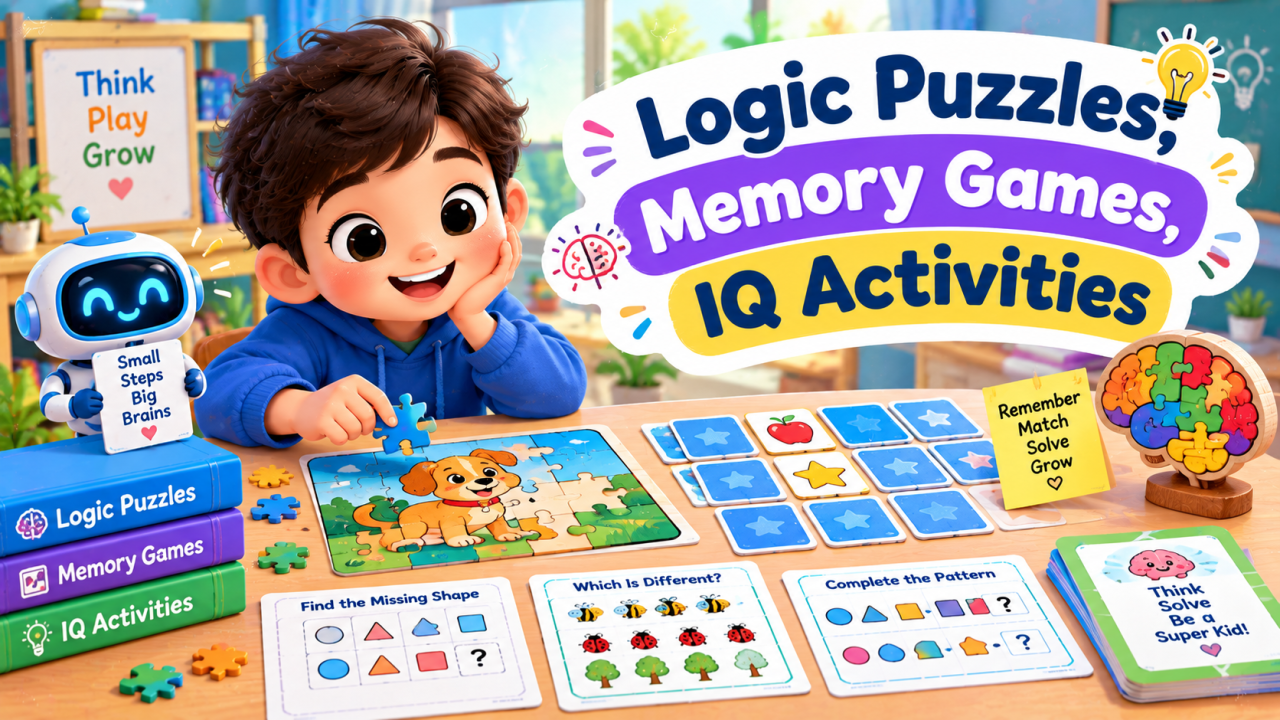
Explore fun logic puzzles, memory games, and IQ activities for kids to build problem-solving, concentration, observation, reasoning, and thinking skills.
Logic Puzzles, Memory Games & IQ Activities for Kids
Children naturally enjoy activities that make them think, discover patterns, remember information, and solve problems. Logic puzzles, memory games, and IQ activities can turn these skills into enjoyable learning experiences at home or in the classroom.
These activities do not need expensive equipment or complicated instructions. A simple matching game, number puzzle, pattern activity, or "find the difference" challenge can give children an opportunity to think carefully and explain their ideas.
The goal is not to make every activity difficult. Good brain activities should be suitable for the child's age and provide an appropriate level of challenge.
Why Logic Puzzles and Brain Activities Matter
Children use thinking skills throughout everyday life.
They make decisions, remember instructions, compare objects, recognize patterns, solve problems, and figure out what to do next.
Activities that encourage these skills can give children additional opportunities to practice them.
For example, a child solving a simple pattern puzzle may need to:
- Look carefully at the sequence.
- Identify what changes.
- Notice what stays the same.
- Predict the next item.
- Check the answer.
- Story Land
- Number Ninjas
- Word Wizards
- Brain Boosters 10.Puzzle Path
This is a simple activity, but it involves observation and reasoning.
What Are Logic Puzzles for Kids?
Logic puzzles are activities that require children to use clues, patterns, relationships, or reasoning to find an answer.
They can include:
- Matching puzzles
- Number patterns
- Picture sequences
- Odd-one-out activities
- Sorting puzzles
- Simple riddles
- Maze activities
- Sudoku-style puzzles
- Classification activities
- Deduction puzzles
The difficulty should increase gradually.
A preschool child may identify which object does not belong in a group, while an older child may solve a multi-step logic problem using several clues.
Simple Example
Look at the pattern:
⭐ ⭐ 🔵 ⭐ ⭐ 🔵 ⭐ ⭐ __
What comes next?
The child needs to recognize that the pattern repeats:
⭐ ⭐ 🔵
So the missing shape is:
🔵
This type of activity introduces pattern recognition in a simple way.
What Are Memory Games for Kids?
Memory games are activities that ask children to remember information and use it later.
Common examples include:
- Matching pairs
- Remembering pictures
- Sequence recall
- Card memory games
- Object memory games
- Number recall
- Word recall
- Story memory activities
- Simon Says-style activities
Memory games can be played with cards, paper, household objects, or simply through conversation.
Simple Memory Game
Place five objects on a table.
For example:
- Pencil
- Spoon
- Toy
- Book
- Ball
Give the child a short time to look at them.
Then cover the objects and ask:
"Can you remember all five objects?"
You can make the game easier or harder depending on the child's age.
What Are IQ Activities for Kids?
The term IQ activity is often used online for puzzles and brain challenges that involve skills such as reasoning, pattern recognition, memory, classification, and problem-solving.
For children, these activities can include:
- Pattern puzzles
- Number sequences
- Visual reasoning
- Shape matching
- Classification
- Analogies
- Spatial puzzles
- Logical sequences
- Odd-one-out questions
It is important to treat these activities as learning and thinking exercises rather than as a way to measure a child's overall intelligence.
A single puzzle cannot provide a complete picture of how a child learns or thinks.
Types of Logic Puzzles for Kids
1. Pattern Puzzles
Pattern puzzles ask children to identify a repeating or changing sequence.
Example:
🔴 🔵 🔴 🔵 🔴 __
Answer:
🔵
Pattern activities can use:
- Colors
- Shapes
- Numbers
- Letters
- Pictures
- Objects
For younger children, visual patterns are often easier to understand.
2. Odd-One-Out Puzzles
Show a group of objects and ask which one is different.
Example:
Apple – Banana – Orange – Car
The car is different because the other three are fruits.
This activity encourages children to classify objects based on shared characteristics.
3. Matching Puzzles
Matching activities ask children to connect related items.
Examples include:
- Animal → Home
- Animal → Food
- Number → Quantity
- Shape → Name
- Uppercase letter → Lowercase letter
Matching can be adapted for many ages and subjects.
4. Sequence Puzzles
Sequence puzzles ask children to put events or pictures in the correct order.
For example:
Plant seed → Water plant → Plant grows
Children learn to recognize order and relationships between events.
5. Maze Puzzles
Mazes require children to find a path from one point to another.
They can help children practice:
- Visual tracking
- Planning
- Attention
- Problem-solving
- Following a route
Simple mazes are suitable for younger children, while older children can try more complex paths.
Types of Memory Games
Matching Cards
Place cards face down and ask children to find matching pairs.
The player turns over two cards at a time and tries to remember where each picture is located.
This creates a simple memory challenge that can be adjusted by changing the number of cards.
Remember the Sequence
Say a sequence such as:
2 – 5 – 8
Ask the child to repeat it.
Older children can try longer sequences.
You can also use colors, words, or movements.
What Changed?
Place several objects on a table.
Let the child observe them.
Then remove one object or change its position.
Ask:
"What changed?"
This combines memory and observation.
Story Recall
Tell a short story and ask questions afterward.
For example:
"Riya went to the park with her red ball. She played near the swings and then went home."
Questions:
- Who went to the park?
- What color was the ball?
- Where did she play?
- What happened at the end?
This combines listening, memory, and comprehension.
Logic Puzzles by Age Group
Different ages require different levels of challenge.
| Age or Level | Suitable Activities |
|---|---|
| Preschool | Matching, sorting, simple patterns, picture memory |
| Kindergarten | Mazes, sequences, odd-one-out, memory matching |
| Grade 1 | Number patterns, simple riddles, visual reasoning |
| Grade 2 | Logic grids, sequences, classification, memory challenges |
| Grade 3+ | Multi-step puzzles, Sudoku-style activities, deduction puzzles |
These are general examples rather than strict rules. A child's experience and current skill level also matter.
Logic Activities for Preschool Kids
Preschool children can start with very simple thinking activities.
Useful examples include:
Sorting
Ask children to sort objects by:
- Color
- Size
- Shape
- Type
For example:
Put all the red objects together.
Simple Patterns
Use blocks, toys, or pictures.
🔴 🔵 🔴 🔵 __
Ask the child what comes next.
Matching
Match:
- Same colors
- Same shapes
- Same pictures
- Big and small objects
Picture Memory
Show two or three pictures and then cover them.
Ask the child to name what they remember.
These activities should be short and playful.
Logic Activities for Kindergarten Kids
Kindergarten children can usually handle slightly more structured challenges.
Examples include:
- Picture sequences
- Simple mazes
- Number patterns
- Memory matching
- Odd-one-out
- Classification
- Shape puzzles
- Simple riddles
Example Number Pattern
1, 2, 3, 4, __
Answer:
5
Once children understand simple sequences, introduce slightly more challenging patterns.
2, 4, 6, 8, __
Answer:
10
IQ-Style Activities for Grade 1 Kids
Grade 1 children can try activities that require more reasoning.
Examples include:
Find the Missing Shape
○ △ ○ △ ○ __
Answer:
△
Number Sequence
5, 10, 15, 20, __
Answer:
25
Classification
Which one does not belong?
Dog – Cat – Rabbit – Car
Answer:
Car
The important part is asking children to explain why they chose the answer.
Why Asking "Why?" Is Important
A child can sometimes guess a correct answer without understanding the reasoning.
After a puzzle, ask:
"How did you find the answer?"
or:
"What made you choose that one?"
For example, if a child selects a triangle in an odd-one-out puzzle, encourage them to explain the difference.
This shifts the activity from simply finding an answer to explaining a thought process.
Benefits of Logic Puzzles for Kids
Age-appropriate logic activities can provide practice in several areas.
Problem-Solving
Children need to work out what information is useful and what action to take.
Pattern Recognition
Children learn to notice repeating sequences and relationships.
Observation
Many puzzles require children to look carefully at small details.
Reasoning
Children use clues and relationships to reach a conclusion.
Logic Puzzles, Memory Games & IQ Activities: Advanced Ideas and Practical Games
Advanced Logic Puzzle Ideas for Kids
Once children become comfortable with simple matching, sorting, and pattern activities, they can try puzzles that require multiple steps of thinking.
The goal is not simply to make puzzles harder. The activity should encourage children to observe information, make connections, test ideas, and explain their answers.
1. Number Pattern Puzzles
Number patterns are a simple way to introduce logical thinking.
For example:
2, 4, 6, 8, __
The child needs to identify that the numbers increase by 2.
Answer:
10
Once children understand simple patterns, try sequences with different rules.
5, 10, 15, 20, __
Answer:
25
For older children, introduce patterns where the rule changes or requires multiple steps.
2. Shape Pattern Puzzles
Visual patterns can be useful for children who enjoy pictures more than numbers.
Example:
○ △ ○ △ ○ __
Answer:
△
A more challenging example can use three shapes:
□ ○ △ □ ○ △ __
Answer:
□
Ask the child to explain the repeating pattern rather than simply giving the answer.
3. Classification Puzzles
Classification activities ask children to group items based on shared characteristics.
Example:
Apple – Banana – Carrot – Orange
Which item is different?
The answer is Carrot if the classification is based on fruits.
However, children may sometimes identify a different rule. This creates an opportunity to ask:
"What rule did you use?"
The explanation is often more valuable than simply selecting an answer.
Memory Games That Can Be Played Without Special Equipment
Parents and teachers can create memory games using everyday objects.
Game 1: Remember the Objects
Place five objects on a table.
For example:
- Pencil
- Cup
- Book
- Toy
- Spoon
Allow the child to look at them.
Cover the objects and ask the child to name as many as possible.
To increase the challenge, add more objects.
Game 2: What Is Missing?
Place several objects where the child can see them.
Ask the child to close their eyes.
Remove one object.
Ask:
"What is missing?"
This combines observation and memory.
Game 3: What Changed?
Arrange three or four objects.
Let the child look carefully.
Then change the position of one object.
Ask:
"What changed?"
This can be made more challenging by changing two objects.
Game 4: Remember the Sequence
Say a short sequence:
Red – Blue – Green
Ask the child to repeat it in the same order.
Older children can try longer sequences.
You can also use numbers:
3 – 7 – 2 – 9
Or actions:
Clap – Jump – Tap
This turns memory practice into an active game.
Visual Memory Activities
Visual memory involves remembering what was seen.
Simple activities include:
- Remembering pictures
- Matching cards
- Finding pairs
- Remembering object positions
- Recreating a picture arrangement
- Identifying changes
Example
Show a child four pictures:
🐱 🐶 🐟 🐰
Cover the pictures.
Ask:
"Which animals did you see?"
For younger children, start with two or three pictures and increase the number gradually.
Listening Memory Activities
Memory activities do not always need pictures.
Try a listening game.
Say:
"Apple, ball, cat."
Ask the child to repeat the words.
Then increase the sequence:
"Apple, ball, cat, dog."
For older children, ask them to repeat the words backward or identify a specific word from the sequence.
The activity should remain age appropriate and enjoyable.
Observation Games for Kids
Observation activities ask children to notice details.
Find the Difference
Show two similar pictures and ask children to find differences.
Possible differences include:
- Missing object
- Different color
- Changed shape
- Different number of items
- Changed position
Spot the Odd Object
Show several similar objects with one different item.
Example:
🍎 🍎 🍎 🍌 🍎
Ask:
"Which one is different?"
Detail Hunt
Give children a simple challenge:
"Find three things in the room that are round."
This turns the environment into a learning activity.
Brain Games for Preschool Children
Preschool activities should be simple and visual.
Good choices include:
- Matching identical pictures
- Sorting objects
- Simple patterns
- Shape matching
- Color sorting
- Picture memory
- Easy mazes
- Finding differences
- Simple sequencing
Example Sorting Activity
Give a child several blocks in different colors.
Ask them to make groups:
Red → Red → Red
Blue → Blue → Blue
The child is practicing classification while playing.
Brain Games for Kindergarten Children
Kindergarten children can gradually move toward more structured challenges.
Suitable activities include:
- Number sequences
- Picture sequences
- Simple riddles
- Matching games
- Mazes
- Odd-one-out puzzles
- Memory cards
- Shape patterns
- Sorting challenges
Example
Complete the pattern:
1, 3, 5, 7, __
Answer:
9
Ask the child:
"What is the rule?"
The answer is that the numbers increase by 2.
Brain Games for Grade 1 and Grade 2
Older children can try puzzles involving multiple clues or steps.
Examples include:
- Number patterns
- Word puzzles
- Classification
- Simple logic grids
- Analogies
- Multi-step mazes
- Visual sequences
- Riddles
- Memory challenges
Example Logic Question
Riya is taller than Sam.
Sam is taller than Mia.
Who is the shortest?
Answer:
Mia
The child needs to use the relationships between the three people to reach the answer.
Brain Games for Older Kids
Older children can try more challenging activities such as:
- Sudoku-style puzzles
- Logic grids
- Number sequences
- Word riddles
- Analogies
- Spatial reasoning
- Multi-step deduction puzzles
- Complex mazes
- Strategy games
For these activities, encourage children to write down clues or eliminate possibilities.
This helps them organize their thinking.
Logic Puzzles vs Memory Games
Logic puzzles and memory games can both involve concentration, but their main purposes can differ.
| Feature | Logic Puzzles | Memory Games |
|---|---|---|
| Main focus | Reasoning | Recall |
| Common activity | Number sequence | Matching cards |
| Uses clues | Often | Sometimes |
| Pattern recognition | Common | Sometimes |
| Visual memory | Sometimes | Often |
| Problem-solving | Strong focus | May be involved |
| Example | Logic grid | Remember the objects |
A balanced collection can include both types.
IQ-Style Activities vs Traditional Learning Worksheets
IQ-style activities are often presented as puzzles or challenges, while traditional worksheets usually focus on specific academic skills.
| Activity | Primary Purpose |
|---|---|
| Math worksheet | Practice mathematical concepts |
| Phonics worksheet | Practice sounds and reading |
| Logic puzzle | Practice reasoning |
| Memory game | Practice recall |
| Maze | Practice planning and visual tracking |
| Pattern activity | Practice recognizing relationships |
| Reading worksheet | Practice comprehension |
Children can benefit from using both academic worksheets and thinking activities.
Pros of Logic and Memory Activities
Encourages Active Thinking
Children need to interact with the problem rather than simply copy information.
Can Be Turned Into Games
Many activities can be played individually, with a parent, or in groups.
Flexible for Different Ages
The same basic activity can be simplified or made more challenging.
Requires Few Materials
Many games can be played using paper, cards, toys, or household objects.
Supports Conversation
Parents and teachers can ask children to explain how they solved a puzzle.
Limitations to Keep in Mind
A Puzzle Is Not a Complete Intelligence Test
Solving one type of puzzle does not provide a complete measurement of a child's overall abilities.
Difficulty Should Be Appropriate
A puzzle that is too difficult may create frustration rather than productive challenge.
Variety Matters
Children should have opportunities to read, write, play, create, move, communicate, and explore—not just solve puzzles.
Avoid Excessive Competition
Some children enjoy competition, while others may become discouraged by it.
Focus on learning and improvement rather than comparing children.
Common Mistakes When Using Brain Games
Mistake 1: Making Every Puzzle Difficult
Not every activity needs to be a challenge.
Better approach: Start with easy puzzles and increase difficulty gradually.
Mistake 2: Giving the Answer Too Quickly
If a child struggles, immediately giving the answer removes the opportunity to think.
Better approach: Give a small hint.
For example:
"Look at what changes between each number."
Mistake 3: Focusing Only on Speed
Fast answers do not always mean better understanding.
Give children time to observe and reason.
Mistake 4: Using the Same Game Repeatedly
Repeated practice can be useful, but children also need variety.
Rotate between:
- Logic
- Memory
- Observation
- Patterns
- Mazes
- Riddles
- Sorting
Mistake 5: Comparing Children
Avoid statements such as:
"Your friend solved it faster."
Instead say:
"Let's look at your method and see what you noticed."
Best Practices for Parents
Start Simple
Introduce activities that the child can understand without too much explanation.
Ask Open Questions
Instead of asking only:
"What is the answer?"
Try:
"How did you figure it out?"
Give Hints
A small hint can help children continue thinking without solving the problem for them.
Celebrate Effort
Recognize persistence, careful observation, and good explanations.
Follow the Child's Interest
If a child enjoys number puzzles, introduce more number-based activities. If they enjoy pictures, use visual puzzles.
Best Practices for Teachers
Teachers can integrate thinking activities into regular lessons.
Use Puzzles as Warm-Ups
A five-minute puzzle can introduce a lesson or get students thinking.
Create Small Groups
Students can work together to solve a puzzle and explain their reasoning.
Use Brain Breaks
Short memory or observation games can provide a change of pace between academic activities.
Connect Puzzles to Subjects
A number sequence can support math learning.
A word riddle can support vocabulary.
A story recall game can support reading comprehension.
Encourage Explanations
Ask students to explain the steps they used.
This gives teachers useful information about how students approach problems.
How to Build a Weekly Brain-Game Routine
A simple weekly routine could look like this:
| Day | Activity |
|---|---|
| Monday | Number or shape pattern |
| Tuesday | Memory matching |
| Wednesday | Maze or visual puzzle |
| Thursday | Riddle or classification game |
| Friday | Mixed brain challenge |
The routine can be adjusted according to the child's age and school schedule.
The activities do not need to take a long time. A short challenge can be enough to add variety to a learning routine.
How to Track Progress Without Turning It Into a Test
Parents can keep a simple record of the types of activities a child can complete independently.
For example:
| Skill | Earlier | Later |
|---|---|---|
| Simple patterns | Needed help | Independent |
| Memory matching | 3 pairs | 6 pairs |
| Number sequences | Simple | More complex |
| Mazes | Needed guidance | More independent |
This type of observation can help parents understand which activities are becoming easier.
The focus should be on progress rather than assigning an intelligence score.
How to Make Logic Activities More Fun
Add a Story
Turn a puzzle into a small challenge.
For example:
"The robot needs to find the correct path to reach the charging station."
Then give the child a maze.
Use Favorite Themes
Use animals, vehicles, space, dinosaurs, or other topics the child enjoys.
Create Family Challenges
Parents and children can solve puzzles together.
Let Children Create Their Own Puzzles
Ask a child to create a pattern for someone else to solve.
This changes the child from a puzzle solver into a puzzle creator.
Final Best Practice
Logic puzzles, memory games, and IQ-style activities are most useful when they are treated as enjoyable opportunities to think.
Children do not need to solve extremely difficult puzzles to benefit from these activities. Simple challenges can encourage observation, memory, reasoning, and problem-solving when they are presented at the right level.
Mix different activities, provide hints when needed, and encourage children to explain their thinking.
Most importantly, keep the experience enjoyable. A child who is curious and willing to try another solution is already practicing an important part of problem-solving.
Concentration
A puzzle often requires children to stay focused until they find a solution.
Creativity
Some problems can have different ways of being approached.
Persistence
A challenging puzzle can encourage children to try another approach when the first attempt does not work.
These are skills that children can use in many learning situations.
Benefits of Memory Games
Memory games provide opportunities to practice remembering information.
They may involve:
- Visual memory
- Listening memory
- Sequence recall
- Recognition
- Attention
- Concentration
For example, remembering the position of a matching card requires the child to pay attention to where the card was previously seen.
Logic Puzzles vs Memory Games vs IQ Activities
These activities overlap, but they do not have exactly the same focus.
| Activity | Main Focus | Example |
|---|---|---|
| Logic puzzles | Reasoning and problem-solving | Solve a sequence |
| Memory games | Recall and recognition | Find matching cards |
| IQ-style activities | Reasoning and pattern tasks | Find the missing shape |
| Observation games | Attention to details | Find the differences |
| Sorting games | Classification | Group objects |
| Maze puzzles | Planning and visual tracking | Find the correct path |
Using a mixture of activities can give children different types of thinking practice.
How Parents Can Use Brain Games at Home
Parents do not need to create a formal study session.
A few minutes of puzzle time can be added to an ordinary day.
For example:
Morning: One simple number pattern
Afternoon: Memory matching game
Evening: Short riddle or observation activity
The activity should feel like a game rather than a test.
Parents can also use household objects.
Try:
- Sorting buttons by color
- Arranging toys by size
- Remembering a short shopping list
- Finding objects with a particular shape
- Creating patterns with blocks
This makes thinking practice accessible without special materials.
How Teachers Can Use Logic and Memory Activities
Teachers can use these activities as part of classroom learning.
They can be useful for:
- Warm-up activities
- Small-group work
- Brain breaks
- Independent activities
- Early-finisher tasks
- Revision
- Classroom games
For example, a teacher teaching number patterns can begin with a short pattern challenge before introducing the lesson.
A memory activity can also be used after a reading lesson to check whether students remember important details.
Keep the Challenge Age-Appropriate
A good puzzle should make children think without making them feel that they cannot succeed.
If an activity is too easy, children may lose interest.
If it is too difficult, they may become frustrated.
A useful approach is to provide gradual levels:
Level 1: Simple pattern
Level 2: Longer pattern
Level 3: Pattern with two changing elements
For example:
Level 1: 🔴 🔵 🔴 🔵 __
Level 2: 🔴 🔵 🟢 🔴 🔵 🟢 __
Level 3: 🔴 🔵 🔵 🟢 🔴 🔵 🔵 __
The child can move forward after understanding the earlier pattern.
Final Thought for Part 1
Logic puzzles, memory games, and IQ-style activities can make learning more engaging while giving children opportunities to practice reasoning, observation, memory, concentration, and problem-solving.
The best activities are not necessarily the hardest ones. They are the ones that match the child's level, encourage thinking, and make the child want to try again.
In the next section, we will look at more advanced puzzle ideas, practical examples, comparisons, common mistakes, and best practices for using these activities with children.
Conclusion
Logic puzzles, memory games, and IQ activities can be a fun way to give children extra opportunities to practice thinking skills.
From simple matching and sorting games to number patterns, memory challenges, mazes, riddles, and visual reasoning puzzles, these activities can be adapted for different ages and learning levels.
The goal should not be to make children solve the hardest puzzle possible. Instead, choose activities that are challenging enough to encourage thinking while still allowing children to experience progress and success.
For younger children, start with simple patterns, matching, sorting, and picture memory games. As children become more comfortable, introduce sequences, reasoning puzzles, multi-step challenges, and more complex memory activities.
Parents and teachers can also make these activities more meaningful by asking children to explain how they reached an answer. This encourages them to think about the process rather than simply guessing the correct answer.
Used alongside reading, math, creative activities, games, and hands-on learning, logic puzzles and memory games can become a useful part of a balanced learning routine.
Call To Action
Ready to make learning more engaging?
Explore our collection of logic puzzles, memory games, and IQ activities for kids and find age-appropriate challenges for home or classroom use.
Choose a puzzle, give your child time to think, and encourage them to explain how they found the answer. Start with simple activities and gradually introduce more challenging puzzles as their skills develop.
Explore our kids' brain games and printable activities today for fun, screen-free learning practice.
Frequently Asked Questions
1. What are logic puzzles for kids?
Logic puzzles for kids are activities that require children to use clues, patterns, relationships, or reasoning to find an answer. Examples include sequences, matching puzzles, classification tasks, mazes, and simple deduction puzzles.
2. What are memory games for kids?
Memory games are activities that encourage children to remember and recall information. Matching cards, sequence recall, picture memory, and "what changed?" games are common examples.
3. What are IQ activities for kids?
IQ activities for kids generally refer to puzzles and thinking challenges involving skills such as pattern recognition, reasoning, classification, visual thinking, and problem-solving. They should be treated as learning activities rather than complete measures of a child's intelligence.
4. What age can children start playing logic games?
Young children can start with simple matching, sorting, patterns, and picture-based activities. The difficulty can gradually increase as their reasoning and attention skills develop.
5. Are memory games good for preschool children?
Yes. Simple memory activities can be suitable for preschool children. For example, parents can use picture matching, object recall, or short sequences that are appropriate for the child's age.
6. What are some easy logic activities for kindergarten children?
Kindergarten children can try simple mazes, picture sequences, odd-one-out activities, sorting games, shape patterns, matching puzzles, and basic number sequences.
7. How can I make memory games more difficult?
You can gradually increase the number of cards or objects, use longer sequences, reduce the amount of viewing time, or introduce more similar-looking items. Increase difficulty gradually rather than making the game frustrating.
8. How often should children play logic and memory games?
There is no fixed schedule that applies to every child. Short and regular activities can be included as part of play or learning time. The important factors are age-appropriate difficulty, enjoyment, and variety.
9. Can teachers use logic puzzles in the classroom?
Yes. Teachers can use logic puzzles and memory games as warm-up activities, brain breaks, small-group tasks, independent work, revision activities, or early-finisher activities.
10. Do logic puzzles and IQ games measure a child's intelligence?
A single puzzle or game cannot provide a complete measure of a child's intelligence or overall learning ability. These activities are better viewed as opportunities to practice specific skills such as reasoning, memory, observation, and problem-solving.