Fun Ways to Learn Multiplication Tables: 25 Easy Ideas for Kids
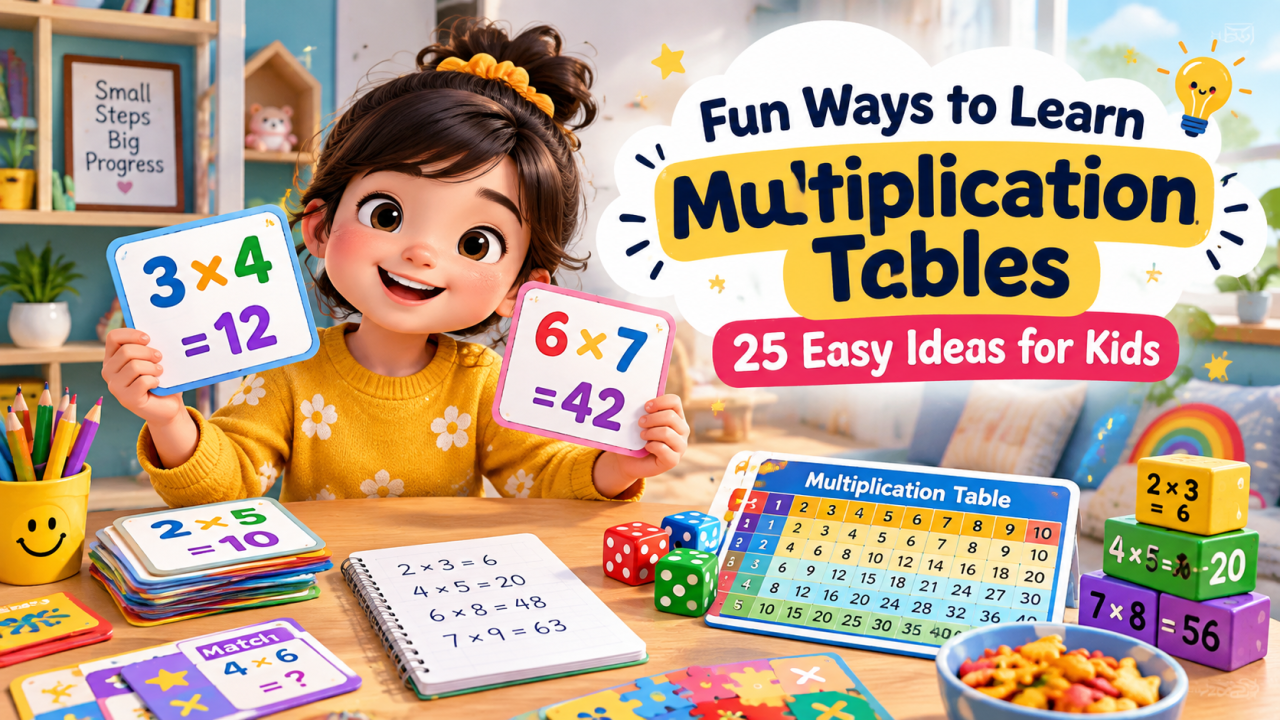
Discover 25 fun ways to learn multiplication tables using games, songs, cards, movement, and simple daily activities that make multiplication easier for kids.
Fun Ways to Learn Multiplication Tables: 25 Easy Ideas for Kids
Learning multiplication tables does not have to mean sitting with a worksheet and repeating the same facts again and again.
There are many fun ways to learn multiplication tables using games, movement, songs, cards, dice, drawing, and everyday objects. These activities can help children understand multiplication while also giving them plenty of practice.
The key is to make practice short, active, and regular.
Instead of asking a child to memorize dozens of facts at once, introduce a small group of facts and practice them in different ways. Over time, the facts become easier to remember.
Worksheets & Activities
Why Should Children Learn Multiplication Tables?
Multiplication facts are an important part of elementary math.
When children know basic multiplication facts, they can solve later math problems more easily. Multiplication is used when learning:
- Division
- Fractions
- Area
- Measurement
- Word problems
- Multi-digit multiplication
- Decimals
- Ratios
- Percentages
For example, knowing that:
6 × 4 = 24
helps a child solve problems without having to count groups from the beginning every time.
However, children should not be expected to memorize facts without understanding what multiplication means.
What Does Multiplication Mean?
Multiplication can be understood as equal groups.
For example:
3 × 4
can mean 3 groups of 4.
That gives:
4 + 4 + 4 = 12
So:
3 × 4 = 12
Showing multiplication as groups can make multiplication tables easier to understand.
Children can use blocks, buttons, pencils, toys, or drawings to build these groups.
25 Fun Ways to Learn Multiplication Tables
Here are simple activities that parents and teachers can use at home or in the classroom.
1. Make a Multiplication Hopscotch Game
Turn multiplication practice into a movement game.
Write numbers on the floor using paper cards or chalk.
For example, make cards showing:
2, 4, 6, 8, 10, 12
Ask:
"What is 2 × 4?"
The child finds or jumps to 8.
You can change the table each time.
Why it works
The child connects multiplication facts with physical movement, making practice more active and memorable.
2. Use Multiplication Flashcards
Flashcards are a simple way to practice multiplication facts.
Write the question on one side:
7 × 3 = ?
Write the answer on the other:
21
Show one card at a time and let the child answer.
Keep the session short.
Try 5–10 cards rather than making the child go through a large stack every time.
Make it more fun
Ask the child to beat their own previous score rather than competing against someone else.
3. Roll Two Dice and Multiply
This is an easy multiplication game for home or school.
Give the child two dice.
Ask them to roll both.
If they roll:
4 and 6
they calculate:
4 × 6 = 24
Then roll again.
Variation
Give one point for every correct answer.
For younger children, use dice with smaller numbers or make your own number cards.
4. Play Multiplication Bingo
Create a bingo board with multiplication answers.
For example:
| 6 | 12 | 18 |
|---|---|---|
| 24 | 30 | 36 |
| 42 | 48 | 54 |
Call out a multiplication fact such as:
6 × 5
The child finds 30 and marks it.
Continue until someone completes the agreed pattern.
Multiplication bingo can be played with two or more children.
5. Sing Multiplication Tables
Songs and rhythm can make repeated facts easier to remember.
Choose one multiplication table and say it with a steady beat.
For example:
3, 6, 9, 12, 15, 18...
You can clap while saying the numbers.
Children can also create their own rhythm for a table.
Try this
Clap once for each answer:
4, 8, 12, 16, 20
This combines sound, rhythm, and repetition.
6. Use a Multiplication Chart
A multiplication chart gives children a visual reference.
Start with a small section rather than asking them to memorize the whole chart.
For example, focus on the:
- 2 times table
- 5 times table
- 10 times table
Then gradually introduce other tables.
Ask children to look for patterns.
For example, the answers in the 5 times table end in:
5, 0, 5, 0...
The 10 times table ends in:
0
Finding patterns helps children understand that multiplication facts are connected.
7. Play Multiplication War
This is a simple card game for two players.
Use a deck of number cards.
Each player turns over one card.
Multiply the two numbers.
For example:
Player 1 draws 4.
Player 2 draws 5.
The multiplication fact is:
4 × 5 = 20
You can give a point for a correct answer.
Easier version
Use only cards from 1 to 5.
Harder version
Use cards up to 10 or 12.
8. Build Arrays With Blocks
Arrays are a great way to show what multiplication means.
Give a child 12 blocks.
Ask them to make:
3 rows of 4
They can build:
● ● ● ●
● ● ● ●
● ● ● ●
Then ask:
How many blocks are there?
The child can see:
3 × 4 = 12
Arrays also help children understand why multiplication can be represented in different ways.
9. Draw Multiplication Pictures
Children can draw groups to solve multiplication facts.
For:
4 × 3
they can draw four groups of three:
⭐⭐⭐
⭐⭐⭐
⭐⭐⭐
⭐⭐⭐
Then count:
3 + 3 + 3 + 3 = 12
So:
4 × 3 = 12
This activity is especially useful when a child is still developing multiplication understanding.
10. Use Everyday Objects
You do not need special math materials.
Use objects around the house.
For example:
- 4 plates with 2 spoons each
- 3 boxes with 5 pencils each
- 5 pairs of socks
- 2 rows of 6 books
- 4 groups of 3 toys
Ask:
"How many are there altogether?"
Then connect the situation to multiplication.
For example:
4 groups × 3 toys = 12 toys
This shows children that multiplication is useful outside worksheets.
11. Play a Multiplication Matching Game
Make two sets of cards.
One set contains multiplication questions:
- 2 × 5
- 3 × 4
- 5 × 6
- 7 × 2
The other set contains answers:
- 10
- 12
- 30
- 14
Mix the cards.
Children match each question with its answer.
Make it harder
Add similar answers to make children think carefully.
For example:
3 × 4 = 12
and
2 × 6 = 12
This helps children understand that different multiplication facts can have the same product.
12. Try a Times Table Treasure Hunt
Hide multiplication questions around a room.
For example:
Card 1: 2 × 5
Card 2: 3 × 4
Card 3: 5 × 5
Give the child a recording sheet.
They find each card, solve the multiplication problem, and write the answer.
You can turn the activity into a treasure hunt by giving a small clue after each correct answer.
13. Use a Multiplication Number Line
A number line can help children understand multiplication as repeated jumps.
For:
4 × 3
start at 0 and make four jumps of 3:
0 → 3 → 6 → 9 → 12
Therefore:
4 × 3 = 12
This is especially helpful for children who are still connecting multiplication with repeated addition.
14. Play "What's Missing?"
Write an incomplete multiplication fact.
For example:
6 × ___ = 24
Ask the child to find the missing number.
The answer is:
4
because:
6 × 4 = 24
You can also try:
___ × 5 = 20
or:
3 × ___ = 18
Missing-number problems encourage children to think about multiplication relationships rather than simply recite facts.
15. Make a Multiplication Wheel
Create a simple paper multiplication wheel.
Put a number in the center, such as 4.
Around it, write:
1, 2, 3, 4, 5, 6, 7, 8, 9, 10
The child calculates:
- 4 × 1 = 4
- 4 × 2 = 8
- 4 × 3 = 12
- 4 × 4 = 16
- 4 × 5 = 20
Continue around the wheel.
Children can decorate their wheels and keep them for practice.
Start With Easier Multiplication Tables
Children do not need to learn every multiplication table at the same time.
A gradual approach can reduce frustration.
Start With the 2 Times Table
The 2 times table is closely connected to counting by 2s.
2, 4, 6, 8, 10, 12...
Use pairs of objects to demonstrate it.
Practice the 5 Times Table
The 5 times table has an easy-to-see pattern.
5, 10, 15, 20, 25, 30...
The products end in either 5 or 0.
Children can practice by counting groups of five objects.
Learn the 10 Times Table
The 10 times table is often straightforward to recognize.
10, 20, 30, 40, 50...
Children can connect it to groups of ten and place value.
Then Add Other Tables
Once children are comfortable with easier patterns, introduce tables such as:
- 3
- 4
- 6
- 7
- 8
- 9
The exact order can be adjusted based on the child's learning needs.
Teach Patterns Instead of Only Memorizing
Multiplication tables contain useful patterns.
For example, the 2 times table increases by 2 each time:
2, 4, 6, 8, 10, 12
The 5 times table increases by 5:
5, 10, 15, 20, 25, 30
The 10 times table increases by 10:
10, 20, 30, 40, 50
Ask children:
"What do you notice?"
This simple question encourages mathematical thinking.
Use Multiplication Facts Children Already Know
Children can use known facts to find new ones.
For example, if a child knows:
5 × 4 = 20
they can use that fact to think about:
6 × 4
Add one more group of 4:
20 + 4 = 24
Therefore:
6 × 4 = 24
This approach can be more useful than asking children to memorize every fact separately.
Teach the Commutative Property
Children should learn that the order of factors can be switched.
For example:
3 × 4 = 12
and:
4 × 3 = 12
Both facts have the same product.
Use arrays to demonstrate this.
A rectangle with 3 rows of 4 has 12 objects.
Turn the array around and it becomes 4 rows of 3.
There are still 12 objects.
This means children may not need to memorize both facts as completely separate facts.
Make Multiplication Practice Short
Long practice sessions can make multiplication feel tiring.
Instead, try short sessions throughout the week.
For example:
Monday: 5 minutes of flashcards
Tuesday: Dice multiplication game
Wednesday: Multiplication song
Thursday: Array activity
Friday: Multiplication bingo
Saturday: Quick review
Sunday: Rest or casual practice
Short, regular practice can help children revisit facts without feeling overwhelmed.
Avoid Making Speed the Main Goal
Fast recall can be useful, but speed should not be the only measure of success.
A child may know that:
7 × 6 = 42
but need a few seconds to remember it.
That does not necessarily mean the child does not understand multiplication.
First focus on:
- Understanding the concept
- Getting the answer correct
- Explaining the strategy
- Building accurate recall
- Increasing speed naturally over time
Accuracy and understanding should come before racing through facts.
Use Multiplication in Daily Life
Everyday situations can become quick multiplication practice.
At the dinner table
"There are 4 plates. Each plate has 2 pieces of bread. How many pieces are there?"
4 × 2 = 8
While organizing toys
"There are 3 boxes. Each box has 5 cars. How many cars are there?"
3 × 5 = 15
While arranging books
"There are 4 shelves with 6 books on each shelf. How many books are there?"
4 × 6 = 24
These questions help children see multiplication as a useful everyday skill.
Let Children Create Their Own Multiplication Problems
One of the best ways to check understanding is to ask children to create a problem.
Give them:
4 × 5 = 20
Ask:
"Can you make a story for this multiplication fact?"
A child might say:
"There are 4 boxes. Each box has 5 pencils. There are 20 pencils altogether."
The child has now connected:
equation → groups → story → answer
That is deeper learning than simply memorizing the fact.
Simple Multiplication Practice Routine
A short routine can be enough for regular practice.
5-Minute Routine
Minute 1: Review 3 known facts.
Minute 2: Learn 2 new facts.
Minute 3: Use objects or drawings to show one fact.
Minute 4: Play a quick multiplication game.
Minute 5: Review the new facts again.
Keep the routine positive.
If the child is tired or frustrated, stop and try again later.
Common Mistakes When Learning Times Tables
Mistake 1: Trying to Learn Everything at Once
Children may become overwhelmed if they are given too many tables together.
Better approach: Focus on one table or a small group of related facts at a time.
Mistake 2: Only Using Repetition
Repeating facts can help with recall, but children also need to understand what multiplication means.
Better approach: Combine memorization with arrays, objects, drawings, and stories.
Mistake 3: Focusing Only on Speed
A child may rush and make many mistakes.
Better approach: Build accuracy first and let speed improve gradually.
Mistake 4: Practicing Only on Worksheets
Worksheets are useful, but children benefit from different types of practice.
Better approach: Mix worksheets with games, movement, cards, objects, and real-life examples.
Mistake 5: Making Mistakes Feel Like Failure
Multiplication takes practice.
Better approach: Treat mistakes as opportunities to find a different strategy.
For example, if a child forgets:
6 × 4
ask:
"Do you know 5 × 4?"
If they know:
5 × 4 = 20
they can add another 4:
20 + 4 = 24
So:
6 × 4 = 24
This teaches a useful strategy instead of simply giving the answer.
Worksheets & Activities
More Fun Ways to Learn Multiplication Tables
Once children understand the basic idea of multiplication, the next step is to give them different ways to practice. Some children remember facts better through movement, while others prefer pictures, patterns, games, or repeated practice.
Using different activities keeps multiplication practice fresh and gives children more than one way to remember a fact.
16. Multiplication Around the Room
Turn the room into a multiplication activity.
Write multiplication questions on small cards and place them around the room.
For example:
- 3 × 4 = ?
- 5 × 6 = ?
- 7 × 2 = ?
- 8 × 3 = ?
Give the child a notebook or recording sheet.
They walk around the room, find a card, solve the problem, and write the answer.
Make It More Active
Add a simple movement after each correct answer:
- 1 correct answer = 1 jump
- 2 correct answers = 2 claps
- 3 correct answers = 3 steps
The movement does not need to be complicated. The goal is to make practice active and enjoyable.
17. Multiplication Dice Challenge
Use two dice for a quick multiplication game.
Ask the child to roll both dice and multiply the numbers.
If the dice show:
3 and 5
the child solves:
3 × 5 = 15
Then roll again.
Make It a Family Game
Each player gets five turns.
Write down each multiplication fact and answer. Give one point for each correct answer.
The goal should be accurate thinking rather than making the game stressful.
18. Make a Multiplication Board Game
Create a simple path on paper.
Write multiplication questions on different spaces.
For example:
START → 2 × 4 → 5 × 3 → 4 × 6 → 7 × 2 → FINISH
Players roll a die and move forward.
When they land on a multiplication space, they solve the problem.
If they answer correctly, they stay on the space.
If they need help, let them use a multiplication chart or another strategy.
This turns repeated practice into a simple game.
19. Play "True or False?"
Say a multiplication statement and ask the child whether it is true or false.
For example:
4 × 5 = 20
True.
Then:
6 × 3 = 15
False.
Ask the child to correct it:
6 × 3 = 18
This activity helps children check multiplication facts instead of simply repeating them.
Try Some Tricky Ones
Include statements such as:
3 × 7 = 7 × 3
True.
This can reinforce the idea that changing the order of the factors does not change the product.
20. Multiplication Fact Relay
This activity works well with two or more children.
Write multiplication questions on cards and place them at one end of the room.
Children take turns:
- Walk or run to a card.
- Read the multiplication fact.
- Solve it.
- Return and record the answer.
The next player takes a turn.
For younger children, walking is perfectly fine.
The focus should be on solving the facts correctly.
21. Use Egg Cartons or Muffin Tins
An empty egg carton or muffin tray can become a multiplication tool.
For example, ask:
"Can you make 3 groups of 4?"
The child can place four small objects into each of three sections.
Then count:
4 + 4 + 4 = 12
So:
3 × 4 = 12
You can use:
- Buttons
- Pom-poms
- Small blocks
- Bottle caps
- Paper balls
Choose objects that are safe and suitable for the child's age.
22. Make Multiplication With Building Blocks
Building blocks can make multiplication visible.
Ask:
"Build 4 groups of 3 blocks."
The child builds four equal groups.
Then ask:
"How many blocks did you use?"
The child counts 12.
Write:
4 × 3 = 12
You can then rearrange the blocks into:
3 groups of 4
and show that the total is still 12.
This gives children a concrete model of multiplication.
23. Play the "Product Hunt" Game
Choose a target number.
For example:
Target: 24
Ask:
"Can you find multiplication facts that make 24?"
The child might find:
- 3 × 8 = 24
- 4 × 6 = 24
- 6 × 4 = 24
- 8 × 3 = 24
This helps children see connections between multiplication facts.
For children who are ready, ask them to find as many related facts as possible.
24. Find Multiplication Around the House
Ask children to look for equal groups in everyday objects.
For example:
- Eggs in an egg carton
- Wheels on toy cars
- Chairs arranged in rows
- Plates on a table
- Books on shelves
- Socks in pairs
- Tiles on the floor
Ask:
"Can you find an example of equal groups?"
Then turn it into a multiplication problem.
For example:
There are 4 rows of 5 chairs.
4 × 5 = 20
This helps children understand that multiplication is useful outside a math worksheet.
25. Make a Times Table Poster
Choose one multiplication table.
For example, the 6 times table.
Write:
6 × 1 = 6
6 × 2 = 12
6 × 3 = 18
6 × 4 = 24
6 × 5 = 30
Continue as appropriate for the child's level.
Let the child decorate the poster with drawings, patterns, or examples.
Place it somewhere the child can see it during the day.
The poster should be a learning aid, not something the child must memorize all at once.
Easy Strategies for Learning Each Times Table
Different multiplication tables have different patterns. Help children notice those patterns instead of treating every fact as completely new.
The 2 Times Table
Think about doubling.
For example:
2 × 6 = 12
because double 6 is 12.
Practice with pairs of objects.
The 3 Times Table
Think about groups of three.
For example:
3 × 4 = 12
This means three groups of four.
Children can also practice counting:
3, 6, 9, 12, 15...
The 4 Times Table
Think of the 4 times table as doubling twice.
For example:
4 × 6
Double 6:
6 + 6 = 12
Double 12:
12 + 12 = 24
So:
4 × 6 = 24
The 5 Times Table
Look for the pattern in the last digit.
The products end in:
5 or 0
For example:
5, 10, 15, 20, 25, 30
Counting by fives can make this table easier to learn.
The 6 Times Table
Build from a fact the child already knows.
For example:
5 × 4 = 20
Add one more group of 4:
20 + 4 = 24
So:
6 × 4 = 24
This strategy helps children work out facts they have not memorized yet.
The 7 Times Table
The 7 times table may need more practice because it has fewer simple patterns than some other tables.
Use:
- Flashcards
- Games
- Arrays
- Skip counting
- Known multiplication facts
For example:
7 × 5
can also be thought of as:
5 × 7
If the child knows the 5 times table, this gives them a useful connection.
The 8 Times Table
Think about doubling.
For example:
8 × 3
Double 3:
6
Double 6:
12
Double 12:
24
So:
8 × 3 = 24
This strategy helps children build the answer from a fact they already know.
The 9 Times Table
The 9 times table has some interesting patterns.
The products are:
9, 18, 27, 36, 45, 54, 63, 72, 81, 90
The digits of many of these products add to 9:
- 1 + 8 = 9
- 2 + 7 = 9
- 3 + 6 = 9
- 4 + 5 = 9
These patterns can be useful for checking answers, although children should still understand the multiplication facts rather than depend only on tricks.
The 10 Times Table
The 10 times table is closely connected to place value.
Examples:
3 × 10 = 30
7 × 10 = 70
9 × 10 = 90
Children can notice that multiplying a whole number by 10 gives a number with a zero in the ones place.
The 11 Times Table
For small single-digit numbers, the 11 times table has an easy pattern:
11 × 1 = 11
11 × 2 = 22
11 × 3 = 33
11 × 4 = 44
and so on.
Use this pattern as a helpful observation while still connecting the facts to equal groups.
The 12 Times Table
The 12 times table can be connected to groups of 12.
For example:
12 × 3 = 36
because:
12 + 12 + 12 = 36
Children can also use known facts to break the problem apart.
For example:
12 × 4
can be thought of as:
10 × 4 + 2 × 4
40 + 8 = 48
So:
12 × 4 = 48
Teach Patterns Instead of Only Memorizing
Multiplication tables contain useful patterns.
For example, the 2 times table increases by 2 each time:
2, 4, 6, 8, 10, 12
The 5 times table increases by 5:
5, 10, 15, 20, 25, 30
The 10 times table increases by 10:
10, 20, 30, 40, 50
Ask children:
"What do you notice?"
This simple question encourages mathematical thinking.
Use Multiplication Facts Children Already Know
Children can use known facts to find new ones.
For example, if a child knows:
5 × 4 = 20
they can use that fact to think about:
6 × 4
Add one more group of 4:
20 + 4 = 24
Therefore:
6 × 4 = 24
This approach can be more useful than asking children to memorize every fact separately.
Teach the Commutative Property
Children should learn that the order of factors can be switched.
For example:
3 × 4 = 12
and:
4 × 3 = 12
Both facts have the same product.
Use arrays to demonstrate this.
A rectangle with 3 rows of 4 has 12 objects.
Turn the array around and it becomes 4 rows of 3.
There are still 12 objects.
This means children can connect related facts instead of treating them as completely separate facts.
Make Multiplication Practice Short
Long practice sessions can make multiplication feel tiring.
Instead, try short sessions throughout the week.
For example:
Monday: 5 minutes of flashcards
Tuesday: Dice multiplication game
Wednesday: Multiplication song
Thursday: Array activity
Friday: Multiplication bingo
Saturday: Quick review
Sunday: Rest or casual practice
Short, regular practice can help children revisit facts without feeling overwhelmed.
Avoid Making Speed the Main Goal
Fast recall can be useful, but speed should not be the only measure of success.
A child may know:
7 × 6 = 42
but need a few seconds to remember it.
That does not mean the child does not understand multiplication.
First focus on:
- Understanding the concept
- Getting the answer correct
- Explaining the strategy
- Building accurate recall
- Increasing speed naturally over time
Accuracy and understanding should come before racing through facts.
Use Multiplication in Daily Life
Everyday situations can become quick multiplication practice.
At the Dinner Table
"There are 4 plates. Each plate has 2 pieces of bread. How many pieces are there?"
4 × 2 = 8
While Organizing Toys
"There are 3 boxes. Each box has 5 cars. How many cars are there?"
3 × 5 = 15
While Arranging Books
"There are 4 shelves with 6 books on each shelf. How many books are there?"
4 × 6 = 24
These questions help children see multiplication as a useful everyday skill.
Let Children Create Their Own Multiplication Problems
One of the best ways to check understanding is to ask children to create a problem.
Give them:
4 × 5 = 20
Ask:
"Can you make a story for this multiplication fact?"
A child might say:
"There are 4 boxes. Each box has 5 pencils. There are 20 pencils altogether."
The child has now connected:
equation → groups → story → answer
That is deeper learning than simply memorizing the fact.
Simple Multiplication Practice Routine
A short routine can be enough for regular practice.
5-Minute Routine
Minute 1: Review 3 known facts.
Minute 2: Learn 2 new facts.
Minute 3: Use objects or drawings to show one fact.
Minute 4: Play a quick multiplication game.
Minute 5: Review the new facts again.
Keep the routine positive.
If the child is tired or frustrated, stop and try again later.
Common Mistakes When Learning Times Tables
Mistake 1: Trying to Learn Everything at Once
Children may become overwhelmed if they are given too many tables together.
Better approach: Focus on one table or a small group of related facts at a time.
Mistake 2: Only Using Repetition
Repeating facts can help with recall, but children also need to understand what multiplication means.
Better approach: Combine memorization with arrays, objects, drawings, and stories.
Mistake 3: Focusing Only on Speed
A child may rush and make many mistakes.
Better approach: Build accuracy first and let speed improve gradually.
Mistake 4: Practicing Only on Worksheets
Worksheets are useful, but children benefit from different types of practice.
Better approach: Mix worksheets with games, movement, cards, objects, and real-life examples.
Mistake 5: Making Mistakes Feel Like Failure
Multiplication takes practice.
Better approach: Treat mistakes as opportunities to find a different strategy.
For example, if a child forgets:
6 × 4
ask:
"Do you know 5 × 4?"
If they know:
5 × 4 = 20
they can add another 4:
20 + 4 = 24
So:
6 × 4 = 24
This teaches a useful strategy instead of simply giving the answer.
Printable Multiplication Worksheet Ideas
You can create simple worksheets around one specific skill.
Worksheet 1: Fill in the Answers
2 × 3 = _____
2 × 5 = _____
2 × 7 = _____
2 × 9 = _____

## A 7-Day Multiplication Practice Plan

| Day       | Activity                          |      Time |
| --------- | --------------------------------- | --------: |
| Monday    | Review one table with a chart     |  5–10 min |
| Tuesday   | Dice multiplication game          |    10 min |
| Wednesday | Build arrays with objects         |    10 min |
| Thursday  | Flashcards and matching           |  5–10 min |
| Friday    | Multiplication bingo              | 10–15 min |
| Saturday  | Real-life multiplication problems |    10 min |
| Sunday    | Quick review of difficult facts   |     5 min |


## Conclusion

Fun ways to learn multiplication tables can make math practice easier, more active, and less stressful for children. Games, flashcards, dice, arrays, songs, movement, and everyday examples give children different ways to understand and remember multiplication facts.

Start with simple tables such as 2, 5, and 10, then gradually introduce more challenging facts. Encourage children to look for patterns, use facts they already know, and explain how they found an answer.

Most importantly, keep practice short and positive. Children do not need to memorize every fact in one sitting. With regular practice and the right support, multiplication tables can become a skill children feel confident using in both classroom math and everyday situations.

- Help children understand multiplication before focusing on memorization.
- Use games, movement, cards, dice, objects, drawings, and songs for practice.
- Start with easier tables such as 2, 5, and 10.
- Teach children to notice patterns in multiplication tables.
- Use known multiplication facts to work out unfamiliar facts.
- Show children that multiplication can be used in everyday situations.
- Use arrays and equal groups to build conceptual understanding.
- Connect multiplication with related division facts.
- Keep practice sessions short and regular.
- Focus on accuracy and understanding before speed.
- Encourage children to explain their strategies.
- Make mistakes a normal part of learning.

## Help Your Child Learn Multiplication Tables

Looking for simple ways to make math practice more enjoyable?

Use these **fun ways to learn multiplication tables** at home or in the classroom. Start with one table, choose one activity, and practice for just a few minutes each day.

You can also combine multiplication games with **math worksheets, word problems, flashcards, and printable activities** to give children balanced practice.

The goal is not just to memorize answers. Help children understand multiplication, recognize patterns, solve problems, and become confident with numbers.

Try one activity today and build from there.

---

# Frequently Asked Questions

## 1. What are the best fun ways to learn multiplication tables?

Some effective activities include multiplication bingo, dice games, flashcards, arrays, matching games, hopscotch, songs, scavenger hunts, and real-life multiplication problems. Using different activities keeps practice interesting.

## 2. What is the easiest multiplication table to learn first?

The 2, 5, and 10 times tables are often good starting points because they have clear patterns. However, the best starting point depends on the child's current understanding and learning needs.

## 3. How can I help my child memorize multiplication tables?

Use short, regular practice sessions instead of long memorization sessions. Combine flashcards with games, skip counting, arrays, drawings, and real-life examples. Encourage children to connect new facts with facts they already know.

## 4. How long should children practice multiplication tables each day?

For many children, 5–15 minutes of focused practice can be enough for a daily review. The ideal time depends on the child's age, attention span, and confidence. Short and regular practice is usually easier to maintain than long sessions.

## 5. Should children memorize multiplication tables?

Yes, developing quick recall of basic multiplication facts is useful, but memorization should come after children understand what multiplication means. Children should also learn strategies for working out facts they do not remember.

## 6. How can I make multiplication practice fun at home?

Try dice multiplication, card games, multiplication bingo, treasure hunts, building arrays with toys, skip-counting games, or finding equal groups around the house. Everyday objects can become simple math learning tools.

## 7. How can children learn difficult multiplication facts?

Connect difficult facts to facts they already know. For example, if a child forgets 7 × 4, they can use 5 × 4 = 20 and add two more groups of 4 to get 28. Arrays, repeated addition, doubling, and related facts can also help.

## 8. Is speed important when learning multiplication tables?

Speed is useful for fluent recall, but it should not be the first goal. Children should first understand the multiplication concept and give correct answers. Speed can improve naturally with regular practice.

## 9. How can I teach multiplication without worksheets?

Use blocks, toys, buttons, dice, playing cards, number lines, arrays, movement games, songs, and household objects. Children can also create their own multiplication stories and word problems.

## 10. What should a child know before learning multiplication tables?

Children should have a basic understanding of counting, equal groups, repeated addition, and numbers. Being able to skip count by 2s, 5s, or 10s can also provide a useful foundation for learning multiplication.