Free Printable Worksheets for Kids: Fun Learning Activities
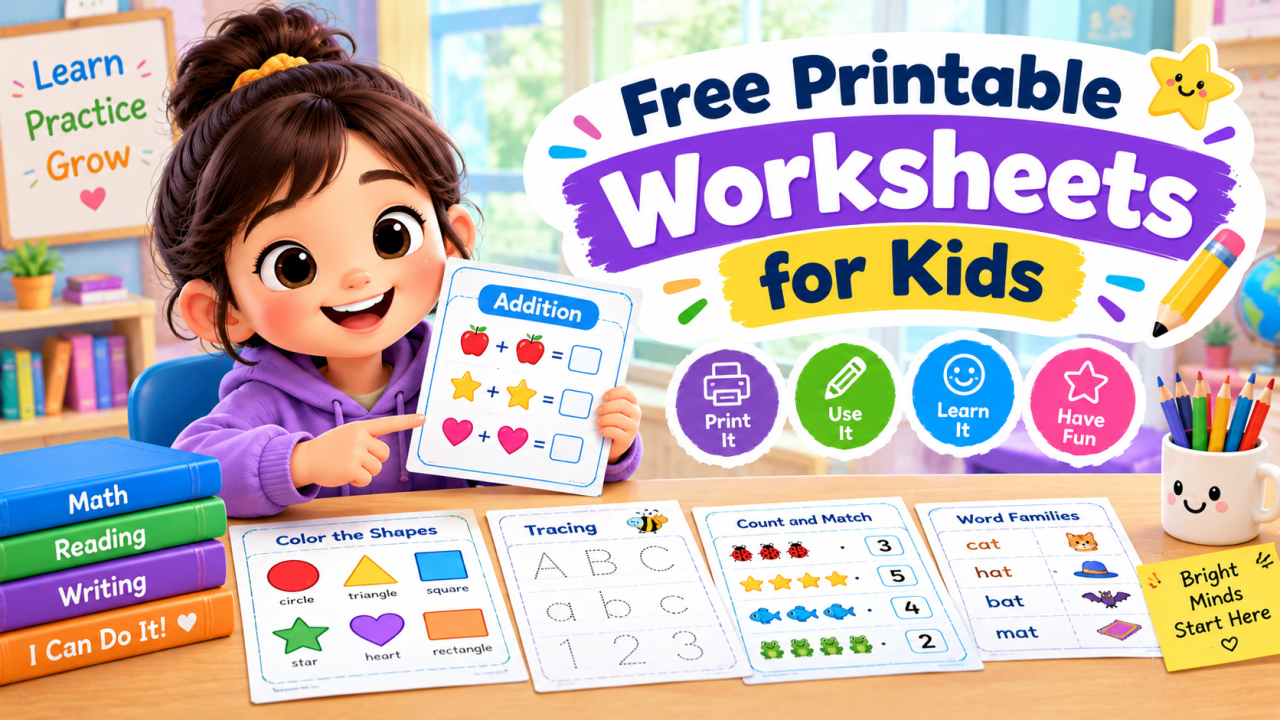
Find free printable worksheets for kids covering math, English, phonics, writing, numbers, shapes, and other fun learning activities for home and school.
Free Printable Worksheets for Kids: Fun Learning Activities
Finding simple and useful learning activities for children does not always require expensive books, apps, or classroom materials. Free printable worksheets for kids can give children an easy way to practice important skills at home or in the classroom.
From counting and addition to alphabet practice, phonics, handwriting, shapes, colors, and early reading, printable worksheets can support children at different stages of learning.
Parents can print a few pages for home practice, while teachers can use worksheets as classroom activities, homework, revision exercises, or extra practice.
The key is choosing worksheets that match a child's age and current learning level.
Why Free Printable Worksheets for Kids Are Useful
Children learn through repetition and practice. A worksheet gives them a structured activity with a clear beginning and end.
For example, a child learning numbers may benefit from activities such as:
- Worksheets & Activities
- 20 Free Printable Worksheets
- Word Wizards
- Counting objects
- Tracing numbers
- Matching numbers with quantities
- Filling in missing numbers
- Comparing numbers
- Solving simple addition problems
A child learning English may practice:
- Alphabet recognition
- Letter sounds
- CVC words
- Beginning sounds
- Sight words
- Handwriting
- Simple sentences
Because printable worksheets can be used again and again with different topics, they are a practical learning resource for both parents and teachers.
What Are Printable Worksheets for Kids?
Printable worksheets are educational activity pages that can be printed on paper and completed by children.
They may contain questions, pictures, tracing exercises, matching activities, puzzles, coloring tasks, or simple problems.
For young children, worksheets are often designed around basic skills rather than long written answers.
For example, a preschool worksheet might ask a child to:
Circle the bigger object.
A kindergarten worksheet might ask:
Trace the letter A.
A Grade 1 worksheet might include:
Solve: 7 + 5 = ____
This makes worksheets flexible enough for different ages and learning goals.
Types of Free Printable Worksheets for Kids
There are many types of printable worksheets available for children. Choosing the right type depends on the child's age, grade, and current skills.
1. Math Worksheets
Math worksheets help children practice numbers and early mathematical concepts.
Common topics include:
- Number recognition
- Counting
- Number tracing
- Addition
- Subtraction
- Number bonds
- Comparing numbers
- Shapes
- Measurement
- Patterns
- Place value
- Multiplication
- Division
For younger children, a worksheet might use pictures and objects to make numbers easier to understand.
For example:
🍎 🍎 🍎 + 🍎 🍎 = ?
Visual problems can help children connect mathematical symbols with quantities.
2. Alphabet Worksheets
Alphabet worksheets are useful for children who are beginning to recognize letters.
Activities may include:
- Uppercase letter tracing
- Lowercase letter tracing
- Letter matching
- Finding a specific letter
- Alphabet sequencing
- Letter identification
- Beginning sound activities
A simple worksheet could show several letters and ask the child to circle every B.
These activities can help children become more familiar with letter shapes and names.
3. Phonics Worksheets
Phonics worksheets focus on the connection between letters and sounds.
Children may practice:
- Beginning sounds
- Ending sounds
- Short vowel sounds
- CVC words
- Rhyming words
- Letter-sound matching
- Word families
For example, children learning CVC words might practice words such as:
| Word | Beginning Sound | Vowel | Ending Sound |
|---|---|---|---|
| cat | c | a | t |
| dog | d | o | g |
| sun | s | u | n |
| pig | p | i | g |
Simple phonics worksheets can provide additional practice after a sound or word pattern has been introduced.
4. Handwriting Worksheets
Handwriting practice is especially useful during the early years of education.
Printable handwriting worksheets can help children practice:
- Lines and curves
- Pre-writing patterns
- Uppercase letters
- Lowercase letters
- Numbers
- Names
- Simple words
- Short sentences
A typical progression may look like:
Lines → Shapes → Letters → Numbers → Words → Sentences
Children do not need to complete large numbers of pages at once. Short, regular practice can be easier for young learners.
5. Number Worksheets
Number worksheets help children build early number skills.
Activities can include:
- Number tracing
- Counting pictures
- Number matching
- Missing numbers
- Number ordering
- Before and after numbers
- Greater than and less than
- Number recognition
For example:
4, 5, __, 7, 8
The child needs to identify the missing number.
Number worksheets can also combine pictures with numerals so children can connect written numbers with quantities.
6. Shapes Worksheets
Learning shapes is an important early math skill.
Common shapes include:
- Circle
- Square
- Triangle
- Rectangle
- Oval
- Star
- Diamond
A printable shape worksheet might ask children to:
- Match shapes
- Trace shapes
- Name shapes
- Count shapes
- Find a particular shape
- Color specific shapes
For example:
Color all the circles blue and all the squares yellow.
Activities like this can combine shape recognition with following directions.
7. Coloring Worksheets
Coloring worksheets can combine creativity with basic learning.
Educational coloring pages may focus on:
- Letters
- Numbers
- Animals
- Shapes
- Fruits
- Vehicles
- Seasons
- Everyday objects
Coloring can also be used alongside other activities.
For example, a worksheet may ask a child to identify the letter A, trace it, and then color an apple picture.
Free Printable Worksheets by Age Group
Not every worksheet is suitable for every child. A preschool learner and a Grade 1 student may need very different activities.
Here is a simple guide:
| Age or Level | Suitable Worksheet Topics |
|---|---|
| Preschool | Shapes, colors, matching, tracing, counting |
| Pre-K | Alphabet, numbers, patterns, beginning sounds |
| Kindergarten | Phonics, handwriting, addition, subtraction, sight words |
| Grade 1 | Reading, writing, addition, subtraction, place value |
| Grade 2 | Multiplication, reading comprehension, grammar, writing |
| Grade 3 | Multiplication, division, fractions, vocabulary, comprehension |
These are general guidelines. Children can develop skills at different rates, so the best worksheet is usually the one that matches the child's current ability.
Free Printable Worksheets for Preschool Kids
Preschool worksheets should generally be simple, visual, and easy to understand.
At this stage, children may be developing skills such as:
- Recognizing colors
- Identifying shapes
- Counting objects
- Recognizing numbers
- Recognizing letters
- Tracing lines
- Improving pencil control
- Matching objects
- Following simple instructions
Example Preschool Worksheet Activities
A preschool worksheet could include:
Trace the lines
— — — — —
/ / / / /
○ ○ ○ ○ ○
Or:
Count the animals
🐟 🐟 🐟 🐟
How many fish? ______
These activities are simple but can provide useful early practice.
Free Printable Worksheets for Kindergarten
Kindergarten worksheets can introduce more structured academic practice while keeping activities engaging.
Popular kindergarten worksheet topics include:
- Alphabet
- Letter sounds
- CVC words
- Sight words
- Number recognition
- Counting
- Addition
- Subtraction
- Shapes
- Patterns
- Handwriting
- Simple reading
Example Kindergarten Math Activity
Count and add:
🍎 🍎 + 🍎 = ______
The child counts the objects and writes the answer.
Example Kindergarten Phonics Activity
Choose the word that begins with /m/:
- sun
- map
- dog
The child identifies map.
These short exercises can make practice more manageable for young learners.
Free Printable Worksheets for Grade 1
Grade 1 children are usually ready for more structured reading, writing, and math activities.
Useful worksheet topics include:
Math
- Addition within age-appropriate number ranges
- Subtraction
- Number bonds
- Place value
- Comparing numbers
- Word problems
- Patterns
- Basic measurement
English
- Alphabet review
- Phonics
- CVC words
- Sight words
- Sentence formation
- Grammar basics
- Reading comprehension
- Vocabulary
- Handwriting
Example Grade 1 Worksheet
Complete the number sentence:
8 + 4 = ____
10 - 3 = ____
Write a sentence using the word:
cat
________________________________
The activities can gradually move children from isolated skills toward practical reading, writing, and problem-solving.
How Parents Can Use Printable Worksheets at Home
Printable worksheets can be helpful for home learning when they are used as part of a balanced routine.
A simple routine could look like this:
- Choose one skill.
- Select a worksheet at the child's level.
- Explain the instructions.
- Let the child try independently.
- Help only when needed.
- Check the answers together.
- Praise effort and improvement.
- Stop when the child becomes tired or frustrated.
For example, a 20-minute learning session could include:
| Activity | Approximate Time |
|---|---|
| Letter or number review | 5 minutes |
| Printable worksheet | 10 minutes |
| Reading or speaking activity | 5 minutes |
The exact time does not need to be fixed. Younger children may need shorter sessions.
How Teachers Can Use Printable Worksheets
Teachers can use worksheets for more than homework.
They can be useful for:
- Classroom practice
- Independent work
- Revision
- Warm-up activities
- Small-group learning
- Homework
- Skill review
- Early-finisher activities
- Assessment preparation
A worksheet can also help a teacher see which concepts students understand and which areas may need more practice.
However, worksheets work best when they support teaching rather than replace hands-on learning, discussion, reading, games, and other classroom experiences.
What Makes a Good Kids' Worksheet?
A good worksheet should be appropriate for the child's developmental and learning level.
Look for worksheets with:
Clear Instructions
Children should be able to understand what they need to do.
Simple Layout
Too many activities on one page can make a worksheet difficult for young learners.
Age-Appropriate Difficulty
The worksheet should provide practice without being unnecessarily difficult.
Useful Practice
Each activity should have a clear learning purpose.
Enough Writing Space
Children need enough room to trace, write, circle, draw, or solve problems.
Readable Text
Large, clear text is especially important for preschool and early elementary learners.
Why Printable Worksheets Can Be Better Than Random Practice
When children practice without a clear goal, it can be difficult to know whether they are working on the right skill.
A worksheet gives a specific task.
For example:
Skill: Number recognition
Activity: Match each number to the correct group of objects.
Or:
Skill: Beginning sounds
Activity: Match each picture to the letter that represents its beginning sound.
This makes practice more focused.
Tips for Choosing Free Printable Worksheets
Before printing a worksheet, check a few simple things.
1. Check the Learning Level
Make sure the activity is not far above or below the child's current skill level.
2. Choose One Main Skill
Especially for younger children, a worksheet focused on one main concept can be easier to complete.
3. Look at the Instructions
Make sure the directions are clear enough for the child or adult helping them.
4. Check the Print Quality
Text and pictures should remain clear when printed.
5. Avoid Overloading the Child
One or two well-chosen worksheets can be more useful than a large stack of pages.
Printable Worksheets and Screen-Free Learning
One benefit of printable activities is that they provide a simple screen-free option.
Children can use a pencil, crayon, or colored pencil instead of completing every activity on a device.
Printable worksheets can be combined with:
- Reading books
- Flashcards
- Drawing
- Puzzles
- Educational games
- Counting objects
- Letter cards
- Hands-on math activities
This gives children different ways to practice the same concept.
Final Thought for Part 1
Free printable worksheets for kids can make everyday learning easier for parents, teachers, and children. From preschool tracing pages to Grade 1 math and phonics practice, the right worksheet can provide focused practice without requiring complicated materials.
The most important thing is not how many worksheets a child completes. It is whether the activity matches the child's learning needs and gives them meaningful practice.
Free Printable Worksheets for Kids: Advanced Ideas, Examples, and Best Practices
How to Make Free Printable Worksheets More Effective
Free printable worksheets for kids can become much more useful when they are connected to a clear learning goal.
Instead of giving children random pages, choose an activity based on what they are currently learning.
For example:
Learning goal: Recognize numbers from 1 to 20
Worksheet activities:
- Trace numbers
- Match numbers to quantities
- Fill in missing numbers
- Circle the larger number
- Count pictures
The same approach can be used for English, phonics, handwriting, and early reading.
A simple learning goal helps parents and teachers decide which worksheet to use and how to measure progress.
Worksheet Ideas for Different Learning Skills
Early Math Worksheet Ideas
Math worksheets can cover many skills as children progress.
| Skill | Example Worksheet Activity |
|---|---|
| Counting | Count objects and write the number |
| Number recognition | Match numbers with pictures |
| Number order | Complete missing numbers |
| Addition | Solve simple addition problems |
| Subtraction | Cross out objects and find the answer |
| Shapes | Identify and match shapes |
| Patterns | Complete the pattern |
| Measurement | Compare longer and shorter objects |
| Place value | Identify tens and ones |
| Multiplication | Practice simple multiplication facts |
For younger children, pictures can make mathematical concepts easier to understand.
For older children, worksheets can gradually use more numbers, symbols, word problems, and written calculations.
English Worksheet Ideas
English worksheets can support vocabulary, reading, writing, spelling, and grammar.
Useful activities include:
- Alphabet matching
- Uppercase and lowercase matching
- Beginning sounds
- CVC words
- Rhyming words
- Sight words
- Word families
- Sentence building
- Noun identification
- Verb identification
- Punctuation
- Reading comprehension
- Vocabulary matching
Example: Sentence Building
Give children a few words:
The | cat | is | sleeping.
Ask them to arrange the words into the correct sentence.
This type of activity helps children understand word order while practicing reading.
Phonics Worksheet Ideas
Phonics worksheets can be organized by specific sound patterns.
For example:
Beginning Sounds
Match the picture with its beginning letter.
- 🐱 Cat → C
- 🐶 Dog → D
- 🐟 Fish → F
Short Vowels
Ask children to identify the vowel in simple words.
| Word | Missing Vowel |
|---|---|
| c_t | a |
| p_g | i |
| d_g | o |
| s_n | u |
Word Families
Children can practice groups such as:
- -at: cat, bat, hat
- -an: man, fan, pan
- -ig: pig, dig, big
- -op: hop, top, mop
- -un: sun, run, fun
Grouping words by patterns can help children notice similarities between words.
Writing Worksheet Ideas
Writing worksheets should gradually move from basic pencil control to independent writing.
A useful progression is:
Tracing → Copying → Completing → Writing independently
For example:
Stage 1: Tracing
A A A A A
Stage 2: Copying
Apple
__________
Stage 3: Completing
I like ______.
Stage 4: Independent Writing
Write one sentence about your favorite animal.
This progression gives children opportunities to build confidence before they are expected to write independently.
Reading Comprehension Worksheets
As children become independent readers, comprehension worksheets can help them practice understanding what they read.
A simple worksheet may include:
Short passage:
"Sam has a red ball. He plays with the ball in the garden."
Then ask:
- What does Sam have?
- What color is the ball?
- Where does Sam play?
For young readers, questions should focus on information that is clearly stated in the passage.
As reading skills improve, worksheets can include:
- Main idea
- Character identification
- Sequence of events
- Vocabulary
- Cause and effect
- Inference
- Short-answer questions
Comparison: Different Types of Printable Worksheets
Different worksheet formats serve different purposes.
| Worksheet Type | Best For | Example |
|---|---|---|
| Tracing | Early writing skills | Trace letters |
| Matching | Recognition | Match number to quantity |
| Fill in the blank | Recall | Complete a number sequence |
| Multiple choice | Quick practice | Choose the correct answer |
| Coloring | Recognition and creativity | Color specific shapes |
| Cut and paste | Hands-on practice | Sort pictures |
| Mazes | Following directions | Find the correct path |
| Word search | Vocabulary | Find target words |
| Writing prompts | Writing practice | Write a short sentence |
| Comprehension | Reading skills | Answer questions about a passage |
Using different formats can keep practice from becoming repetitive.
Printable Worksheets vs Digital Learning Activities
Both printable and digital activities can support learning.
The best choice depends on the child's age, learning goal, available resources, and teaching situation.
| Feature | Printable Worksheets | Digital Activities |
|---|---|---|
| Requires a device | No | Usually yes |
| Requires printing | Yes | No |
| Screen use | No | Yes |
| Easy to reuse | Can be reprinted | Usually reusable |
| Hands-on writing | Strong | Depends on activity |
| Immediate digital feedback | Usually no | Often available |
| Suitable for group use | Yes | Depends on setup |
| Easy to store | Physical copies | Digital files |
Printable worksheets can be particularly useful when parents want a simple activity that does not involve a screen.
Pros and Cons of Printable Worksheets
Advantages
1. Easy to access
A printable worksheet can be used whenever a printer and paper are available.
2. Simple to understand
Many worksheets have one clear task, making them suitable for short practice sessions.
3. Useful for revision
Children can revisit previously learned skills.
4. Flexible
The same worksheet format can be used for different subjects.
5. Supports handwriting
Children physically write, trace, circle, draw, or solve problems on paper.
6. Helpful for teachers
Worksheets can be used for independent practice, homework, revision, and classroom activities.
Limitations
1. Printing is required
Families without access to a printer may find printable resources less convenient.
2. Too many worksheets can become repetitive
Children also need reading, conversation, games, creative activities, and hands-on learning.
3. Quality varies
Not every worksheet available online is accurate, well-designed, or age appropriate.
4. Some concepts need more than paper practice
Skills such as speaking, physical coordination, and practical problem-solving may require activities beyond worksheets.
The goal should be to use worksheets as one learning tool rather than the only learning method.
Common Mistakes When Using Kids' Worksheets
Mistake 1: Choosing Worksheets That Are Too Difficult
A child may struggle because the worksheet is above their current skill level.
Better approach: Start with a manageable activity and gradually increase difficulty.
Mistake 2: Giving Too Many Pages
A large stack of worksheets does not automatically create better learning.
Better approach: Choose a small number of purposeful activities.
Mistake 3: Focusing Only on Correct Answers
Correct answers are important, but understanding the process matters too.
For example, if a child writes the correct answer to an addition problem, ask them how they solved it.
Mistake 4: Ignoring Instructions
Some worksheets have instructions that are difficult for young children to understand.
Better approach: Read the instructions aloud and demonstrate one example when necessary.
Mistake 5: Using Worksheets as a Punishment
Worksheets should not become something children associate only with punishment or correction.
Use them as short practice activities with encouragement and clear goals.
Mistake 6: Comparing One Child With Another
Children learn at different rates.
Instead of comparing children, focus on individual progress.
For example:
Yesterday: The child could recognize numbers up to 10.
Now: The child can recognize numbers up to 20.
That progress is more useful than comparing scores with another child.
How to Create a Simple Worksheet Routine
Parents can create a weekly routine without making learning stressful.
Monday — Math
Practice counting, addition, subtraction, or number recognition.
Tuesday — English
Practice letters, vocabulary, spelling, or sentence formation.
Wednesday — Phonics
Practice sounds, CVC words, or word families.
Thursday — Writing
Practice handwriting, words, or simple sentences.
Friday — Review
Use a short mixed worksheet to revisit the week's skills.
This routine can be adjusted according to the child's school schedule and learning needs.
How to Make Worksheet Time More Fun
Worksheets do not have to feel like a test.
Try combining paper activities with simple games.
Use a Timer Carefully
For some children, a short timer can make an activity feel like a challenge.
However, avoid creating pressure around speed.
Add Coloring
Let children color pictures after completing the learning task.
Use Stickers
A small sticker or progress chart can make repeated practice more engaging.
Give Choices
Instead of saying:
"Complete this worksheet."
Try:
"Would you like to do the numbers page or the shapes page first?"
Giving limited choices can help children feel involved.
Connect Worksheets to Real Life
If the worksheet is about counting, count toys together.
If it is about shapes, look for shapes around the home.
If it is about vocabulary, ask children to find objects that match the words.
How to Check Whether a Worksheet Is Working
Parents and teachers can look for simple signs of progress.
Ask:
- Can the child complete the activity with less help?
- Does the child understand the instructions?
- Are mistakes becoming less frequent?
- Can the child explain the answer?
- Can the child use the skill outside the worksheet?
For example, if a child practices addition on paper, ask a simple real-life question:
"You have 3 apples and I give you 2 more. How many do you have?"
Using a skill outside the worksheet can show whether the child understands the concept rather than simply memorizing an answer pattern.
Tips for Printing Worksheets at Home
Before printing a large number of pages, check the print settings.
Useful tips include:
- Preview the page before printing.
- Select the correct paper size.
- Check that important content is not cut off.
- Use black-and-white printing when color is not necessary.
- Use thicker paper for activities that involve coloring or cutting.
- Print only the pages you need.
- Keep completed worksheets in a folder if you want to track progress.
For many ordinary practice pages, standard A4 paper works well for families in India.
How to Organize Printable Worksheets
A simple filing system can prevent worksheets from becoming difficult to manage.
You can create folders such as:
Math
- Numbers
- Addition
- Subtraction
- Shapes
- Patterns
English
- Alphabet
- Phonics
- Reading
- Grammar
- Writing
General Learning
- Colors
- Animals
- Seasons
- Puzzles
For children who are working across multiple grade levels or subjects, separate folders can make it easier to find the right activity.
How to Use Worksheets for Revision
Revision worksheets should focus on skills children have already learned.
For example, after teaching:
- Counting 1–20
- Addition within a simple range
- Short vowel sounds
- Basic sight words
A revision worksheet can combine these skills in a short activity.
However, mixed worksheets should not become so broad that the child forgets what each question is testing.
For younger children, focused revision pages are often easier to manage.
How to Use Printable Worksheets Before a Test
Worksheets can help children review school topics before an assessment.
A simple revision plan is:
- Review the concept.
- Complete a few practice questions.
- Check mistakes.
- Explain difficult questions.
- Try a similar question.
- Review again later.
Avoid turning every worksheet into a timed test unless timing is specifically part of the learning goal.
Best Practices for Parents
Parents can make worksheet-based learning more productive by following a few simple habits.
Keep Sessions Short
Young children often benefit from short activities rather than long study sessions.
Give Clear Instructions
Explain what the child needs to do before they begin.
Encourage Questions
If the child does not understand something, allow them to ask for help.
Celebrate Progress
Praise specific improvements.
For example:
"You recognized all the short-a words today."
This is more useful than simply saying:
"Good job."
Review Mistakes
Mistakes can show where additional practice is needed.
Avoid simply giving the correct answer. Help the child understand how to find it.
Best Practices for Teachers
Teachers can also make worksheets more effective by connecting them to classroom instruction.
Introduce Before Practice
Teach the concept before expecting students to practice it independently.
Use Different Difficulty Levels
If students have different skill levels, prepare activities that provide suitable levels of challenge.
Use Worksheets as Evidence of Learning
Completed work can help identify concepts that may need reteaching.
Mix Worksheet Formats
Alternate between tracing, matching, problem-solving, writing, and comprehension activities.
Combine Paper With Hands-On Learning
A worksheet about shapes can be followed by a classroom activity where children identify shapes around the room.
A Simple Worksheet Selection Checklist
Before downloading or printing a worksheet, use this checklist:
- Is it suitable for the child's age or grade?
- Does it match a specific learning goal?
- Are the instructions clear?
- Is the text easy to read?
- Is there enough space for answers?
- Is the difficulty appropriate?
- Are the questions accurate?
- Does the worksheet avoid unnecessary clutter?
- Can the child complete it with reasonable support?
- Does it provide meaningful practice?
If most answers are yes, the worksheet is more likely to be useful.
Final Best Practice
The most effective use of free printable worksheets for kids is purposeful and balanced.
A worksheet should help a child practice a skill, understand a concept, or review something they have already learned.
It does not need to be colorful, complicated, or filled with dozens of questions to be useful.
A simple page with clear instructions and appropriate questions can provide valuable practice.
Parents and teachers can get better results by combining worksheets with reading, conversation, games, hands-on activities, and real-world learning.
That balance keeps learning practical, varied, and child-friendly.
Conclusion
Free printable worksheets for kids are a simple and practical way to support learning at home and in the classroom. Children can use them to practice numbers, math, alphabet skills, phonics, handwriting, reading, vocabulary, shapes, and many other early learning concepts.
The most important factor is choosing worksheets that match the child's age, grade, and current ability. A short, focused worksheet can be more useful than a large collection of pages that feels repetitive or difficult.
For the best results, combine printable worksheets with reading, games, conversations, creative activities, and hands-on learning. This gives children different ways to understand and practice the same skill.
Whether you are a parent looking for home learning activities or a teacher preparing classroom practice, free printable worksheets can be a useful part of a balanced learning routine.
Call To Action
Looking for simple learning activities that children can use at home or in the classroom?
Explore our collection of free printable worksheets for kids and find activities for math, English, phonics, numbers, handwriting, shapes, reading, and more.
Choose worksheets that match your child's learning level, print the pages you need, and make learning part of a simple daily practice routine.
Start exploring our printable worksheets today and give your child an easy way to practice important skills at home or school.
Frequently Asked Questions
1. What are free printable worksheets for kids?
Free printable worksheets for kids are educational activity pages that can be downloaded and printed for children to complete. They can cover subjects such as math, English, phonics, handwriting, reading, numbers, shapes, and vocabulary.
2. What age are printable worksheets suitable for?
Printable worksheets are available for different age groups, from preschool and kindergarten to elementary or primary school. The right worksheet depends on the child's age, grade, and current learning skills.
3. What subjects can children practice with printable worksheets?
Children can practice many subjects, including math, English, phonics, reading, writing, spelling, numbers, shapes, patterns, vocabulary, and basic grammar.
4. Are printable worksheets useful for preschool children?
Yes. Preschool worksheets can support early skills such as tracing, counting, matching, color recognition, shape recognition, alphabet recognition, and pencil control.
5. Can I use printable worksheets for kindergarten learning?
Yes. Kindergarten worksheets can provide practice with alphabet letters, phonics, CVC words, sight words, counting, addition, subtraction, shapes, handwriting, and early reading.
6. Are printable worksheets good for Grade 1 students?
Yes. Grade 1 worksheets can provide additional practice in reading, writing, addition, subtraction, number concepts, phonics, vocabulary, sentence formation, and basic comprehension.
7. How many worksheets should a child complete each day?
There is no single number that works for every child. It is generally better to choose a small number of purposeful activities based on the child's age, attention span, and learning goals rather than focusing on completing as many pages as possible.
8. How can parents make worksheet activities more interesting?
Parents can combine worksheets with coloring, reading, educational games, counting objects, drawing, flashcards, and hands-on activities. Giving children a choice between two suitable worksheets can also make practice feel more engaging.
9. Can teachers use printable worksheets in the classroom?
Yes. Teachers can use printable worksheets for classroom practice, revision, homework, independent work, small-group activities, and additional skill practice.
10. Should printable worksheets replace other learning activities?
No. Worksheets are best used as one part of a balanced learning routine. Children can benefit from combining worksheets with reading, conversation, games, creative activities, hands-on learning, and real-world experiences.